Founder field note
Where Investors Discover Emerging Indie Startups: A Practical Sourcing Guide
Find where investors discover emerging indie startups, assess launch directories, founder signals, public filings, and build a repeatable sourcing workflow.
For investors asking where investors discover emerging indie startups, start with public launch directories, founder communities, product and open-source pages, targeted referrals, and—when a company raises publicly—official filing records. The useful question is not which channel produces the most names; it is which one makes it possible to verify a founder’s work, product, and early evidence. This guide helps investors choose channels by sourcing job, and helps founders make those signals easier to find without mistaking visibility for investment quality.
Each channel has a different blind spot. A launch page can reveal a product and its reception, but not necessarily revenue. A community conversation can expose how a founder thinks, but may say little about retention. A filing can document an offering, but does not replace diligence. Treat discovery as the start of a verification process, not a shortcut around it.
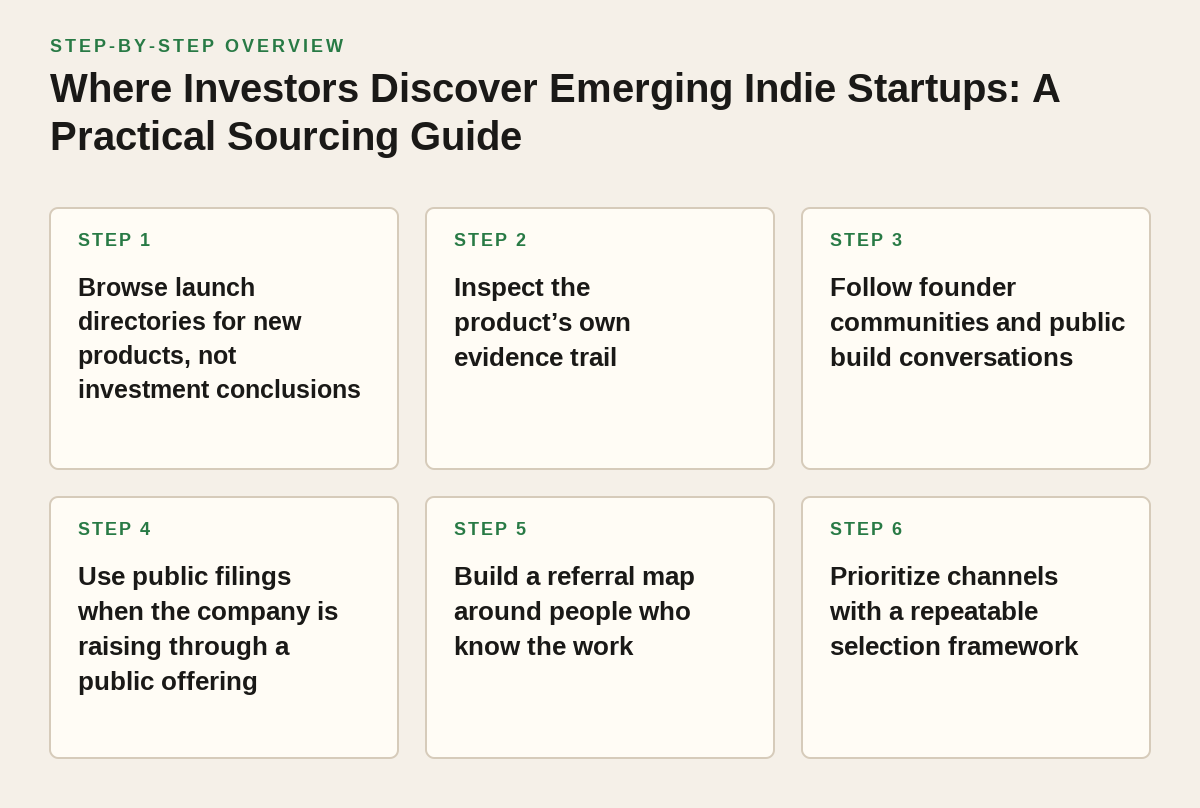
1. Browse launch directories for new products, not investment conclusions
Use launch directories when you want a broad, time-bounded scan of software and AI tools that have recently entered public view. A launch page can put the product description, founder context, and community response in one place. That makes it useful for finding companies before they have a polished fundraising narrative, and for noticing repeated problems or product categories across launches.
The mechanism is visibility, not validation. A ranking or burst of engagement can help prioritize what to inspect next, but it does not establish that users are paying, returning, or recommending the product. One practical workflow is to browse a recent launch window, save only products that fit a stated thesis, then check their own product pages and founder activity before contacting anyone.
Turn a browsing session into a sourcing queue
- Write down the thesis first: for example, “small-business workflow software with a clear self-serve use case.”
- Capture the product, founder, launch date, claimed user, and one question that needs verification.
- Sort by evidence to inspect next—not by launch popularity alone.
Failure mode: treating a high-visibility launch as proof of a durable business. A busy discussion may reflect curiosity about a clever demo rather than repeated use. For an illustrative example, an investor browsing newly launched developer tools could shortlist a product with a clearly described workflow, then verify whether the founder shares a working demo, customer examples, or a credible account of what users do after trying it.
For founders, a launch page is most useful when it makes the product legible to someone who does not already know the team. Include the problem, intended user, product status, and a direct next step. SuperPublic supports launch submissions, publishing, discovery, and browsing newly launched indie products; founders can submit your product launch when they are ready to put that information in front of early adopters and people researching emerging products.
2. Inspect the product’s own evidence trail
Move from discovery to verification by following the product back to its primary surfaces: its website, demo, documentation, changelog, and, where relevant, public code. This applies when a directory listing or social post makes an unfamiliar product sound promising but leaves basic questions unanswered. The company’s own material can show whether the description matches a usable product and whether the team communicates its scope clearly.
For open-source products, repository organization can provide useful context. GitHub’s documentation explains how repository topics categorize projects and help people find repositories by subject; that makes topics a practical discovery clue, not evidence of commercial traction. See GitHub’s guidance on repository topics. A repository can be active while its business model remains unclear, and a quiet repository may simply reflect a product that is not open source.
Check for coherence, not polish
- Does the demo show the specific job the product claims to solve?
- Do docs, product pages, and founder descriptions agree on who the product serves?
- Can you identify a recent, concrete change or customer problem the team addressed?
Failure mode: confusing visible activity with customer value. Frequent updates, a tidy website, or a large public codebase may be encouraging but do not prove adoption. As an illustrative example, an investor researching a small developer tool might compare the product’s documentation with its demo and ask the founder which user task is currently hardest to complete. If those surfaces describe different products, that is a question to resolve—not a reason to assume misconduct.
Founders should make the public trail coherent without exposing information they do not intend to share. A concise explanation of what is live, what remains experimental, and who the product is for gives prospective users and investors a better basis for a first conversation.
3. Follow founder communities and public build conversations
Use communities to find context that a launch card cannot carry: how a founder frames a problem, responds to feedback, and explains trade-offs. This channel is especially useful for investors looking for bootstrapped teams that may not be actively fundraising, and for founders seeking early users before a formal raise. Public build logs, focused technical groups, online events, and founder discussions can surface work while it is still changing.
Look for repeated, specific signals. A founder who can explain why a customer workflow breaks, what they tried, and what they changed is easier to assess than someone repeating a broad market claim. The signal is not posting frequency. It is whether the conversation reveals a testable product or customer insight. For example, an investor following a founder’s public discussion of onboarding friction might later check whether the product or documentation reflects the proposed fix.
Participate without turning the community into a lead list
- Follow a narrow topic or problem area rather than collecting every founder handle.
- Read the full discussion before reaching out; respond to the work, not just the person’s fundraising potential.
- Ask a useful, bounded question and accept that the founder may not be raising or seeking investors.
Failure mode: mistaking popularity in a founder group for customer demand. Founders may receive feedback from peers who understand the product but are not its target buyers. A concrete example: if a founder receives enthusiastic comments about a workflow tool, ask whether the comments came from actual intended users and what those users did afterward. That question separates peer encouragement from a customer signal without dismissing either.
Founders can make community participation more valuable by sharing a specific decision or obstacle, then reporting what changed. A post that says “we changed this step because users got stuck here” gives readers something concrete to evaluate. A constant stream of generic promotion tends to obscure the product and makes it harder for the right people to offer useful feedback.
4. Use public filings when the company is raising through a public offering
Check official records for the right kind of company. Public filings are relevant when a startup is conducting an offering that requires them, not as a universal index of indie businesses. The SEC’s Regulation Crowdfunding materials describe the framework for eligible companies raising through registered intermediaries and explain that the process involves prescribed disclosures. Start with the SEC’s Regulation Crowdfunding resource to understand the context before searching for an offering.
For a company that files with the SEC, EDGAR provides access to company filings and search tools. The SEC describes its EDGAR search and access options for finding filings. This route can help an investor locate formal offering information or follow up on a known company. It will not surface every bootstrapped or privately financed software startup; absence from EDGAR is not evidence that a company is inactive or uninteresting.
Use filings as source documents, not endorsements. Read what a filing actually says, note the date, and distinguish company-provided disclosures from independently verified facts. If a detail matters to a decision, confirm it with the company or another reliable source rather than relying on a search snippet.
Failure mode: searching filings as if they were a comprehensive startup directory. For an illustrative case, an investor researching a founder-led software company could first establish that the company is conducting a relevant public offering, then use EDGAR to locate the associated material. If the company is not raising through that route, return to product, community, and referral channels instead of treating the missing record as a negative signal.
5. Build a referral map around people who know the work
Use targeted referrals when a product is difficult to assess from public information, or when you want to find founders outside the loudest launch cycles. Relevant connectors might include operators in the product’s niche, technical specialists, early customers, and other founders who have worked on adjacent problems. The reason this can work is contextual: a well-placed introduction can explain why a product matters to a particular user or what the founder has already learned.
Keep the request narrow. “Who is building software for independent clinics that reduces this specific administrative task?” is easier to answer than “Who are the best startups?” Ask the connector what they have personally observed, and whether the founder is open to an introduction. This respects the founder’s time and gives you a way to judge how much of the referral is direct knowledge.
Separate a warm introduction from a diligence shortcut
A referral is a path to a conversation, not a substitute for examining the product. When speaking with a founder, make clear what you want to understand: the user, the product’s current state, or whether the company is exploring capital. Y Combinator’s fundraising guidance discusses preparing for seed fundraising and investor conversations; its guide to raising a seed round is useful background for founders preparing to explain their company, but an investor should still assess claims independently.
Failure mode: treating a respected introducer’s enthusiasm as proof. A connector may know the founder well but not the product’s economics, customer experience, or technical constraints. For example, if an operator introduces a promising workflow product, thank them, ask what they have directly seen, then speak with the founder and inspect the product yourself before drawing a conclusion.
6. Prioritize channels with a repeatable selection framework
Choose channels by the evidence they can reveal. Investors often waste time when they use one source for every job: a launch directory for revenue validation, a repository for market sizing, or a referral for product quality. Use the table below to decide where to look next. The scores are a working rubric, not a measured ranking of channel performance.
| Channel | Best discovery job | Useful first signal | Common blind spot | Next verification step |
|---|---|---|---|---|
| Launch directory | Find recently visible products | Clear product and target user | Engagement mistaken for adoption | Inspect demo and ask about user behavior |
| Product site or docs | Understand what is actually usable | Specific workflow and product scope | Polished claims without independent evidence | Try the product or request a walkthrough |
| Founder community | Observe thinking and iteration | Specific problem-solving discussion | Peer interest mistaken for buyer demand | Check whether target users are involved |
| Public filing | Find formal offering disclosures | Company-filed offering information | Not a complete startup universe | Read the source filing and verify key claims |
| Referral | Reach a founder through relevant context | Connector’s direct experience | Reputation mistaken for diligence | Ask the founder and inspect the product |
A simple selection rule is to pick the channel that can answer the next unanswered question. If you do not know what the product does, inspect the product surface. If you know the product but not who needs it, seek customer context. If the company is conducting a public offering, check the applicable disclosures. One source should generate the next question, not a confident conclusion.
Failure mode: building a spreadsheet that rewards volume over learning. A long list of names is not progress if every record contains only a URL and a popularity signal. For an illustrative starting policy, require each candidate to have one thesis-fit note and one concrete verification question before adding them to an active review queue. Adjust that policy to the size and focus of your investment effort.
7. Run a sequenced discovery process
Make discovery a weekly operating loop rather than an occasional search binge. This works for investors who need a manageable flow of relevant companies and for founders who want their work to be understandable wherever a potential user or investor encounters it. The sequence below keeps discovery, verification, and outreach distinct.
- Define the search. Write a short thesis covering the user, problem, product type, and any exclusions. A narrow scope makes it easier to identify useful channels and to explain why a company is relevant.
- Choose two complementary sources. Pair a discovery surface, such as a launch directory or community, with a verification surface, such as a product demo, documentation, or relevant filing. Avoid collecting multiple channels that all provide the same kind of popularity signal.
- Capture evidence and unknowns separately. Record what you observed, where it came from, and what remains unverified. “Founder says the product serves small agencies” is a claim to check; it is not the same as independently confirmed customer use.
- Prioritize the next action. Decide whether the candidate needs a product review, a founder conversation, a customer perspective, or no further attention. Keep the reason for each action short and specific.
- Review what your sourcing misses. At a regular interval, look at which kinds of founders your process repeatedly finds and which it overlooks. If your list is dominated by highly visible launches, add a targeted referral or niche-community route rather than simply increasing browsing time.
Failure mode: letting the process become an outreach machine. A candidate may be interesting without being fundraising, and a founder may want customers or feedback rather than investor contact. Make the first message relevant to the work, state why you are reaching out, and leave an easy way to decline.
For an illustrative starting policy, an investor might reserve one recurring block for discovery and another for follow-up, then revise the cadence after seeing whether the sources produce thesis-fit conversations. The schedule is a practical choice, not a universal benchmark. Founders can apply the same sequence in reverse: make the product and user clear, publish in places where relevant people browse, and use community feedback to improve the evidence trail.
SuperPublic helps bootstrapped, pre-seed, and angel-funded founders publish launches, while giving readers ways to discover listed indie products and browse new launches. If that fits your next step, explore SuperPublic as one discovery surface in a broader sourcing process.
Authored with NotFair SEO