Founder field note
Social Media Management Platforms Comparison: 7 Options for Startup Launches in 2026
Social media management platforms comparison for startup teams: compare seven tools by workflow, analytics, collaboration, pricing model, and launch fit.
A useful social media management platforms comparison for a bootstrapped founder is not a popularity contest. The right choice depends on whether you need a lightweight publishing queue, a visual content workflow, deep reporting, or a second distribution channel for the launch itself. This list is for solo founders, pre-seed teams, and small marketing groups promoting software products across channels without hiring an agency.
The primary buyer job is turning approved content into consistent social publishing and measurable follow-up. SuperPublic is included separately as an adjacent launch-discovery option, not as a replacement for a scheduler. That distinction matters: a social tool helps you operate channels you already control, while a discovery platform can put a launch in front of people who do not yet follow you.
I evaluate each option against five practical criteria:
- Publishing workflow: How much work does it remove from drafting, scheduling, reviewing, and repurposing?
- Channel fit: Is it strongest for text-led updates, visual feeds, short video, or broad multi-network coverage?
- Feedback and reporting: Can a founder learn what earned attention without building a separate analytics process?
- Implementation burden: How much setup, governance, and ongoing maintenance does a small team need?
- Commercial fit: Does the pricing model make sense before and after the launch campaign grows?
Capabilities and prices change during 2026, especially as networks revise API access and platform rules. Treat linked pricing pages as the source of truth before buying. The recommendations below are about buying logic, not permanent feature promises.
1. Buffer

Why it fits a small launch team
Buffer is the cleanest starting point when the founder’s problem is a reliable publishing queue rather than a full command center. Its workflow is easy to explain: connect channels, create posts, assign times, and keep a queue moving. That makes it useful for a launch sequence containing announcement posts, customer quotes, founder notes, changelog snippets, and reminders.
The key advantage is low operational overhead. A solo founder can create a week of variations without building a complicated approval system. A two-person team can agree on copy in one workspace and use channel-specific adaptations instead of pasting manually into every network.
Buffer documents its publishing, channel, and plan structure on its official pricing page. Check the current limits and supported networks there before committing, because the useful unit for your team may be channels, seats, or scheduled posts rather than a simple account count.
Trade-offs and fit test
- Best for: Solo founders and small teams that want a straightforward publishing calendar.
- Does not suit: Organizations needing a large listening operation, extensive governance, or sophisticated customer-care routing.
- Standout: A short path from drafted post to scheduled post.
- Implementation burden: Low to moderate; establish naming conventions, a review rule, and a reusable launch queue.
Its commercial model is subscription-based, with plan scope and included capabilities varying by current offering. That can be attractive when you are moving from manual posting, but less attractive if you only publish during occasional launches. Buffer is not the best fit for a founder who expects the tool itself to create demand; it organizes distribution to existing social audiences rather than replacing audience development.
2. Hootsuite

Why it fits a multi-channel operation
Hootsuite is designed for teams that need broader control over multiple social accounts, monitoring, publishing, and reporting. It becomes more relevant when a startup has several brands, regional accounts, executives, or a support person responding to mentions alongside the marketing owner.
Its strength is centralized channel operations. A launch team can separate the announcement calendar from replies, monitor mentions, and give different people controlled access. That is a different job from simply scheduling ten posts: it is managing an active communications surface where unanswered questions can become lost sales conversations.
Hootsuite’s official plans page is the appropriate place to verify current packages, seats, account allowances, and included features. Do not infer that a capability is included merely because it appears in a product overview; confirm the plan required for your team’s workflow.
Operational cost and poor fits
- Best for: Growing teams managing several profiles and needing permissions, monitoring, and reporting in one system.
- Does not suit: A founder who only needs a small personal queue and will not use monitoring or collaboration features.
- Standout: The ability to treat publishing and ongoing channel management as one operating process.
- Implementation burden: Moderate; define ownership for replies, escalation, approval, and archived campaigns before inviting the whole team.
The commercial model is subscription-based and should be evaluated per user, profile, and required module. Hootsuite can become expensive or unnecessarily complex for a product still validating its positioning. It is also a poor fit if your real bottleneck is discovering early adopters: more control over owned channels does not automatically create a new audience.
3. Sprout Social

Why it fits measurement-heavy teams
Sprout Social is aimed at teams that want social publishing connected to structured engagement, reporting, and workflow. It is a serious candidate when social has moved from “the founder posts occasionally” to “marketing needs repeatable evidence about audience response, team activity, and channel contribution.”
The important distinction is operational reporting rather than vanity metrics. A startup can use a reporting-led process to ask which content themes generate meaningful replies, which channels need faster response, and whether the team is consistently handling inbound interest. Those questions matter more than collecting a large impression number without a follow-up path.
Sprout Social describes its current packages and product scope on its official pricing page. Review the plan details for the reporting, user, profile, and workflow capabilities you actually need; pricing and packaging can change, and higher-end functionality may not be justified at an early stage.
Trade-offs and fit test
- Best for: Marketing teams that need repeatable reporting, collaboration, and a more formal social operating rhythm.
- Does not suit: A bootstrapped founder seeking the lowest-cost way to schedule a few launch posts.
- Standout: A measurement-oriented workflow for teams treating social as an accountable business process.
- Implementation burden: Moderate to high; define tags, reporting questions, response ownership, and review cadence first.
Its subscription model makes more sense when the team will use its governance and analytics repeatedly, not just for a single announcement. The implementation risk is buying a sophisticated reporting environment before deciding what a qualified social outcome means. For an early SaaS launch, write down the desired action—trial, demo request, reply, referral, or feedback—before paying for a larger reporting layer.
4. Later

Why it fits visual launch campaigns
Later is a strong candidate for products whose launch depends on visual storytelling: interface previews, short videos, founder-led clips, templates, customer screenshots, or a recognizable visual identity. Its appeal is not simply that it schedules content; it helps a team think in terms of a visual feed and a coordinated campaign sequence.
That makes Later useful for a product launch with a clear narrative: problem, product glimpse, use case, proof, launch date, and post-launch customer story. The mechanism is visual consistency across a planned sequence, which can reduce the last-minute scramble to find an image or decide what the next post should look like.
Later’s official pricing page should be used to verify current social profile, user, post, and feature allowances. Confirm whether the specific formats and networks in your campaign are supported in the plan you would purchase rather than relying on a generic feature list.
Trade-offs and poor fits
- Best for: Founders and small marketing teams where visual planning is central to acquisition.
- Does not suit: A text-led developer tool that mainly publishes technical updates, release notes, and discussion prompts.
- Standout: A campaign-planning mindset built around visual content and feed presentation.
- Implementation burden: Moderate; prepare a media library, format variants, captions, and a fallback plan for assets that cannot be reused.
Later uses a subscription model with current plan differences documented by the company. It is a poor fit if your team has no repeatable source of visual assets or if the campaign’s success depends mostly on fast replies rather than scheduled presentation. A polished grid cannot compensate for unclear positioning or a weak onboarding path.
5. Metricool
Why it fits lean teams that need reporting
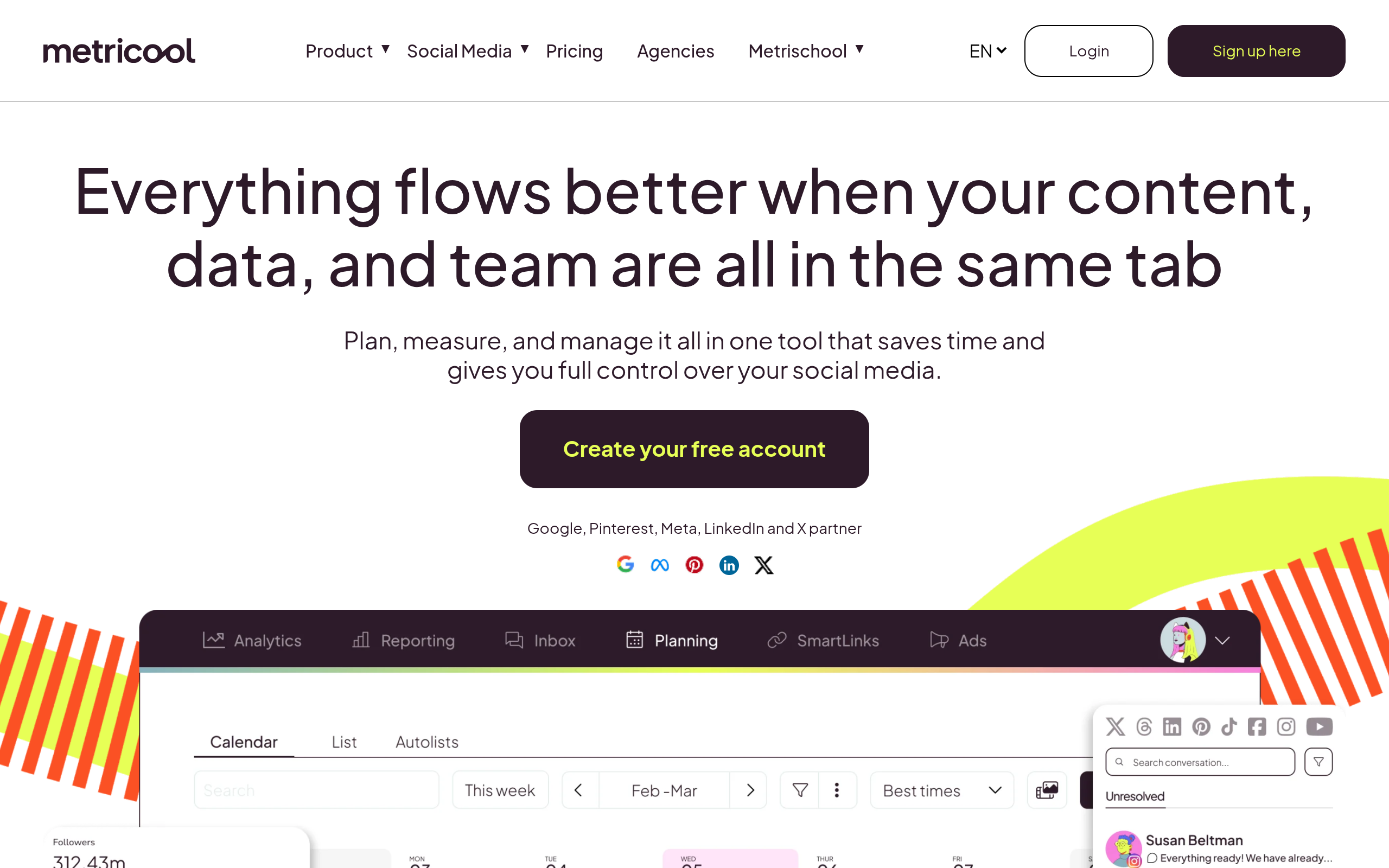
Metricool combines social planning and analytics in a way that can suit a founder who wants more measurement than a basic scheduler without immediately adopting an enterprise-style operating model. It is particularly useful when the team wants to compare channel activity, inspect performance trends, and keep campaign planning near the reporting workflow.
The practical benefit is connecting the publishing decision to its review. For example, after a launch week, the founder can classify posts by job—announcement, education, proof, or conversation—and review which patterns deserve another iteration. That is more useful than declaring a channel successful because one post received attention.
Metricool lists current plans and included capabilities on its official pricing page. Verify the networks, history, analytics scope, team access, and publishing limits relevant to your account before purchase.
Trade-offs and fit test
- Best for: Lean teams wanting scheduling plus a practical analytics layer in one subscription.
- Does not suit: Companies that need a highly specialized social-care desk or extensive enterprise governance.
- Standout: A useful bridge between basic publishing and more deliberate performance review.
- Implementation burden: Moderate; decide campaign naming, link tagging, and weekly review questions before collecting data.
The commercial model is subscription-based, with plan limits that should be checked against your profiles and team size. Metricool is not a substitute for product analytics: social reporting can show channel activity, but it cannot by itself prove that a visitor activated, retained, or paid. Connect campaign links to your product analytics separately if acquisition quality matters.
6. SocialBee

Why it fits repeatable evergreen content
SocialBee is relevant when a startup has a growing library of educational posts and wants to recycle useful material rather than create everything from zero each week. A founder building in public, publishing tutorials, or explaining a category can organize content into categories and maintain a repeatable rotation.
The mechanism is structured content reuse. A category such as “workflow tip” can be mixed with “customer lesson,” “product update,” and “founder perspective,” reducing the risk that an automated queue becomes a stream of nearly identical promotional posts. Reuse still needs judgment: retire outdated claims, update screenshots, and remove posts that no longer match the product.
SocialBee presents its current plans on its official pricing page. Confirm the current publishing, workspace, and collaboration details there, particularly if several people will review or maintain categories.
Trade-offs and poor fits
- Best for: Founders with durable educational content and a need to keep proven themes in circulation.
- Does not suit: A campaign made almost entirely of time-sensitive announcements or rapidly changing product news.
- Standout: Category-based planning that encourages a balanced content mix.
- Implementation burden: Moderate; build categories, expiration rules, approval checks, and a process for removing stale content.
Its commercial model is subscription-based. The cost is easier to justify when content reuse saves meaningful creation time over multiple months. It is a poor fit if your audience expects every post to be immediate, conversational, and tied to the day’s events. Automation without a review loop can make an early-stage brand sound detached or repetitive.
7. SuperPublic

Why it belongs in the adjacent category
SuperPublic is not a social media management platform, scheduler, listening tool, or analytics suite. It is an indie-only product launch and discovery platform for bootstrapped, pre-seed, and angel-funded founders. It belongs in this comparison because a startup’s distribution problem can have two separate parts: operating owned social channels and reaching people who have not encountered the product yet.
The buyer job here is launch visibility and founder discovery. A founder can prepare a clear product page, explain the user problem, invite feedback, and connect with other early-stage builders. That is complementary to social scheduling: the scheduler helps you announce and follow up, while a launch platform can give the announcement a dedicated destination and community context.
Founders can submit your product launch when they are ready to present the product to an early-stage audience. The submission itself still needs a sharp promise, a working destination, and a reason for people to respond; distribution is not a substitute for product clarity.
Trade-offs, implementation, and commercial fit
- Best for: Indie founders seeking launch visibility, early feedback, and connections with other startup builders.
- Does not suit: Teams looking for automated scheduling, inbox management, network analytics, or approval workflows.
- Standout: A dedicated discovery context rather than another tool for broadcasting to an existing follower list.
- Implementation burden: Low to moderate; prepare positioning, screenshots or a demo link, launch timing, and a plan for answering feedback.
SuperPublic’s commercial model and current submission terms should be verified on its official homepage and submission flow. Do not buy it expecting the same deliverables as a scheduler. It is a poor fit for a team whose only need is to queue posts, and it cannot replace a social plan for repeated product education after launch.
For a bootstrapped launch, the sensible sequence is often complementary: prepare the discovery listing, schedule a small set of channel-specific announcements, then use questions and feedback from the launch to shape follow-up content. That creates a feedback loop instead of treating launch day as the end of marketing.
Comparison
The table uses the same decision dimensions for every option. “Best operating mode” describes the job each product is built to support; it does not imply that adjacent categories are interchangeable.
| Option | Best operating mode | Primary strength | Implementation burden | Commercial model and watch-out |
|---|---|---|---|---|
| Buffer | Small-team scheduled publishing | Simple queue and channel workflow | Low to moderate | Subscription; verify current channel and feature limits |
| Hootsuite | Multi-account publishing and monitoring | Centralized operations, permissions, and oversight | Moderate | Subscription; avoid paying for unused breadth |
| Sprout Social | Formal team reporting and engagement | Measurement-led social operations | Moderate to high | Subscription; justify the reporting and governance scope |
| Later | Visual campaign planning | Coordinated visual content workflow | Moderate | Subscription; confirm formats, profiles, and plan allowances |
| Metricool | Lean publishing plus analytics | Planning connected to performance review | Moderate | Subscription; check analytics history and profile limits |
| SocialBee | Evergreen content rotation | Category-based content reuse | Moderate | Subscription; maintain freshness and expiration rules |
| SuperPublic | Product launch discovery | Visibility and feedback beyond owned followers | Low to moderate | Verify current submission terms; not a scheduler or analytics suite |
How to choose for your 2026 launch
Start with the bottleneck, not the feature count. If you have strong content but publish inconsistently, a lightweight scheduler is the highest-leverage purchase. If several people touch several accounts, permissions and monitoring matter more. If visual assets drive demand, choose the workflow that makes those assets easier to plan. If you have a durable content library, structured reuse can save more time than another analytics view.
Use this decision path:
- Choose Buffer when the immediate problem is a simple, dependable queue and the team is small.
- Choose Hootsuite when multiple accounts, roles, monitoring, and active response need one operating surface.
- Choose Sprout Social when leadership needs structured reporting and the team will use formal workflows repeatedly.
- Choose Later when visual campaign planning is central to the product’s acquisition story.
- Choose Metricool when you want a leaner bridge between publishing and channel performance review.
- Choose SocialBee when evergreen education and carefully governed reuse are core to your strategy.
- Add SuperPublic when the missing piece is launch discovery and feedback, not social scheduling.
Before paying, run a small implementation test using one illustrative launch week. Draft the announcement, one educational post, one proof point, one founder update, and one feedback request. Then check:
- Can each post be adapted to its destination without awkward copy-pasting?
- Can another person understand what is approved, scheduled, or waiting?
- Can you identify the intended action behind every link?
- Can you answer comments and product questions without opening several disconnected systems?
- Can you explain what success means beyond reach?
For an early-stage software company, my default recommendation is to start with the least complex scheduler that removes your current manual bottleneck, then add reporting or discovery only when a specific decision requires it. Buffer is the sensible lightweight starting point; Metricool is the stronger direction when analytics must sit close to publishing; SuperPublic is the complementary choice when you need a launch destination and early-founder audience rather than another queue.
Keep the buying policy explicit: verify current 2026 pricing and capabilities on the linked official pages, avoid paying for enterprise controls before the team needs them, and review the workflow after the first launch rather than collecting tools indefinitely. When the product is ready for broader early-stage visibility, SuperPublic can help founders present a launch and connect with a relevant founder community.
Authored with NotFair SEO