Founder field note
Sample Product Launch Marketing Plan for Indie SaaS Founders
Use this sample product launch marketing plan to choose channels, build launch momentum, recruit early adopters, and measure what deserves more effort.
A sample product launch marketing plan is useful only when it helps you make trade-offs: which audience to target first, what to say before the product is ready, where to spend limited founder time, and what evidence justifies doing more. This guide is designed for bootstrapped and pre-seed software founders who need early adopters rather than vanity reach. It gives you a practical launch system for turning a clear customer problem into a small, measurable campaign across owned, earned, community, and paid channels.
The plan assumes you do not have a large marketing team or a guaranteed audience. Your advantage is speed and proximity to users. You can speak directly to a narrow group, change the product quickly, and make every conversation improve the next version. The central decision is not “How do I promote everything everywhere?” It is which audience, promise, and channel combination can produce useful learning first.
If you need the fundamentals before choosing channels, دورة التسويق الرقمي للمبتدئين covers the digital marketing, social media marketing, digital advertising, content marketing, marketing strategy, and freelancing concepts needed to build and execute a product launch campaign.
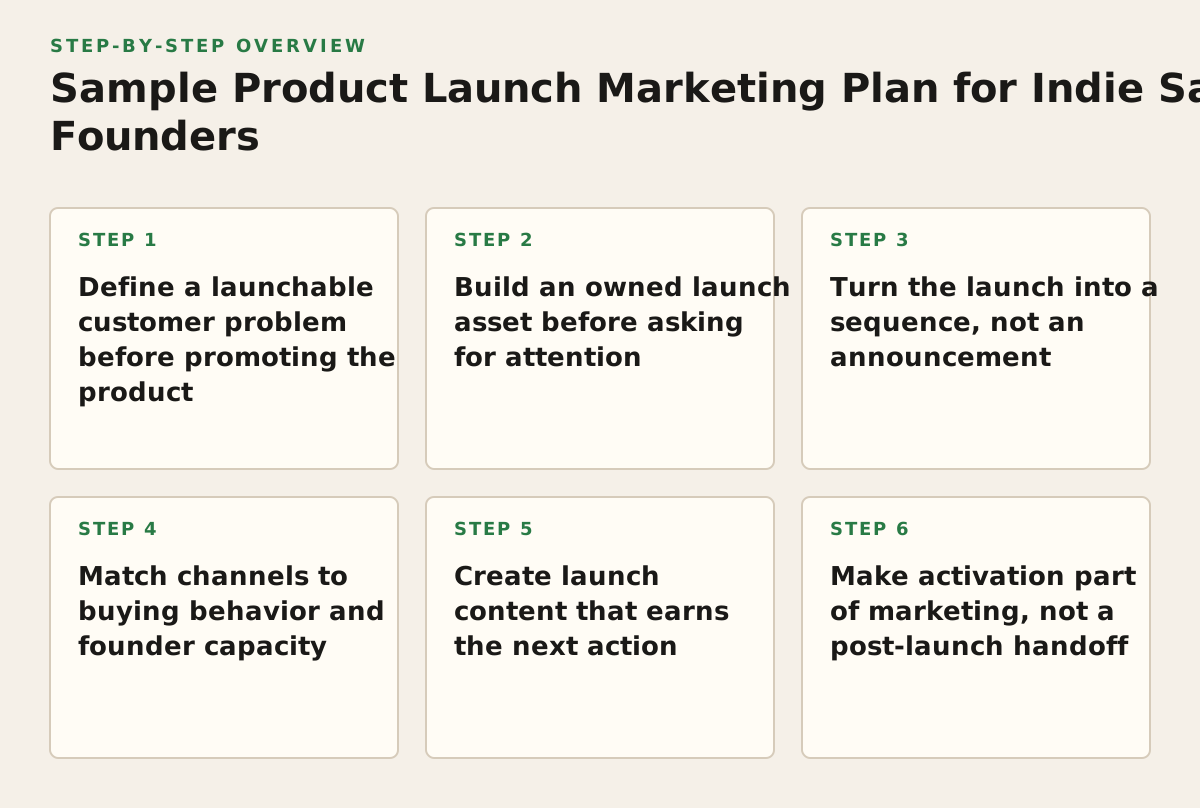
1. Define a launchable customer problem before promoting the product
Use this principle when your product could plausibly serve several customer types or when your homepage currently describes features instead of an urgent job. A launch campaign needs a narrow starting point because people share problems they recognize, not product categories they do not understand.
Choose one primary launch audience and one painful situation. “Small businesses that need automation” is too broad. “Independent consultants who lose proposal context between a discovery call and a signed project” gives you a person, moment, and consequence. The narrower statement also makes it easier to decide which communities, newsletters, search terms, and partners are relevant.
Build the message from evidence
Interview prospects, review support requests, inspect competitor complaints, or revisit conversations that caused someone to ask for access. You are looking for the language people already use. Avoid treating a feature request as proof of a market; ask what happened before the request and what the current workaround costs in time, risk, or frustration.
- Audience: who experiences the problem often enough to seek a solution?
- Trigger: what event makes the problem urgent now?
- Current workaround: spreadsheet, email thread, manual service, or doing nothing?
- Desired outcome: what changes after the product is used?
- Proof: what can you show without inventing customer results?
A useful launch message follows this structure: “For [specific audience] facing [specific situation], [product] helps you [concrete outcome] without [important objection].” The outcome should describe a job, not a technical capability. “Automatically classify inbound requests” is a capability. “See which client requests need a response before they disappear in your inbox” is a launchable outcome.
Failure mode: solving for a category instead of a moment
“An AI workspace for modern teams” may sound broad enough to attract everyone, but it gives nobody a reason to act today. Replace category language with a moment that causes a search, a conversation, or a trial. For example, a founder launching an onboarding tool might begin with “When a new customer signs, your team knows what to send next without assembling a checklist from scratch.”
Implementation example: Write three landing-page versions for the same product, each aimed at a different audience. Ask five people from each audience to explain what they think the product does and when they would use it. Keep the version where people paraphrase the intended problem most accurately, not the version that receives the most polite compliments.
2. Build an owned launch asset before asking for attention
This principle applies whenever your launch depends on a social platform, directory, community post, or one-time announcement. Borrowed distribution can create a spike, but an owned destination gives every later mention somewhere to go. Your minimum asset is a focused landing page with one action: join the waitlist, request access, start a trial, or book a conversation.
The page must answer four questions quickly: who is this for, what painful job does it address, why is this approach credible, and what should the visitor do next? It does not need every feature. Early visitors need enough context to decide whether the problem is theirs.
Recommended page components
- A headline naming the audience and outcome.
- A short explanation of the triggering problem.
- A product demonstration, annotated screenshot, or concrete workflow.
- Three benefits tied to work completed or risk reduced.
- A low-friction call to action with accurate expectations.
- A short founder note explaining why the product exists.
- Answers to the first objections: setup, switching, privacy, workflow fit, or timing.
Use one primary call to action on the page. A visitor should not have to choose among “Book a demo,” “Join the community,” “Read the guide,” “Follow us,” and “Start a trial” unless those actions serve clearly different stages. One page, one next step makes launch traffic easier to interpret.
For discoverability, describe the actual problem in page copy rather than hiding it behind a coined brand term. Google’s SEO starter guidance recommends making content understandable to both users and search engines, including clear page titles and descriptive content; use that as a baseline rather than expecting search traffic to appear immediately. Google’s SEO Starter Guide is the relevant reference for structuring this foundation.
Failure mode: publishing an attractive but untestable page
A page can look polished and still fail to teach you anything. If five different audiences land on it and each sees a different promise, you will not know whether the product or the positioning caused weak conversion. Put the audience in the headline, keep the action singular, and record the source of each visitor.
Implementation example: A founder building a lightweight client portal creates a page for freelance designers, not “service businesses.” The page demonstrates the handoff from approved design to client feedback, asks visitors to request early access, and includes a question in the form: “What do you currently use for client approvals?” That answer becomes both qualification data and future copy.
3. Turn the launch into a sequence, not an announcement
Use a sequence when your product needs explanation, trust, or behavior change. A single launch post asks strangers to understand the product, believe the promise, and act within one scroll. A staged campaign gives each interaction a job and lets you adjust before the public release.
Separate the campaign into four phases:
- Research: collect language, objections, and potential early adopters.
- Preparation: build the page, demo, onboarding, email sequence, and launch assets.
- Release: concentrate attention around a clear availability moment.
- Follow-through: help users activate, publish learning, and continue acquisition.
A starting policy for an illustrative launch might be two weeks of preparation, a release day, and two weeks of follow-through. This is not a universal timeline; use a shorter cycle for a simple utility and a longer one when users need migration, collaboration, or education.
Give every phase a specific job
- Research: recruit conversations and identify repeated language.
- Preparation: turn repeated language into page copy and content.
- Release: create a concentrated reason to visit and try the product.
- Follow-through: convert attention into activation, referrals, and product fixes.
Before release, share useful fragments rather than vague teasers. Show a workflow, explain a design decision, publish a checklist, or invite people to critique a prototype. The aim is not to exhaust the announcement early; it is to create context so the final invitation feels like a continuation.
On release day, prepare a small set of assets with different jobs: a concise announcement, a product walkthrough, a founder story, answers to common objections, and a direct invitation to try the product. Reuse the core message, but do not paste the same paragraph into every community.
Failure mode: treating launch day as the deadline for all marketing
Founders often spend weeks polishing the product and reserve one afternoon for distribution. That creates a fragile campaign: a post underperforms, a directory review is delayed, or onboarding breaks under new traffic, and there is no second move. A sequence creates multiple chances to learn and redirect.
Implementation example: A scheduling product spends the preparation phase publishing short analyses of missed appointments and asking independent coaches how they currently follow up. The release announcement then presents the product as a response to those workflows. The follow-through phase sends new users a three-step setup guide and publishes answers to the two most common setup questions.
4. Match channels to buying behavior and founder capacity
This principle applies when you have a long list of possible channels: launch directories, communities, email, search, partnerships, short-form video, paid ads, or founder-led outreach. Do not rank channels by popularity. Rank them by whether the audience has the problem, whether the format supports your message, and whether you can participate without damaging product work.
Use channel-job fit rather than a generic channel checklist. Search can capture existing intent, but it may take time to compound. A community can create high-quality conversations, but promotional posts may be unwelcome. A personal network can produce fast feedback, but it may not resemble your target market. Paid acquisition can buy controlled exposure, but it can also amplify unclear positioning.
| Channel | Best launch job | Use when | Primary signal | Common failure |
|---|---|---|---|---|
| Founder outreach | Validate the problem and recruit first users | You can name people or teams with the trigger | Qualified conversations and completed activation | Sending a generic pitch to weakly related contacts |
| Relevant communities | Earn trust through useful problem context | You can contribute without making the space an ad channel | Relevant replies, referrals, and visits | Dropping a link before demonstrating usefulness |
| Email list | Build continuity between launch moments | You can offer a clear reason to subscribe | Replies, activation, and retained interest | Collecting addresses without a follow-up promise |
| Search content | Capture recurring problem-oriented intent | The problem has language people search for | Qualified visits and assisted conversions | Publishing broad articles unrelated to the product job |
| Launch directories | Create a concentrated discovery event | Your page and onboarding can handle curious visitors | Qualified signups and activation | Optimizing votes or views instead of user fit |
| Paid advertising | Test a defined message with controlled exposure | You have a clear audience, page, and conversion event | Cost per qualified activation | Buying traffic before fixing the offer |
For an indie founder, start with one primary channel and one supporting channel. For example, founder outreach can generate conversations while a problem-focused guide gives prospects something useful to share. Adding five channels at once makes attribution noisy and creates a maintenance burden.
Use consistent campaign labels in URLs so visits from different launch assets can be separated in analytics. Google Analytics documents campaign URL parameters such as source, medium, and campaign, which can help distinguish traffic from an email, community post, or partner mention when implemented consistently. See the official Google Analytics campaign URL guidance before creating your naming convention.
Failure mode: choosing a channel because other startups use it
A launch directory may be useful for discovery, but it is not automatically the best route to your first ten active users. A founder community may contain many builders but few buyers. Choose the place where your audience already discusses the triggering problem, then adapt to its norms. If you cannot explain why a channel is relevant in one sentence, it is probably a distraction.
Implementation example: A developer tool for independent agencies chooses direct outreach to agency owners as its primary channel and a technical troubleshooting guide as its supporting channel. It delays paid ads until the founder can identify which agency profile activates and which objection stops setup.
5. Create launch content that earns the next action
Use this principle when your current marketing consists mainly of feature announcements. Content should move a prospect one step closer to a useful behavior: recognizing a problem, comparing approaches, seeing the workflow, trying the product, or inviting a teammate.
Design content around decision friction. A prospect who does not understand the problem needs a practical explanation. Someone who understands the problem but distrusts the product needs proof of process or transparency. Someone who wants to try the product needs a low-risk next step and clear onboarding.
A practical content ladder
- Problem content: explain the cost or pattern behind the pain.
- Workflow content: show how the job is handled before and after the product.
- Proof content: demonstrate the product honestly through examples, screenshots, or a public build log.
- Objection content: address setup time, switching effort, fit, or missing capabilities.
- Action content: invite a trial, early-access request, conversation, or referral.
For each asset, write a private brief before publishing:
- Who should recognize themselves in this?
- What question does the asset answer?
- What evidence or example makes the answer credible?
- What is the one next action?
- How will you know the action happened?
Founder-led content works especially well for early products when it reveals reasoning rather than manufacturing excitement. Explain why you chose a narrow workflow, what you removed from the first version, or what an early user misunderstood. That material gives prospects a reason to trust your judgment and gives potential users a reason to correct it.
Failure mode: confusing activity with useful content
Posting daily does not create momentum if every post asks for attention and none helps the audience make a decision. A useful rule is to make the majority of launch content independently valuable, while the product invitation remains clear but proportionate. A teardown, template, or workflow example should still help someone who does not sign up.
Implementation example: A knowledge-base product publishes a guide showing how a small support team turns repeated questions into reusable answers. The product appears in the workflow demonstration, but the guide also includes a manual version using existing tools. Readers can join early access after seeing precisely where the product removes effort.
6. Make activation part of marketing, not a post-launch handoff
This principle applies whenever signups do not reliably become meaningful product use. Acquisition creates an opportunity; activation determines whether the promise survives contact with the product. If a new user cannot reach the first useful outcome, more promotion only produces a larger queue of disappointed visitors.
Define the first value event in observable terms. It might be importing a project, sending the first client request, publishing a page, completing a report, or inviting a collaborator. “Logged in” is usually too weak. The event should represent the moment when the user experiences the outcome promised in the launch message.
Connect the campaign promise to onboarding
- Repeat the audience and use case in the welcome message.
- Ask only for information needed to reach the first value event.
- Provide sample data or a safe demo path when an empty workspace feels intimidating.
- Show the shortest route to the promised outcome.
- Offer human help through a reply, community, or founder contact.
- Ask one useful question after activation: what almost stopped you?
Segment follow-up by behavior rather than sending every signup the same sequence. A person who started setup needs a completion prompt. Someone who reached the first value event needs a deeper workflow or invitation prompt. Someone who never returned may need a clarification of the original problem, not another feature list.
Be careful with automated urgency. If access is genuinely limited because you are onboarding users manually, say so. If it is not, do not invent scarcity to improve a short-term conversion number. Early adopters are also your future references, referrals, and critics.
Failure mode: measuring signup volume as launch success
A signup can be accidental, unqualified, or abandoned. Track a small funnel: qualified visitor, signup, first value event, repeat use, and a meaningful user response. The exact event definitions depend on the product, but they should be written before launch so you do not redefine success after seeing the numbers.
Implementation example: A lightweight analytics product defines activation as connecting a data source, creating one dashboard, and viewing it with a real dataset. Its welcome email links directly to that path. Users who sign up but do not connect a source receive a short troubleshooting message rather than a broad newsletter.
7. Measure learning, not just reach
Use this principle when you need to decide whether to improve the product, revise the message, change the audience, or increase distribution. Early launch data is often sparse and noisy. Treat it as evidence for a decision, not as a scoreboard.
Pair every metric with a decision rule. For example, if a page attracts the intended audience but few visitors start the requested action, revise the promise or reduce friction. If many people start but fail to activate, investigate onboarding. If activation is strong among a narrow segment, concentrate distribution there before expanding.
Build a simple measurement sheet
- Asset or channel name.
- Audience segment.
- Message or offer used.
- Visits or conversations generated.
- Qualified actions.
- First value events.
- User objections and exact language.
- Next change and owner.
Use source labels consistently, but do not pretend attribution is perfect. A person may see a community post, search your name, read a founder thread, and then use a direct link. Ask new users “How did you hear about this?” and record the answer alongside tracked traffic. Quantitative signals show where behavior changed; qualitative signals explain why.
For pages that receive meaningful traffic, watch whether the experience is usable on mobile and whether the page loads acceptably. Google’s Core Web Vitals documentation describes user-centered measures related to loading, interactivity, and visual stability; it is a useful technical reference when a slow or unstable page may be undermining campaign performance. See web.dev’s Core Web Vitals overview.
Failure mode: optimizing a weak proxy
Impressions, followers, votes, and email opens can be directional clues, but they do not prove that the right people reached value. A post with fewer views and several qualified conversations may be more valuable than a widely shared announcement. Record visibility metrics, but make qualified activation the primary launch outcome when the product is available.
Implementation example: A founder sees that a launch post generated many visits but few completed setups. Interviews reveal that visitors expected a browser extension, while the product requires a desktop workflow. The founder changes the page explanation and onboarding before pursuing more distribution.
8. Use communities and launch platforms with respect for context
This principle applies when you want discovery beyond your existing network. Platforms such as product directories, builder communities, and startup discovery sites can introduce your product to people who actively enjoy trying new tools. They work best when you treat them as places to build context and relationships, not as broadcast slots.
Earn attention before requesting a click. Read the community’s norms, identify recurring questions, and contribute without forcing the product into every response. When you do share the launch, explain the target user, the problem, what is available now, and what kind of feedback would be useful.
Prepare a community-specific launch kit
- A one-sentence description with no unexplained jargon.
- A short founder explanation of the problem.
- A visual or brief demo showing the core workflow.
- A transparent note about the product’s current stage.
- Two questions that invite useful feedback.
- A direct route to try the product or request access.
- Replies ready for likely objections, without copy-pasting them everywhere.
Consider the difference between discovery and validation. A broad startup audience may help you discover unexpected use cases or find enthusiastic testers. It may not validate a buyer segment. If investors or startup enthusiasts see your launch, treat their interest as a useful signal, but do not confuse attention from observers with evidence that the intended customer will pay or return.
For SuperPublic’s audience, the relevant action is to submit your product launch when you have a clear product page, a defined audience, and a specific launch request; doing so gives independent builders a focused discovery surface instead of leaving the product buried in a general social feed.
Failure mode: treating a community as free advertising
Low-effort promotion damages trust faster than a quiet launch. Do not enter a conversation only to drop a link, misrepresent the product’s stage, or ask members to perform engagement actions unrelated to their interests. A smaller number of thoughtful replies and qualified visits is a better outcome than broad but resentful exposure.
Implementation example: A bootstrapped founder joins discussions about client reporting, answers questions using a neutral checklist, and later shares a product walkthrough that implements the checklist. The post asks for feedback on report setup, not generic support such as “upvote and share.”
Sequenced implementation plan for a 2026 product launch
Use the following as a starting policy, not a universal benchmark. Adjust the pace to your product’s complexity, user access model, and founder availability. The important constraint is sequence: do not scale attention before you can observe and support the first useful outcome.
- Choose the launch wedge. Write one audience, one triggering situation, one outcome, and one major objection. Remove secondary audiences from the first campaign brief.
- Collect language and objections. Have targeted conversations, review existing requests, and capture exact phrases. Mark which statements are observed and which are your hypotheses.
- Define activation. Name the first value event and the steps required to reach it. Add a way to identify users who stall at each step.
- Build the owned destination. Publish a focused landing page with one primary action, an honest product stage, a concrete workflow, and a founder contact route.
- Create the minimum content set. Prepare one problem explanation, one workflow demonstration, one objection answer, one announcement, and one follow-up resource.
- Select two channels. Choose one channel for direct learning and one for repeatable or compounding discovery. Write the job, audience, cost in founder time, and success signal for each.
- Install measurement. Add consistent campaign labels, define the funnel events, and create a short feedback form or onboarding question. Test every link and event before sending traffic.
- Run a private release. Invite a small, relevant group first. Watch for confusion, broken setup steps, and mismatch between the campaign promise and the actual first experience.
- Publish the public launch. Concentrate the announcement across your chosen channels, adapting the format to each context. Ask for a specific action and a specific kind of feedback.
- Support activation immediately. Reply to questions, observe setup friction, and send behavior-based follow-up. Fix the largest obstacle before adding another acquisition channel.
- Review evidence on a fixed date. For an illustrative starting policy, review after the first several days and again after two weeks. Decide whether to narrow the audience, revise the message, repair onboarding, or expand distribution.
- Publish what you learned. Share a useful postmortem, workflow lesson, or product change. This extends the launch, gives the community value, and creates a reason for new prospects to enter the sequence.
The strongest recommendation is to launch a narrow promise to a reachable audience, then let activation evidence determine the next channel. If you can explain the problem clearly, support the first users personally, and document what changed, your campaign becomes more than a one-day announcement—it becomes a repeatable discovery system.
When the product is ready for a broader independent-builder audience, SuperPublic offers a place to present it to founders and startup enthusiasts looking for new products; use SuperPublic as one part of the distribution sequence, alongside direct learning and ongoing follow-through.
Authored with NotFair SEO