Founder field note
SaaS Product Marketing: A Practical Launch System for Early-Stage Founders
SaaS product marketing for bootstrapped founders: build positioning, demand, launch loops, and measurement on a small budget that compounds.
SaaS product marketing is the discipline of turning a software product’s capabilities into a clear reason for a specific customer to notice, try, adopt, and recommend it. For a bootstrapped founder or pre-seed team, it is less about publishing constantly and more about connecting customer problems, product proof, distribution, and learning into one operating system.
That distinction matters at launch. A product can be useful and still receive little attention if the right people do not recognize themselves in the message. It can attract signups and still fail if new users do not reach a meaningful first outcome. Marketing, in this context, is not a layer added after development. It is the set of decisions that helps a small team find a reachable market and make the product’s value understandable.
What SaaS Product Marketing actually includes
SaaS product marketing sits between product development, sales, customer success, and distribution. It answers four connected questions:
- Who is the product for? Not “small businesses” or “modern teams,” but a reachable group with a recognizable job, trigger, and level of urgency.
- What painful change does it create? This is the customer outcome, not the list of features shipped.
- Why should someone believe the claim? Evidence may include a workflow demonstration, customer language, a before-and-after example, or a useful free tool.
- What should the customer do next? The next step might be joining a waitlist, starting a trial, booking a conversation, installing an integration, or submitting a product for discovery.
A useful working model is:
Audience → problem → promise → proof → path → feedback.
If one link is vague, the whole system becomes expensive. Broad audience definitions produce generic messages. Generic messages force the team to rely on volume. Volume without a strong first-use experience produces shallow signups, poor retention, and misleading acquisition metrics.
Marketing is not the same as promotion
Promotion is one part of the job: announcements, launch posts, paid campaigns, partnerships, and outreach. Product marketing includes the decisions that make those activities more effective. It shapes the landing page, onboarding sequence, pricing explanation, sales material, customer interview questions, and release narrative.
For example, suppose a founder has built an AI tool that turns customer interviews into searchable insights. “AI-powered research workspace” describes a category, but it does not identify a buying moment. A sharper starting position might be: “For product teams that lose interview evidence across documents, turn each call into tagged, searchable evidence before the next roadmap meeting.” The second statement gives distribution and onboarding something to work with.
Positioning is a decision about who gets priority. It does not permanently exclude everyone else, but it gives the first audience a reason to pay attention. A useful positioning brief can contain:
- The first customer segment and the role that feels the problem.
- The triggering event that makes the problem urgent.
- The current workaround and its cost or frustration.
- The product’s differentiated mechanism, not just its output.
- The proof available today and the proof still missing.
Keep this brief short enough to revise. Early-stage teams should expect their language to change as they hear how prospects describe the problem. The goal is not to produce a permanent brand manifesto. The goal is to create a testable explanation of value.
How product marketing differs by business model
A self-serve SaaS product has to explain enough value for a stranger to take action without a sales call. A sales-assisted product can use a conversation to clarify the problem, but then needs strong qualification and proof. A product with a long implementation process must market the transition and the operational change, not only the software interface.
That leads to different primary actions:
- For a self-serve tool: activate a workspace, connect a data source, or complete a meaningful first task.
- For a sales-assisted tool: identify the right account, diagnose the cost of the current process, and earn a qualified next meeting.
- For a developer product: install, run, and successfully reach a documented first result.
- For a marketplace or community product: complete a high-quality supply or demand action, not merely create an account.
Why it matters more when the team is small
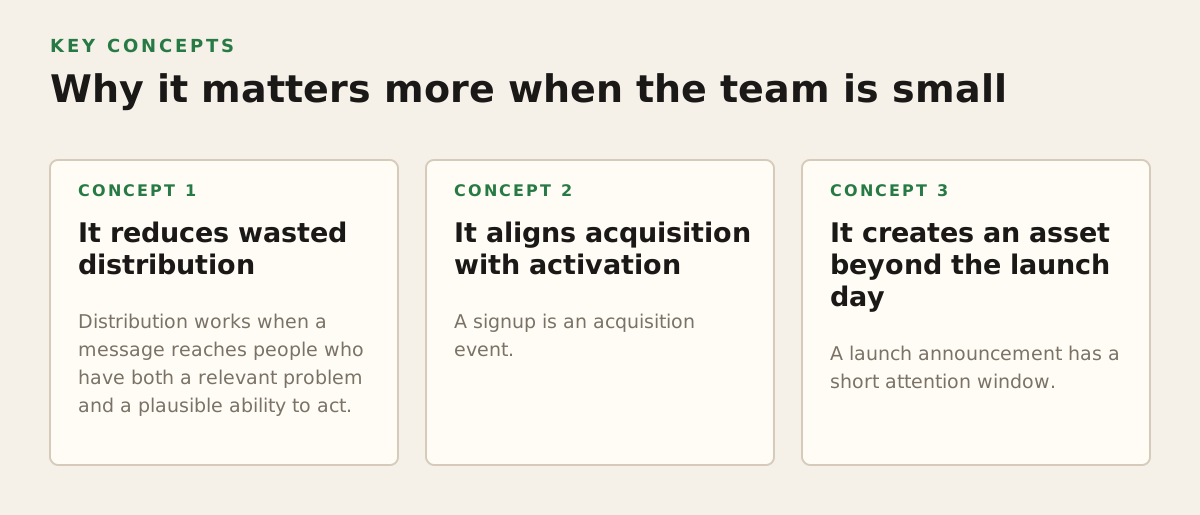
Large companies can compensate for unclear positioning with brand reach, paid distribution, and specialized teams. An indie founder usually cannot. Every unclear page creates support questions; every poorly chosen channel consumes scarce attention; every unqualified signup creates noise in the product feedback loop.
The main constraint is not creativity; it is feedback quality. A small team needs to know whether a weak result came from the audience, the promise, the channel, the product experience, or the follow-up. Without that separation, founders often change five things at once and learn nothing.
It reduces wasted distribution
Distribution works when a message reaches people who have both a relevant problem and a plausible ability to act. A founder promoting an expense approval tool in a general startup forum may receive attention from curious builders but few likely customers. A founder sharing a detailed workflow with finance managers during annual planning may reach fewer people but create more useful conversations.
Channel selection should follow customer behavior rather than founder comfort. Consider:
- Where the audience already asks for help.
- Which people can authorize a purchase or influence one.
- Whether the problem is discovered through search, peers, communities, events, or outbound contact.
- How much explanation is needed before the product makes sense.
- Whether the channel supports a repeatable action rather than a one-time spike.
Search can be valuable when buyers describe the problem in stable language. Google’s own SEO guidance emphasizes making content understandable to search engines and useful to people, including clear organization and descriptive page elements; that is a better foundation than writing pages around disconnected keyword variations. See the Google Search Central SEO Starter Guide for the current guidance in 2026.
It aligns acquisition with activation
A signup is an acquisition event. It is not necessarily evidence of value. For a collaboration product, activation might mean inviting a teammate and completing a shared workflow. For an analytics product, it might mean connecting a source and answering one real business question. For a developer tool, it might mean installing the package and receiving a successful response.
Define the first valuable action before choosing the campaign. Otherwise, marketing optimizes for the easiest event to count. A campaign can appear successful because it creates cheap registrations while bringing in people who never reach the product’s core use case.
For measurement, Google Ads documents conversion tracking as a way to understand actions such as purchases, signups, or other valuable interactions rather than treating every click as equal. The appropriate event depends on the product’s business model; the underlying principle is to define the action before assessing acquisition quality. See Google’s conversion tracking documentation.
It creates an asset beyond the launch day
A launch announcement has a short attention window. A useful comparison page, integration guide, customer story, onboarding email, or problem-specific calculator can keep working after the initial announcement. This is especially important for bootstrapped products, where repeated distribution is more sustainable than constantly inventing new announcements.
Think in layers:
- Immediate assets: launch page, announcement, demo, founder posts, and direct outreach.
- Compounding assets: search-oriented guides, templates, integrations, examples, and customer education.
- Retention assets: onboarding prompts, lifecycle emails, in-product guidance, and usage reviews.
The best early asset is often close to the product’s core workflow. A time-tracking product might publish a practical guide to reconstructing billable hours from calendar records. A compliance workflow product might offer an evidence collection checklist. These assets demonstrate how the founder understands the job rather than merely repeating product claims.
How the operating system works
Effective SaaS marketing is a sequence, not a pile of channels. Start with a narrow hypothesis, create a message and path for that hypothesis, observe what happens, then revise one important assumption at a time.
1. Choose a beachhead audience
Write the audience as a situation, not a demographic. “Founders” is too broad. “Two-person agencies that need client approvals before work enters production” gives you a job, context, and likely trigger.
Score possible segments against four practical criteria:
- Problem intensity: Does the problem cause lost time, revenue, risk, or repeated frustration?
- Reachability: Can you identify and contact these people without an enterprise sales machine?
- Product fit: Does the current product solve a meaningful slice of the problem?
- Learning speed: Can you get feedback from this segment within a reasonable cycle?
These are not market-size calculations. They are prioritization criteria for an early-stage team. A segment with fewer potential buyers may be the better starting point if the problem is visible and the product can create a quick win.
2. Convert features into outcome language
Features describe what the product does. Outcomes explain why a person should care. The conversion is not always one-to-one:
| Feature statement | Outcome-oriented version | Proof to collect |
|---|---|---|
| Automated reminder sequences | Reduce the number of customer follow-ups handled manually | Workflow example, saved steps, customer quote |
| Shared approval inbox | Give a team one place to see what is waiting and who owns it | Before-and-after process map |
| AI meeting summaries | Turn conversations into decisions and assigned follow-up work | Sample summary, action completion, user feedback |
| Webhook support | Move important product events into the systems the team already uses | Implementation guide, example payload, successful workflow |
Do not promise an outcome you cannot substantiate. If you have no evidence for “cuts reporting time in half,” use a more defensible claim such as “helps teams replace a manual reporting step.” Strong positioning can be specific without manufacturing a statistic.
3. Build a message hierarchy
A message hierarchy tells every surface what to say first, second, and third. It prevents a landing page from leading with a technical detail that only matters after the buyer understands the problem.
- Problem: name the costly or frustrating situation.
- Audience: identify who experiences it most clearly.
- Promise: describe the change the product enables.
- Mechanism: explain how the product creates that change.
- Proof: show evidence, examples, or a transparent limitation.
- Action: offer the lowest-friction next step that can produce value.
The same hierarchy can be adapted to a launch post, product page, sales email, or community conversation. Adaptation is not repetition if each channel adds the context its audience needs.
4. Design the first-use path
Acquisition and onboarding should make the same promise. If the page promises “turn support conversations into prioritized product insights,” the first session should guide the user toward importing or entering a conversation and producing an insight. Asking for ten configuration choices before that moment creates a gap between message and experience.
Map the path as a chain:
Click → expectation → first input → first result → repeatable habit.
At each step, ask what could create confusion. A user may understand the headline but not know which data to provide. They may complete setup but not recognize the output as useful. They may receive a result but lack a reason to return next week.
Instrumentation helps locate the break. Google Analytics documentation describes events as interactions that can be measured, allowing teams to distinguish actions such as viewing content, signing up, or completing a product activity. Use an analytics plan that names the events and their purpose; do not install tracking merely to accumulate dashboards. The Google Analytics event documentation is the relevant reference for the current implementation model.
5. Create a distribution loop
A launch should produce more than visits. It should create material for the next distribution cycle:
- A user question becomes a problem-focused article.
- A repeated workflow becomes a template or checklist.
- A successful customer process becomes a case example.
- A product objection becomes a comparison or FAQ.
- A public launch conversation becomes a follow-up interview.
For a discovery platform, a founder can use a launch page as an anchor, then share the specific problem solved, the intended customer, and the request for useful feedback. If you are ready to put a product in front of early adopters and other founders, you can submit your product launch to SuperPublic and use the resulting conversations as input for the next iteration.
Where SaaS marketing breaks down
Most early failures are not caused by a missing channel. They come from confusing activity with progress or making claims that the product experience cannot support.
Broad positioning creates polite interest
“All-in-one productivity for modern teams” is hard to reject and hard to remember. It gives a prospect no clear reason to believe the product was made for their situation. Broad language also makes feedback ambiguous: every visitor may interpret the product differently.
A narrower message can feel risky because it appears to reduce the addressable market. In practice, it often improves learning. You can later expand from a clear foothold; it is difficult to expand from language that never created a foothold.
Feature lists attract evaluators, not necessarily buyers
Feature detail is useful when the visitor is comparing solutions. It is weak as the opening argument. Lead with the problem and outcome, then give technical detail to people who need to verify fit.
Watch for these signs:
- Visitors ask what the product does after reading the homepage.
- Demo calls focus on navigation rather than the customer’s workflow.
- Users activate one feature but never complete the core job.
- Content receives impressions but produces no meaningful conversations.
- Every new segment requires a completely different explanation.
Launch spikes are mistaken for demand
A launch can create attention without creating durable demand. Curiosity, peer support, and genuine buying intent may all appear as visits or signups. Separate them by looking for downstream behavior: a completed first task, a reply that describes a real problem, an invited teammate, a qualified conversation, or a return visit tied to the same workflow.
Use numbers only as operating tools, not as universal benchmarks. The following is an illustrative starting policy for a founder preparing a launch, not a performance standard:
- Collect 10 problem interviews before finalizing the first positioning hypothesis.
- Prepare 3 message variants for the same audience and problem.
- Send 25 targeted outreach messages over 5 business days, personalized around a visible trigger.
- Review 20 activated sessions or signup journeys before changing onboarding.
- Choose 1 primary conversion and 2 supporting events for the first 30-day measurement period.
The numbers make the work concrete. They do not predict results. A developer tool with a small expert audience may learn more from five detailed conversations than from hundreds of casual clicks.
Attribution becomes a false source of certainty
Early-stage teams often ask whether a signup came from search, a post, a community, or a direct message. That question is useful, but imperfect tracking can create false precision. People discover a product in one place, return through another, and convert later through a bookmarked page.
Use a practical mix of signals:
- Self-reported “how did you hear about us?” responses.
- Tagged campaign links where appropriate.
- Landing-page and signup events.
- Activation and retention behavior.
- Qualitative notes from conversations.
Google Search Console’s performance report can show search queries, pages, clicks, and impressions, which helps distinguish visibility from visits in organic search. It is useful for identifying language and pages to improve, but it does not explain the entire customer journey; consult the official Search Console performance report documentation for the report’s scope.
Paid acquisition is used before the message is ready
Paid campaigns can buy faster feedback, but they cannot fix an unconvincing promise or weak activation path. Before spending, confirm that the landing page matches the ad, the conversion is defined, and someone can review the resulting sessions or leads.
Platform mechanics also matter. Meta describes its Pixel as a tool for sending web actions to its systems for measurement and advertising use; implementation and privacy obligations should be reviewed before deployment in the relevant Meta Pixel documentation. Do not assume that installing a tracking script automatically creates useful insight or permission to collect every possible event.
How practitioners apply it in a 30-day launch plan
A practical launch plan should have one learning objective, one primary audience, one core action, and a small number of distribution experiments. The purpose of the first month is not to prove the entire business. It is to discover whether a specific group recognizes a meaningful problem and can reach value through the current product.
Days 1–7: sharpen the problem and message
Review existing conversations, support requests, demo notes, and usage behavior. If those inputs do not exist, conduct targeted interviews with people who plausibly experience the problem. Ask about the last time it happened, what they did instead, what made the situation expensive, and what would cause them to change.
Produce these working documents:
- A one-sentence audience and problem statement.
- A short list of triggering events.
- A comparison of the current workaround and the proposed workflow.
- A landing page with one primary action.
- A list of claims that require proof before publication.
Avoid asking interviews to validate a slogan. Ask about behavior. “Would you use this?” generates encouragement; “How did you handle the last three instances?” produces evidence you can use.
Days 8–14: align the product path
Choose the smallest first-use experience that demonstrates the product’s central promise. Remove or defer setup that does not contribute to that moment. Write onboarding copy that explains why each required input matters.
For each step, document:
- The user’s intended action.
- The product response that should follow.
- The evidence that the step succeeded.
- The likely reason a user would stop.
Then define events in plain language before implementing them. For example, “created workspace” is an administrative event; “completed first client approval” may be closer to value. Both can matter, but they answer different questions.
Days 15–21: distribute to a narrow audience
Select two complementary channels rather than publishing everywhere. One can create direct conversations, such as targeted email or founder outreach. The other can create discoverability, such as a search-oriented guide, a launch listing, a technical tutorial, or a relevant community contribution.
Each distribution action should carry a specific request:
- Ask a likely user to identify what is missing from the workflow.
- Ask an early adopter to complete one defined task.
- Ask a technical evaluator to test one integration or edge case.
- Ask a potential buyer to compare the current workaround with the proposed process.
Do not treat every response as a lead. Some responses are product research, some are distribution feedback, and some are evidence of buying intent. Label them separately so the team does not optimize the wrong outcome.
Days 22–30: review evidence and make one major change
At the end of the cycle, inspect the full path from message to product behavior. Look for the earliest point where the intended audience stops progressing. If the right people never click, revisit positioning or channel. If they click but do not start, revisit the page and offer. If they start but do not activate, revisit onboarding or product fit. If they activate but do not return, investigate whether the problem is recurring enough or whether the product has not become part of the workflow.
| Observed pattern | Most likely area to investigate | Next decision |
|---|---|---|
| Relevant people ignore the message | Audience, trigger, or promise | Rewrite the opening claim and test a narrower segment |
| People click but misunderstand the product | Landing page and proof | Show the workflow and replace abstract category language |
| People start but do not reach the first result | Activation path | Reduce setup and guide the first meaningful task |
| People activate but do not return | Problem frequency or retention value | Interview activated users about when the workflow recurs |
| One channel produces attention but no qualified action | Audience-channel fit | Keep the learning, reduce effort, and test a channel closer to intent |
Change one major assumption per cycle. If you change the audience, headline, offer, onboarding, and channel simultaneously, an improved result will not tell you why it improved. A slower, cleaner learning loop is usually more valuable than a dramatic but uninterpretable spike.
What to keep after the launch
Once the initial cycle is complete, preserve the assets that help future prospects understand and trust the product:
- The clearest problem statement and audience language.
- The best-performing workflow demonstration, without overstating results.
- Questions that repeatedly arise during onboarding or sales.
- Evidence from users who reached a meaningful outcome.
- A lightweight dashboard connecting acquisition to activation.
Then build the next distribution asset from an observed customer need, not from a content calendar. A product launch should be the beginning of a feedback loop: discover a problem, explain a focused solution, help someone reach value, learn where the path fails, and make the next version easier to understand.
For bootstrapped and early-stage teams, the most durable recommendation is to choose one audience, one urgent workflow, one measurable first value event, and two repeatable distribution channels before expanding the marketing surface area. SuperPublic gives founders a place to share those launches, discover other early-stage products, and connect with a community built around making and learning; explore SuperPublic when your next product is ready for that conversation.
Authored with NotFair SEO