Founder field note
Product Roadmap Template for Bootstrapped Startup Launches
Use this product roadmap template to turn founder bets into prioritized experiments, launch milestones, and feedback loops early users can understand.
A product roadmap template is useful only when it helps you decide what not to build. For a bootstrapped founder, the real job is to connect a small set of customer problems to evidence-gathering work, a credible launch sequence, and a feedback loop that can change the plan. This guide gives you a practical structure for doing that in 2026, whether you are still validating an idea, preparing a public launch, or trying to keep an expanding backlog from consuming your team.
The decision is not “Which roadmap format looks most professional?” It is which level of commitment each item deserves. Some ideas should remain hypotheses. Some deserve a time-boxed experiment. A few are ready for a milestone with an owner and a date. Treating all three as firm promises is how early-stage teams end up polishing low-value features while neglecting distribution, onboarding, reliability, or customer conversations.
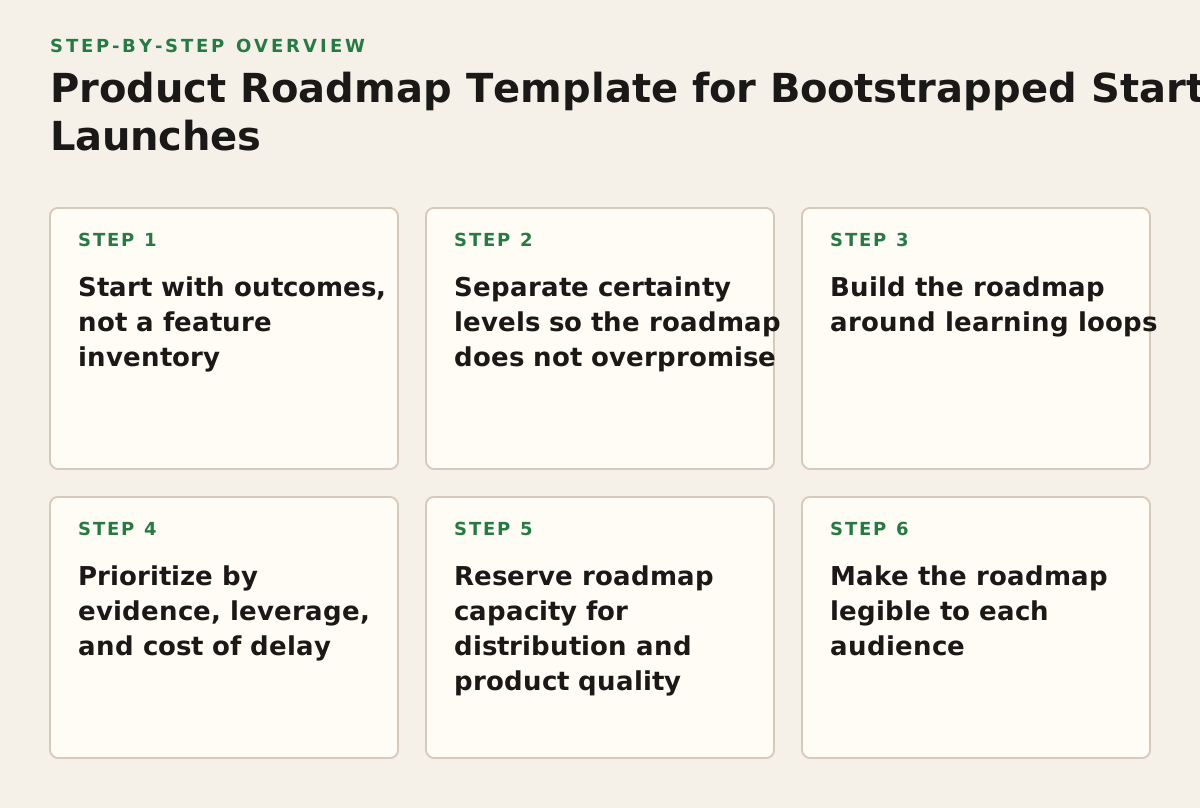
1. Start with outcomes, not a feature inventory
Use this principle when: your backlog is full of requests, ideas, and technical tasks but you cannot explain the business or user result each item is meant to produce. It is especially important before a launch, because an early product needs a learning agenda rather than a long list of capabilities.
An outcome describes a change in user behavior or product health: a new user completes setup, a team invites a collaborator, a creator publishes a first project, or a paying customer receives value without founder intervention. A feature is only one possible route to that result. Starting with outcomes keeps the roadmap flexible when interviews, analytics, or launch feedback disproves your first solution.
This is consistent with the distinction between a roadmap and a delivery plan described by Atlassian: a roadmap communicates direction and intended outcomes, while a backlog contains more detailed work. See Atlassian’s product roadmap guidance for the underlying distinction. The practical implication for a small startup is do not expose sprint-level tasks as strategic commitments.
A workable outcome statement
Write each proposed roadmap item in this sequence:
- Audience: who is experiencing the problem?
- Problem: what are they trying to accomplish or avoid?
- Behavior: what would they do differently if you helped?
- Evidence: what signal would show that the change matters?
- Candidate solution: what might you build, test, or change?
For example, “Add Slack integration” is a weak roadmap item. “For small agencies, reduce the time between a client approval and the team seeing it; validate with five customer calls, then test an approval notification using the channel customers already monitor” is stronger. The integration may still be the answer, but it is no longer treated as inevitable.
Failure mode: replacing feature names with vague aspirations such as “improve engagement” or “delight users.” These phrases sound strategic but cannot guide trade-offs. If your team cannot name the user action that should change, the item is not ready for prioritization.
Implementation example: create a first roadmap column called “Outcome to change.” Put “more automation” nowhere on the board. Instead write, “A solo consultant can turn a meeting transcript into a reviewable client summary in one sitting.” The next cards can include a manual concierge test, a prompt revision, a template library, or an export improvement. The outcome survives even if the implementation changes.
2. Separate certainty levels so the roadmap does not overpromise
Use this principle when: you are publishing a roadmap for early adopters, discussing plans with investors, or coordinating a tiny team whose priorities change as soon as new evidence arrives. The more public the roadmap, the more important it is to distinguish intent from commitment.
A useful roadmap has at least three commitment levels:
- Exploring: a meaningful problem or opportunity is being researched; no delivery promise exists.
- Validating: the team is running an experiment or prototype to decide whether the opportunity deserves more work.
- Committed: the problem is important, the approach is sufficiently understood, and the work has an owner and a delivery window.
You can add “Shipped” for communication, but do not confuse a shipped feature with a successful outcome. Shipping means the implementation is available. It does not prove adoption, retention, or willingness to pay.
GitHub’s public roadmap is a useful example of communicating planned product work with status categories rather than pretending every item has identical certainty. Its official introduction explains the purpose and structure of that roadmap: GitHub’s public roadmap announcement. You do not need to copy its format; the transferable lesson is that status is a promise-management tool.
Assign a commitment rule
Before adding an item, record:
- the current confidence level;
- the evidence that could increase or reduce confidence;
- the next decision date or review trigger;
- the person responsible for making the decision;
- what will be deliberately excluded if this item moves forward.
For a solo founder, “owner” can still be useful. It may mean the person who schedules interviews, reviews support conversations, or decides whether the experiment continues. Without an owner, “validate the idea” becomes an unbounded intention.
Failure mode: adding calendar dates to every card because dates make the roadmap look concrete. A date attached to an unvalidated idea is usually interpreted by users and teammates as a promise. Use a broad time window for committed work and a review date for uncertain work.
Implementation example: an AI invoicing startup labels “automatic tax categorization” as Exploring until the founder has reviewed real invoice samples with target users. “Import existing invoices” becomes Validating with a manual upload workflow and a defined review point. “CSV export for accountants” becomes Committed only after several active users identify it as a launch blocker and the implementation is understood.
3. Build the roadmap around learning loops
Use this principle when: you have not yet reached repeatable product-market fit, your audience is still forming, or you are launching a new workflow with uncertain demand. At this stage, a roadmap that contains only build work hides the most important work: finding out whether the product solves a painful problem.
Every uncertain roadmap item should include a loop with four parts:
- Hypothesis: what do you believe about the user or problem?
- Smallest test: what is the cheapest credible way to learn?
- Signal: what observed behavior or response would change your decision?
- Next move: continue, modify, pause, or remove the idea.
A test is not automatically good because it is small. A landing page may measure interest in a promise, but it cannot prove that users will complete a workflow. A clickable prototype can expose confusion, but it cannot establish sustained usage. Match the test to the uncertainty.
The mechanism is reversible commitment. You spend enough to learn, but not enough to make the original idea emotionally or financially impossible to abandon. For an early software product, that may mean manual fulfillment, a spreadsheet-backed workflow, a fake-door prompt inside an existing experience, or five structured customer sessions. These are not substitutes for the product forever; they are decision instruments.
Map uncertainty to an appropriate test
| Uncertainty | Best first test | Signal to record | Roadmap decision |
|---|---|---|---|
| Does the problem occur often enough? | Structured interviews and workflow observation | Frequency, current workaround, cost of delay | Keep, narrow the audience, or drop |
| Will users understand the promise? | Message test or landing-page conversation | Qualified replies, specific questions, objections | Rewrite positioning or test the problem further |
| Can users complete the workflow? | Clickable prototype or concierge delivery | Completion points, confusion, manual intervention | Redesign, simplify, or build the smallest path |
| Will the workflow recur? | Limited beta with an explicit use case | Repeat usage, return reason, abandoned steps | Improve activation or stop investing |
| Will a customer pay? | Direct offer tied to a defined outcome | Qualified acceptance, objection, buying process | Refine segment, package, or value proposition |
Failure mode: collecting “feedback” without a decision rule. If every interview merely adds notes to a research folder, the roadmap becomes a museum of opinions. Write in advance what would make you advance, revise, or kill the item.
Implementation example: suppose a founder believes independent recruiters need an AI candidate shortlist. The first roadmap card is not “build ranking.” It is: “Interview recruiters about the last shortlist they created; inspect the inputs and judgment they used; prototype a ranked list with explanations; advance only if users can identify a useful candidate faster without losing trust.” That sequence protects the founder from building an impressive but unusable scoring engine.
4. Prioritize by evidence, leverage, and cost of delay
Use this principle when: more plausible ideas exist than you can fund, maintain, or explain. Bootstrapped founders often feel pressure to serve every request because each request comes from a real person. Prioritization is not dismissing customers; it is choosing which problem can receive responsible attention now.
A lightweight scoring model can make trade-offs visible. Score each candidate from 1 to 5 on:
- Reach: how many of your target users encounter the problem?
- Impact: how meaningful is the improvement for each affected user?
- Confidence: how strong is the evidence behind the reach and impact estimates?
- Effort: how much product, design, support, and maintenance work is required?
- Strategic fit: does it strengthen the specific wedge you are trying to own?
One possible starting policy is an illustrative score of (Reach × Impact × Confidence) ÷ Effort, with each factor rated from 1 to 5. This is not a universal benchmark or a scientific measurement. It is a forcing function that makes assumptions discussable. Intercom describes the RICE method and its component scores in its official RICE prioritization guide; use the model as a conversation aid rather than a machine that decides for you.
Add a separate note for cost of delay. A small compliance-related fix, broken onboarding step, or expiring platform dependency may outrank a higher-scoring feature because postponement creates immediate damage. Conversely, a loud request from one prospect may score highly on impact but poorly on reach and strategic fit.
Make the score auditable
For every high-priority item, write:
- the evidence behind the reach estimate;
- the user or revenue consequence behind the impact estimate;
- why your confidence is high or low;
- what effort is included, such as support and migration work;
- which lower-priority item will wait as a result.
Failure mode: false precision. A score of 72 does not mean an idea is exactly twice as good as a score of 36. If the result changes dramatically when you adjust one uncertain assumption, show that sensitivity and run a test instead of arguing over decimals.
Implementation example: a founder compares “team permissions,” “dark mode,” and “faster first-run setup.” Dark mode may be easy, but it has weak evidence of affecting activation. Team permissions may unlock a larger account but require migration and support. Faster setup may affect every new user and can be tested with a narrower flow. The ranking should reflect those consequences, not the founder’s personal enthusiasm or the loudest social comment.
5. Reserve roadmap capacity for distribution and product quality
Use this principle when: the roadmap is dominated by visible features and has no room for launch preparation, support, analytics, documentation, reliability, or learning from users. Early-stage software does not grow merely because more functionality exists. People need to discover it, understand it, trust it, and reach value.
Create explicit roadmap categories for:
- Core product: the workflow that delivers the promised value;
- Activation: the steps between signup and a meaningful first result;
- Distribution: launch assets, integrations with acquisition channels, partnerships, and founder-led outreach;
- Trust and quality: bug fixes, performance work, backups, permissions, and clear user communication;
- Learning: interviews, analytics instrumentation, support review, and experiment analysis.
This does not mean assigning a universal percentage of engineering time to each category. The right mix changes with the product. A pre-launch tool may need more problem validation and onboarding clarity; a product with active users may need reliability and support capacity before another feature.
For measurement, define events around the product’s value path rather than tracking every click. Google’s documentation explains that Google Analytics events can capture user interactions and recommends using meaningful event names and parameters. The relevant lesson is instrument the decisions your roadmap depends on: activation, completion, invited collaborator, exported result, or returned workflow—not vanity activity that never changes prioritization.
A launch-ready slice
For each major product milestone, include at least one item from these groups:
- the narrowest user workflow that must work;
- the proof or explanation needed for a new user to trust it;
- the measurement needed to see whether the workflow succeeds;
- the support path for predictable confusion;
- the distribution action that puts the product in front of the intended audience.
Failure mode: treating marketing as a final-week announcement. A launch post cannot compensate for unclear positioning, an unfinished demo, or no plan for responding to early users. Distribution tasks belong beside product tasks because each affects whether you learn from real usage.
Implementation example: an indie founder launching a browser-based research assistant schedules a milestone with four linked cards: a focused source-to-summary workflow, a three-minute guided example, events for source added and summary accepted, and a founder-led outreach list for researchers who already use the workflow manually. “Launch” becomes an executable system rather than a single announcement.
6. Make the roadmap legible to each audience
Use this principle when: one roadmap is being used to coordinate the founder, contractors, early users, advisors, and investors. They need different levels of detail and interpret uncertainty differently. A public audience wants direction and context; the person implementing a task needs constraints and acceptance criteria.
Use separate views from one source of truth:
- Founder view: assumptions, evidence, scores, trade-offs, and kill criteria;
- Build view: owner, dependencies, acceptance conditions, and current implementation status;
- Public view: user problem, broad horizon, confidence level, and a way to share relevant feedback;
- Investor or advisor view: strategic bets, learning milestones, risks, and evidence of progress.
The data should be shared, but the language should not be identical. “Refactor webhook retry queue” belongs in the build view. “Make important automations more dependable” may belong in the public view. Do not conceal material limitations, but do not force customers to interpret internal engineering shorthand.
Failure mode: using a public roadmap as a negotiation board. If every visitor can add a vote and every vote becomes a promise, the founder loses the ability to prioritize by segment, urgency, or product strategy. Feedback should enter the evidence field; it should not automatically bypass the decision process.
Implementation example: a small analytics product publishes three broad horizons: “Now: improve report setup,” “Next: share reports with clients,” and “Later: explore scheduled delivery.” Internally, each has interview notes, technical risks, an owner, and a review date. A visitor sees a clear direction without being promised a date for a feature that has not been validated.
7. Attach exit criteria and review rhythms to every horizon
Use this principle when: items remain on the roadmap for months, the team repeatedly reopens the same debate, or “in progress” has become a permanent status. A roadmap is a decision system only if work can leave it through more than shipping.
Give each item one of four explicit exits:
- Advance: evidence supports a larger investment;
- Iterate: the problem matters, but the approach needs revision;
- Pause: the opportunity may matter later, but another constraint wins now;
- Remove: evidence or strategy no longer supports keeping it active.
Define completion at two levels. Delivery completion means the agreed implementation is available. Outcome review means you inspect whether the intended user behavior changed. A feature can pass the first and fail the second. That is not necessarily a disaster; it is useful evidence if the team records what it learned.
As an illustrative starting policy, a solo founder might review active experiments weekly, committed milestones at the end of each delivery cycle, and the full roadmap monthly. These are suggested operating policies, not universal benchmarks. The important rule is that the review frequency should match the cost of being wrong: a launch-critical onboarding issue deserves faster attention than a distant exploration.
Use a decision log
For each reviewed item, capture:
- what was expected to happen;
- what actually happened or what was learned;
- which assumptions changed;
- the selected exit;
- the next owner and date, if the item continues.
Failure mode: measuring only output. “Released the new editor” is not a product conclusion. Ask whether the intended users completed the target task, whether support volume changed, and whether the new workflow created a new cost. If the answer is unknown, the roadmap should contain measurement or interviews before another expansion.
Implementation example: after releasing a simplified import flow, a founder reviews whether new accounts reach their first usable dataset without assistance. If users finish importing but do not return because the next step is unclear, the decision is “Iterate on activation,” not “Add more import formats.” The exit criterion prevents local success from disguising a broader funnel problem.
8. Use a copyable Product Roadmap Template that reflects decisions
The following structure works in a spreadsheet, document, issue tracker, or lightweight database. Choose the tool your team will actually update. A sophisticated workspace with stale data is worse than a plain table reviewed consistently.
Roadmap item template
- Item name: a short description of the problem or outcome, not just the feature.
- Target user: the segment and context in which the problem occurs.
- Desired outcome: the user behavior or business result to change.
- Evidence: interviews, support themes, observed behavior, sales objections, or experiment results.
- Current certainty: exploring, validating, committed, or shipped.
- Candidate approach: the current solution hypothesis, explicitly changeable.
- Smallest next step: the action that reduces the most important uncertainty.
- Success signal: the behavior or qualitative evidence that would support continuation.
- Effort and risks: build work plus migration, support, maintenance, and dependency concerns.
- Owner: the person accountable for the next decision.
- Review date: when the item will be advanced, revised, paused, or removed.
- Exclusions: adjacent requests deliberately not included in this slice.
Keep the public version shorter. A useful public card might contain only the user problem, expected benefit, confidence level, and broad horizon. It should help an early adopter recognize whether the direction matters to them, while avoiding a misleading implementation promise.
Practical rule: if an item has no evidence, no next learning step, and no owner, it is not on the roadmap. It is an idea waiting for a decision.
Before publishing, check that the roadmap answers five questions for a bootstrapped product:
- Who is this next work for?
- What will become easier, faster, safer, or more valuable?
- What do you still not know?
- What will you do if the evidence disagrees?
- How can a relevant early adopter give useful feedback?
When the next milestone is ready, use SuperPublic to submit your product launch and give the roadmap a concrete audience: founders, early adopters, and other people actively looking for emerging software. The roadmap should tell visitors what problem you are solving; the launch should give them a way to experience it and respond.
Implement the roadmap in seven deliberate steps
Do not begin by choosing a template tool. Begin with the decisions the roadmap must support. The sequence below is a practical starting plan for a small startup in 2026.
- Write the product bet. In one paragraph, name the target user, painful situation, promised outcome, and why your product is a credible approach. Remove broad audiences and generic benefits.
- Inventory current work. Put features, bugs, research, launch tasks, support problems, and technical risks in one list. Do not prioritize yet. Label anything that has no owner or user rationale as an unexamined assumption.
- Convert features into outcomes. Rewrite each meaningful item using audience, problem, behavior, evidence, and candidate solution. Split items that contain multiple outcomes or multiple audiences.
- Assign certainty levels. Mark each item exploring, validating, committed, or shipped. Add the evidence needed to move it forward and an exit criterion for stopping or pausing.
- Choose the next learning slice. Use a lightweight score to expose reach, impact, confidence, effort, strategic fit, and cost of delay. Then select the smallest test that can resolve the riskiest assumption.
- Build the milestone around the whole user path. Include the core workflow, activation, measurement, support, quality, and distribution work required for a real person to reach value. Give each piece an owner and a review date.
- Publish selectively and review on schedule. Create a public view with broad horizons and honest confidence levels. Review experiments and committed work at the rhythm you selected; record the decision, not merely the activity. After the next milestone, invite relevant early adopters to try the product and use their feedback as evidence for the following cycle.
A roadmap that earns trust is not the one with the most cards or the most precise dates. It is the one that makes your next decision obvious, keeps uncertain bets reversible, and connects product work to real people discovering and using the software. SuperPublic gives early-stage founders a place to share that work with a founder community and early adopters; when your next meaningful slice is ready, SuperPublic can help put it in front of people looking for new products.
Authored with NotFair SEO