Founder field note
Product Promotion for Bootstrapped SaaS: A Practical Launch Plan
Product promotion for bootstrapped SaaS: turn a launch into qualified feedback, early users, and repeatable distribution without wasting your budget.
Product promotion is not a single announcement or a burst of social posts. For a bootstrapped founder, it is a system for putting a specific product in front of a specific buyer, earning a useful next action, and learning whether the message attracts people who can actually benefit. This guide gives you a practical launch plan: define the audience, build a credible offer, choose a small set of channels, sequence the launch, measure intent, and turn feedback into the next release.
The goal is not maximum attention. It is a defensible first loop of qualified visitors, meaningful activation, and retained users. A pre-seed team can use that loop to improve its pitch before spending on acquisition. An indie hacker can use it to distinguish polite encouragement from real demand. An early adopter can use it to decide quickly whether a new tool is worth trying.
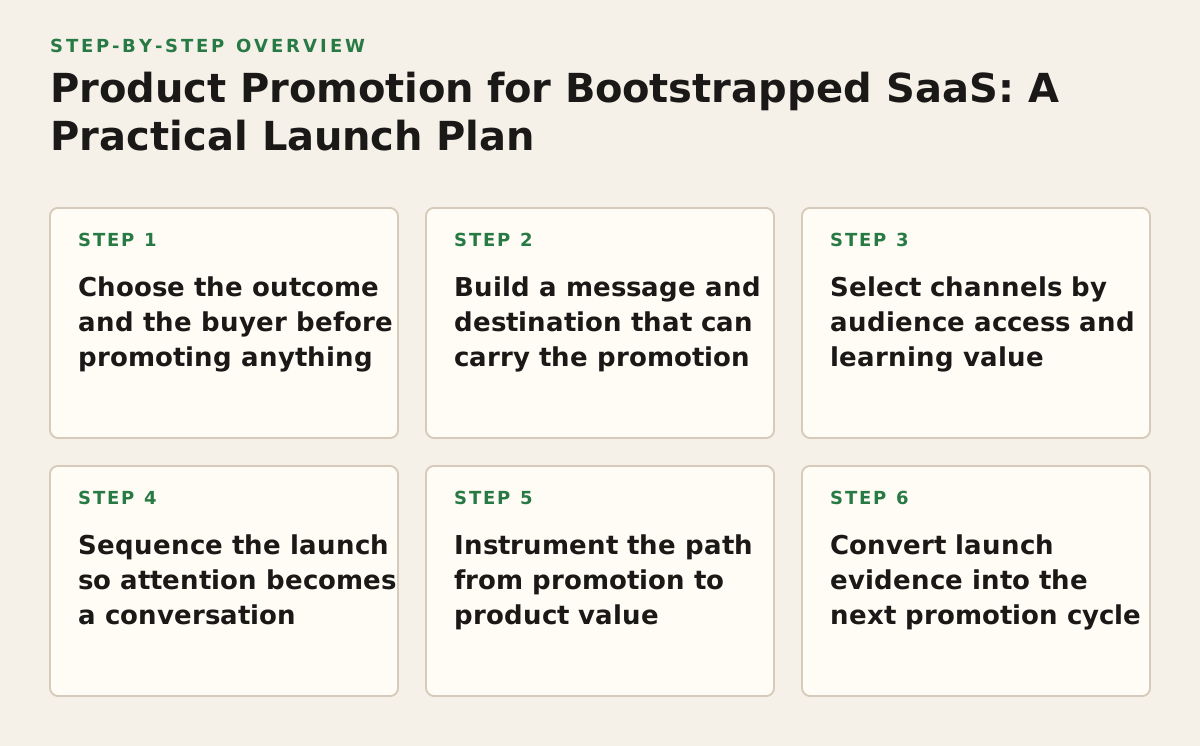
Step 1: Choose the outcome and the buyer before promoting anything
Start by deciding what this launch must prove. “Get more exposure” is too vague to guide a channel, page, or follow-up. A launch may instead be designed to collect five interviews, get the first ten teams to complete a workflow, validate a new use case, or generate a list of qualified prospects for a later sales process.
Write one launch hypothesis in this format:
We believe [specific audience] has [painful situation]. If we show them [promise and proof], they will [observable action] because [reason to believe].
For example: “We believe small design agencies lose time turning client notes into organized tasks. If we show agency owners how BriefFlow converts a meeting transcript into an editable project brief, they will import one real meeting and invite a collaborator because the output is easier to review than starting from a blank document.”
That statement gives you an audience, a problem, a mechanism, and an action. It also exposes weak positioning. “AI productivity tool for everyone” contains no useful targeting decision. “A transcript-to-brief workflow for small design agencies” gives you vocabulary, communities, search topics, examples, and objections to investigate.
Use a qualified action, not a vanity target
Choose one primary action and one learning action. The primary action should move a visitor toward product value; the learning action should help you understand why they did or did not move.
- Primary action: start a workspace, create a project, connect a data source, or request an invitation.
- Learning action: answer one short question after the action, such as “What were you trying to replace?”
- Quality signal: complete the product’s first valuable workflow rather than merely registering.
- Business signal: return, invite a teammate, book a relevant conversation, or ask about a paid plan.
Illustrative starting policy: use one primary action and one learning question for the first launch week. Adjust this when visitors complete the action but do not reach value, or when the question produces repetitive answers that fail to explain behavior. Do not add more goals simply because the first goal is difficult; first check whether the offer and onboarding make the intended action understandable.
Define who is not a fit as well. A product for agencies may not be ready for large enterprises with procurement requirements. A developer tool may need technical users who can install it, not general startup audiences. Exclusion improves promotion because a clear “not for” statement reduces unproductive signups and makes the right prospects feel recognized.
Step 2: Build a message and destination that can carry the promotion
Promotion cannot rescue an unclear landing page. Before distributing a link, make the destination answer four questions within a few seconds:
- Who is this for?
- What job does it help them complete?
- What changes after they use it?
- What should they do next?
Use a headline about the job, not the technology. “Turn customer interviews into searchable product evidence” is more useful than “An intelligent research workspace.” Then show the workflow: input, transformation, output, and next step. A short screen recording or annotated sequence can be more persuasive than a feature inventory because it lets the visitor judge whether the product fits their existing process.
Give the visitor a reason to believe you
Early products often lack a long customer list. That does not mean the page must rely on inflated claims. Use proof that is available and verifiable:
- A before-and-after example using realistic, clearly labeled sample data.
- A founder explanation of the problem and the product’s current boundary.
- A short quote from an actual early user, with permission and context.
- A public changelog showing how feedback changes the product.
- A transparent note about who should wait because a workflow is not supported yet.
Do not invent performance lifts, customer counts, integrations, security certifications, or market-wide claims. A limitation can increase trust when it prevents the wrong person from signing up. It also makes feedback more diagnostic: “I need an export” is more useful when you know whether the request comes from a target customer or a visitor who was never a fit.
Search can become a compounding distribution channel, but it is not a reason to fill a page with repeated phrases. Google’s SEO starter guide recommends making content understandable to search engines and useful to people; use that principle to create a page that explains the problem in the language of the buyer, with a descriptive title and clear structure. Google’s SEO Starter Guide is the relevant reference.
Worked example: turning a feature into a launch promise
Suppose an angel-funded founder has built a browser-based tool that turns support conversations into draft help-center articles. Weak promotion says:
“AI-powered knowledge management for modern teams.”
A stronger version identifies the buyer and the moment of pain:
“Turn resolved support conversations into reviewable help articles, so a small support team can reduce repeated explanations without publishing unedited AI output.”
The second message creates useful page sections: supported conversation formats, the review step, an example article, editorial controls, and a call to import one resolved conversation. It also suggests an appropriate audience: small support teams with repeated questions, rather than every company with a website.
Step 3: Select channels by audience access and learning value
Do not begin with a list of every channel you could use. Begin with where the target buyer already discusses the problem, makes purchasing decisions, or asks for recommendations. Each channel should have a job in the launch system.
| Channel type | Best use | Asset to prepare | Signal to inspect | Common failure |
|---|---|---|---|---|
| Founder or personal network | Warm introductions and candid feedback | Personal note with a precise ask | Replies from people who match the audience | Broadcasting to everyone without context |
| Relevant communities | Problem education and early discussion | Useful example, teardown, or question | Qualified conversations and referral visits | Dropping a link before contributing |
| Search content | Capturing recurring problem-led intent | Focused guide, comparison, or template | Relevant visits and activation over time | Writing broad articles unrelated to the product workflow |
| Launch directories | Concentrated discovery and founder feedback | Clear listing, demo, and feedback request | Fit of visitors and quality of comments | Optimizing for votes instead of product learning |
| Paid social or search | Testing a message after the destination is ready | One audience, one creative angle, one landing page | Qualified action at an acceptable test cost | Buying traffic before knowing what counts as value |
Use a channel only when you can explain the audience match and the next action. A channel that generates traffic but no product use may still provide message feedback, but it should not be described as acquisition success. Conversely, a small number of visits from a tightly matched community can reveal more than a large stream of casual clicks.
For paid campaigns, separate the learning budget from the growth budget. Illustrative starting policy: run one small, time-boxed message test rather than several simultaneous campaigns, and pause it if it produces visits without the chosen qualified action. The correct amount depends on your margins and the value of a customer. Adjust the policy when you have enough consistent conversion and retention data to compare audiences; before that, treat paid traffic as a controlled research expense, not proof of scalable demand.
When creating paid social campaigns, use the platform’s own objective and format guidance rather than assuming every placement behaves alike. Meta’s official ads guide is a useful reference for how campaign objectives and creative formats are organized. Meta Ads Guide supports the setup reference; it does not establish that a particular format will work for your product.
Prepare channel-specific versions of the same idea
The core promise should remain consistent, but the presentation should fit the context:
- Direct message: mention why you chose that person and ask whether the workflow matches their current process.
- Community post: lead with the problem and share a useful example before making the product invitation.
- Search page: answer the problem in depth and make the product’s role explicit without forcing a sales pitch.
- Launch listing: show the product’s current state, intended user, and the feedback you want.
- Paid creative: test one concrete outcome against one recognizable pain point.
Do not paste identical copy everywhere. Repetition can make a founder appear automated, while a modest adaptation demonstrates that you understand the audience’s context.
Step 4: Sequence the launch so attention becomes a conversation
A launch works better as a sequence than as one dramatic post. The sequence should move from private learning to public clarity, then from attention to follow-up.
- Prepare: verify the destination, event tracking, onboarding path, support response, and example data.
- Invite a small fit group: ask people who resemble the target buyer to try the workflow and identify confusion.
- Publish the public explanation: show the problem, product mechanism, current boundary, and primary action.
- Participate: answer questions, demonstrate the workflow, and record objections in the language people use.
- Follow up: thank participants, ask about the result they reached, and tell them what changed.
- Review: compare channel quality, activation, retention, and feedback themes before choosing the next promotion.
Illustrative starting policy: allow a few days for private preparation and a defined launch window for concentrated replies, then review the evidence within the following week. This is a coordination policy, not a universal timeline. Adjust it if your buying cycle is longer, if onboarding requires collaboration, or if support volume prevents thoughtful responses.
Ask for feedback that produces a decision
“What do you think?” creates vague praise. Ask questions that map to a product or marketing decision:
- What were you trying to complete when you opened the product?
- What did you expect to happen after the first click?
- Where did you stop, and what did you do instead?
- What would make this part of your weekly workflow?
- Who else would need to approve or use it?
Separate requests from evidence. One person asking for an unusual export does not automatically justify building it. Look for a repeated job, a target user, and a consequence if the job remains unsolved. Record the exact wording, but code it into themes such as “unclear setup,” “missing workflow,” “trust concern,” or “wrong audience.” That lets you decide whether to change copy, onboarding, product scope, or targeting.
Respond publicly where appropriate, but take sensitive account details into a private channel. A founder community can provide useful transparency; it should not become a support queue containing confidential information.
Step 5: Instrument the path from promotion to product value
At minimum, you need to know where a visitor came from, what they did, and whether the action led to value. Without that chain, you may optimize clicks while the product remains unused.
Use consistent campaign labels on links. Google Analytics documentation explains that UTM parameters can identify the campaigns sending traffic and appear in acquisition reporting; use the official guidance to standardize source, medium, campaign, and content values. Google Analytics campaign URL guidance is the reference for this setup.
A simple naming policy might be:
- Source: the platform or person sending the visitor.
- Medium: community, email, partner, organic, or paid.
- Campaign: the launch or experiment name.
- Content: the specific post, message, creative, or placement.
Keep the names readable. “community_launch_march” is easier to audit than a string of unexplained abbreviations. Use a spreadsheet or shared document as the source of truth so every founder, marketer, and partner uses the same labels.
Measure a funnel that matches an early-stage product
Track these stages separately:
- Reach: who could have seen the message.
- Visit: who arrived at the relevant destination.
- Intent: who clicked the primary action or requested access.
- Activation: who completed the first meaningful workflow.
- Retention: who returned or repeated the workflow.
- Conversation: who supplied useful context, referred a teammate, or entered a relevant sales discussion.
Define activation in product terms. For the transcript tool, activation might mean importing a transcript, accepting an extracted brief, and exporting or sharing it. A registration is not activation if the user never reaches the result that motivated the signup.
Illustrative starting policy: review the funnel daily during a concentrated launch and weekly afterward. Adjust the review cadence when traffic is sparse, the sales cycle is long, or support data arrives asynchronously. The important rule is to investigate changes in behavior rather than react to every fluctuation.
Use a diagnostic table when results are disappointing:
| Observed signal | Likely question | Next decision |
|---|---|---|
| Visits are low | Is the audience reachable, and is the distribution specific enough? | Change channel access or partner outreach before rewriting the product. |
| Visits are high but intent is low | Does the promise match the destination and audience? | Rewrite the headline, proof, or call to action. |
| Intent is high but activation is low | Does onboarding make the first workflow obvious? | Remove setup friction and clarify the first successful result. |
| Activation is high but return is low | Is the product solving a recurring job or only a one-time curiosity? | Improve repeat workflows, reminders, collaboration, or target a more frequent problem. |
| Feedback is enthusiastic but behavior is absent | Are people being polite, or is there a real cost to inaction? | Ask for a concrete trial, referral, payment discussion, or workflow evidence. |
Protect the data from false certainty. A small sample can reveal a serious usability problem, but it cannot establish a stable acquisition rate. Label early numbers as directional, keep the observation window visible, and avoid turning an illustrative threshold into a promise.
Step 6: Convert launch evidence into the next promotion cycle
The launch is complete only when you decide what to repeat, change, or stop. Create a short post-launch review containing the original hypothesis, channel data, activation notes, objections, and next experiment. This prevents the team from relying on the loudest comment or the most flattering screenshot.
Classify each observation into one of four actions:
- Keep: the audience, message, and workflow show alignment.
- Clarify: people appear interested but misunderstand the product or next step.
- Repair: the promise is credible, but onboarding or product behavior blocks value.
- Stop: the channel attracts the wrong audience or the use case lacks urgency.
Then choose one change for the next cycle. If the message attracts the right support leads but activation stalls at data import, improve import guidance before buying more traffic. If activation is strong among agencies but weak among general small businesses, narrow the audience and make the agency workflow more prominent. If one community produces thoughtful users and another produces only compliments, prioritize the former even if its raw reach is smaller.
Build reusable promotion assets without becoming repetitive
Each launch should leave behind assets that reduce the cost of the next one:
- A one-sentence positioning statement for introductions.
- A product demonstration using realistic sample input and output.
- A list of objections with approved, honest answers.
- A set of tagged links that preserve channel attribution.
- A short case narrative showing the problem, workflow, and result.
- A changelog entry explaining what feedback influenced.
Refresh the example when the product changes. An outdated demo creates a mismatch between promotion and experience, which can look like a trust problem even when the underlying product is improving.
Make the page and assets usable by people with different access needs. The Web Content Accessibility Guidelines provide testable guidance for perceivable, operable, understandable, and robust content; use the W3C standard when reviewing text alternatives, keyboard access, contrast, and form labeling. WCAG 2.2 is the authoritative reference. Accessibility is not merely a reach tactic: a confusing form or unlabeled control can block the exact user whose feedback you need.
Keep a record of the date and context for every claim. In 2026, a launch page that says “new” without a date quickly becomes misleading. Add “updated” dates when the content materially changes, and distinguish current product behavior from planned work. Investors, early adopters, and prospective customers all make better decisions when the product’s present state is visible.
What to do first: write the launch hypothesis and one qualified ask
Open a document today and write the audience, painful situation, product mechanism, primary action, and reason to believe in five lines. Then send that draft to three people who match the intended buyer, asking them what they think the product helps them do and where the explanation feels unclear. Do not send a broad announcement until their answers let you state the promise without jargon.
After that, prepare one destination page, one measurable call to action, and two channel-specific messages. Label the links, define activation, and schedule a review that will force a decision about what to keep or change. When the page is ready, you can submit your product launch and put it in front of an early-stage founder audience that understands the difference between visibility and useful product feedback.
SuperPublic is built for indie-only launches from bootstrapped, pre-seed, and angel-funded founders, helping teams present new products, discover other early-stage tools, and connect with peers. For a focused place to share the next iteration, explore SuperPublic.
Authored with NotFair SEO