Founder field note
Product Launch Press Release: A Practical Guide for Indie Founders
Product launch press release guide for indie founders: choose a news angle, write proof-led copy, distribute it, and measure qualified interest from launch day.
A product launch press release is not a longer version of your landing page. It is a compact decision tool for editors, early adopters, investors, and potential users who need to understand what changed, why it matters now, and whether your product deserves attention. For a bootstrapped founder, the job is not to sound like a public company. The job is to choose a credible news angle, support it with usable evidence, and put the announcement where the right people can act on it.
This guide helps you decide whether a press release is the right launch asset, what to include, how to avoid unsupported claims, and how to connect distribution to measurable interest. The examples use an illustrative SaaS product called RelayNote, a lightweight workspace for turning customer interviews into searchable product insights. Adapt the structure to your own software, AI tool, API, or developer product.
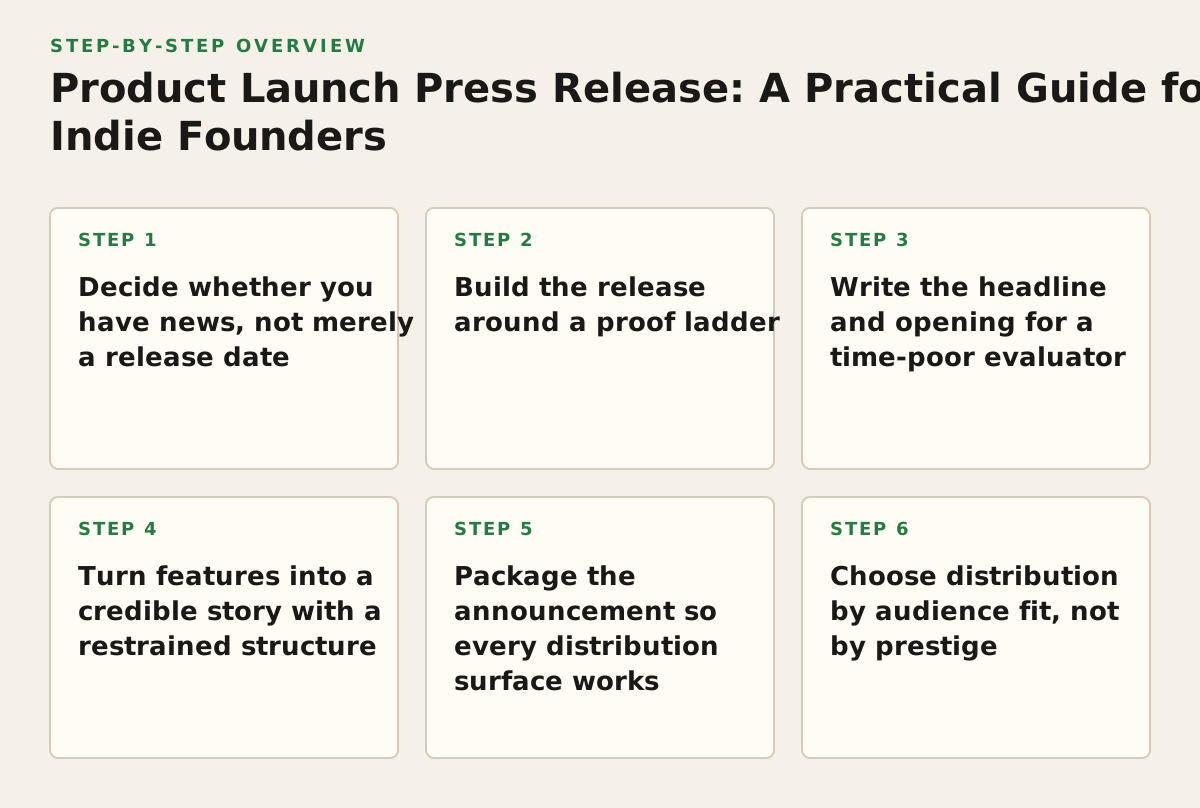
1. Decide whether you have news, not merely a release date
When it applies: Use a press release when you can explain a meaningful change in the market, a customer workflow, or a product category. If the only announcement is “our website is live,” a launch post, founder note, demo, or community submission may be more useful. A release becomes worthwhile when an outside reader can understand why this moment deserves attention.
Why it works: Journalists, curators, early adopters, and investors all face a filtering problem. A clear news angle gives them a reason to spend time on the announcement. It also forces you to distinguish the product from a generic list of features. The strongest angle usually connects four elements: a specific audience, a costly or frustrating problem, a new approach, and a timely reason to care.
Choose one primary angle
- New product: a product is now available to a defined audience.
- Major capability: a meaningful workflow has changed, rather than a minor interface adjustment.
- Founder or market response: the product addresses a visible shift in how a niche team works.
- Availability change: a private beta, waitlist, or limited test has become accessible to a broader group.
- Evidence-led announcement: a credible pilot, open-source release, research artifact, or customer story supports the news.
Do not combine all five into one headline. A release that tries to announce a launch, funding, a partnership, a new integration, and a grand mission usually gives readers no clear reason to click.
Failure mode: Founders describe the product as “revolutionary,” “the future of work,” or “the only tool you need.” These claims are difficult to verify and make a small launch sound less trustworthy. Replace adjectives with a concrete change in behavior.
Implementation example: RelayNote should not lead with “RelayNote revolutionizes customer research.” A sharper angle is: “RelayNote launches a searchable workspace that turns interview notes into linked product evidence for small software teams.” The angle identifies the user, the workflow, and the change without pretending to own an entire category.
2. Build the release around a proof ladder
When it applies: Use a proof ladder when your product is early and you do not yet have large customer numbers, famous logos, or impressive revenue metrics. Early-stage founders often think they have no proof because they lack scale. In practice, they may have demonstrations, transparent constraints, user observations, or a founder with unusually relevant experience.
Why it works: A reader needs enough evidence to believe the announcement, but not a dense investor deck. Arrange proof from easiest to verify to hardest to claim. This makes the release persuasive without forcing you to invent certainty.
Use evidence in descending order of reliability
- Observable product proof: a short demo, public changelog, screenshots, documentation, or an accessible workflow.
- Specific user problem: a clearly described job, delay, error, or workaround experienced by the intended audience.
- Founder context: relevant experience that explains why your team noticed the problem.
- Attributed feedback: a quote from a named customer or tester who has approved its use.
- Measured outcomes: only figures with a defined population, period, method, and permission to publish.
Each proof item should answer a different objection. A demo answers “does it exist?” A workflow example answers “how would I use it?” A customer quote answers “does anyone care?” A measured outcome answers “what changed?” Do not use one vague testimonial to answer all four.
For search visibility, make the announcement useful to a human before optimizing it for a crawler. Google’s guidance says content should be created primarily to help people and should demonstrate original value, first-hand expertise, or substantial coverage rather than being produced mainly to attract search traffic. See Google’s official guidance on creating helpful content. That principle matters for a press release because copied launch language creates little reason for anyone to cite, share, or revisit it.
Failure mode: A founder includes an unsupported statistic such as “teams save 40% of their research time.” Without a defined sample, baseline, method, and permission, the number creates more risk than credibility. Say what you directly observed instead, or omit the claim.
Implementation example: RelayNote can show a two-minute recording of importing an interview transcript, tagging a theme, and linking it to a roadmap item. Its founder can explain that the product came from repeatedly losing evidence across documents. If a tester approves a quote, include the person’s name, role, and organization; otherwise use an unattributed observation and label it as such.
3. Write the headline and opening for a time-poor evaluator
When it applies: This principle applies whenever your announcement may be skimmed in an inbox, community feed, launch directory, social post, or search result. Early adopters and startup investors do not need your entire origin story before they know what launched. Put the decision-making information first.
Why it works: A useful headline reduces interpretation cost. A useful opening paragraph lets someone decide whether to continue, share, request access, or ignore the story. The headline should state the event and audience. The first paragraph should establish the product, problem, availability, and most defensible differentiator.
Use this four-part opening formula
- Event: what is launching, opening, or changing?
- Audience: who is it for?
- Problem: what specific job or frustration does it address?
- Action: where can a reader try, learn, request access, or contact the founder?
A practical headline pattern is: [Product] launches [specific capability] for [specific audience]. A practical opening pattern is: [Company or founder] today announced [product and availability], a [category] for [audience] that helps them [job]. Unlike [common workaround], it [specific difference]. [Call to action].
Use a subhead when the headline needs context, but do not make it a second slogan. Keep the language plain enough for someone outside your niche to understand while retaining the words your target users actually search for, such as “AI meeting notes,” “developer documentation,” or “customer feedback repository.”
Failure mode: The opening begins with four paragraphs about the founder’s childhood, a broad market prediction, or an abstract mission. Those details may belong later. If the reader cannot tell what is available by the end of the first paragraph, the release is making them work too hard.
Implementation example: “RelayNote today announced general availability of its customer-research workspace for small software teams. The product lets founders turn interview transcripts into searchable themes and link those themes to roadmap decisions, replacing scattered notes across documents. Teams can view the workflow and request access at [URL].” This is specific without claiming market leadership or unverified results.
4. Turn features into a credible story with a restrained structure
When it applies: Use a structured release when the product has more than one important workflow, such as a SaaS platform with onboarding, collaboration, and export features. The structure helps readers understand sequence: problem, product, evidence, access, and next step.
Why it works: Features become persuasive when connected to consequences. “AI summaries” is a feature. “A founder can review recurring objections before deciding what to build next” describes a job. A release should make that chain visible without becoming a product manual.
Recommended release architecture
- Headline and subhead: state the news and the audience.
- Dateline and opening: identify the company, location if relevant, date, product, and availability.
- Problem paragraph: describe the costly workaround in concrete terms.
- Product paragraph: explain the smallest set of capabilities that solves the problem.
- Use-case bullets: show two or three workflows, not a feature inventory.
- Evidence paragraph: include a demo, customer quote, founder context, or appropriately qualified data.
- Founder quote: explain the decision or insight behind the launch, not just enthusiasm.
- Availability paragraph: explain who can use it, where to start, and any real limitation.
- Boilerplate and contact: describe the company in one factual paragraph and provide a reachable contact.
Keep the founder quote useful. “We are thrilled to empower the next generation” could describe almost any startup. “We built RelayNote after seeing roadmap decisions separated from the interviews that justified them” explains the product’s origin and gives the reader a reason to remember it.
Include a short list when the product has several workflows that are easier to scan than to describe in prose:
- Capture interview notes from a transcript or manual entry.
- Group repeated themes and attach supporting excerpts.
- Link a theme to a roadmap decision for later review.
Failure mode: The release turns into a disguised landing page with every feature, pricing tier, integration, and future ambition. This buries the announcement and creates claims you may not be ready to support. Link to detailed documentation instead of forcing all information into the release.
Implementation example: RelayNote’s release can describe one end-to-end workflow and three use cases: synthesis after customer interviews, evidence for roadmap reviews, and a searchable archive for a growing founder team. It should avoid promising that every team will make better decisions; it can accurately explain how the workflow is designed to support those decisions.
5. Package the announcement so every distribution surface works
When it applies: This principle applies when the release will be shared through your website, email, founder communities, social networks, launch directories, and direct outreach. Each surface gives you different space and context, so the release needs a stable source page plus concise adaptations.
Why it works: A stable announcement page gives interested people somewhere to verify the details. A short social post earns the click. A direct note gives a relevant curator or journalist a reason to care. Treating every channel as a copy-paste destination usually produces truncated headlines, missing context, or links that cannot be attributed.
Use descriptive page metadata and a share preview that accurately represents the announcement. The Open Graph protocol documents standard metadata such as title, description, URL, and image for representing a page when it is shared; see the official Open Graph protocol documentation. These fields do not replace a good announcement, but they help the shared link communicate the same story as the page.
Social previews can have platform-specific requirements. X documents its Cards system for attaching richer content to links shared on its platform in the official X developer documentation. Check the current platform documentation before assuming a preview will display exactly as it does in your CMS.
Create a small launch asset set
- Canonical page: the complete announcement with one primary call to action.
- Founder post: the personal reason for building it and the clearest lesson.
- Short social version: one problem, one product distinction, and one link.
- Community submission: audience-specific context, launch status, and what feedback you want.
- Direct outreach note: a tailored reason the recipient may find the launch relevant.
- Demo asset: a short recording or annotated screenshots that prove the workflow.
Failure mode: The founder sends the same press-release paragraph to every person and community. Recipients cannot tell why they were contacted, and the message sounds automated. Preserve the facts, but change the lead: a developer community may care about implementation, while an indie-founder community may care about the workflow and feedback request.
Implementation example: RelayNote’s canonical page explains the product. Its founder post explains the repeated problem of disconnected interview evidence. A community submission asks for feedback on the tagging workflow. A direct note to a product-operations writer points to the shift from unstructured interviews to traceable roadmap evidence. All four link to the same source page.
6. Choose distribution by audience fit, not by prestige
When it applies: This principle is for founders deciding between a launch directory, founder community, email list, niche publication, social network, partner channel, or paid distribution service. A bootstrapped product rarely benefits from being everywhere at once. It benefits from being visible where a qualified person already has a reason to look.
Why it works: Distribution is a relevance problem. A small group of people who experience the problem can provide better feedback and more useful referrals than a large untargeted audience. The channel should match the job you need done: discovery, feedback, credibility, signups, customer conversations, or investor awareness.
| Launch objective | Best starting surface | Message emphasis | Useful signal | Common mistake |
|---|---|---|---|---|
| Get qualified early adopters | Niche community, founder network, or launch directory | Who it is for and what feedback is wanted | Relevant visits, replies, demos, or activated users | Chasing broad reach without an onboarding path |
| Earn editorial attention | Targeted individual outreach | Why the product is timely and independently interesting | Responses, interviews, citations, or requests for detail | Sending a mass email with no audience fit |
| Support search discovery | Canonical announcement and useful product page | Plain-language problem and product category | Indexed page, relevant queries, and engaged visits | Repeating keywords or publishing thin copy |
| Learn whether the message converts | Founder posts and tagged campaign links | One clear promise and one action | Visits, signup starts, completed actions, and replies | Using one untagged URL everywhere |
| Reach a technical audience | Developer community, documentation, or technical post | Architecture, workflow, limitation, or integration detail | Technical questions, trials, and qualified referrals | Replacing useful implementation detail with slogans |
For a launch directory or founder community, write an explicit feedback request: “Tell us where this workflow breaks for your team,” is more actionable than “Would love your thoughts.” SuperPublic is designed for bootstrapped, pre-seed, and angel-funded founders who want to submit launches, discover early products, and connect with other founders. When the platform matches your audience and objective, submit your product launch rather than treating submission as a substitute for product work.
Failure mode: The founder pays for distribution before identifying the audience, message, or conversion path. Paid reach can amplify ambiguity. Start with a channel where you can observe questions and objections, then spend only when you know what the added distribution is meant to accomplish.
Implementation example: RelayNote can begin with a targeted founder community post and direct outreach to people responsible for product discovery. If readers repeatedly ask whether the tool supports a particular input format, that objection should improve the page and demo before the founder expands distribution.
7. Measure qualified interest without mistaking attention for traction
When it applies: Use measurement whenever you distribute the release through more than one channel or need to decide what to repeat. The objective is not to create a vanity scoreboard. It is to learn which audience, message, and action deserve another iteration.
Why it works: A launch has multiple stages: someone sees the announcement, visits the page, understands the offer, starts the next action, completes it, and possibly returns. Measuring only page views hides where the message fails. Measuring only signups can hide low-quality acquisition or confusing onboarding.
Define the event chain before publishing
- Exposure: where was the announcement shown?
- Visit: did the person reach the canonical page?
- Intent: did they click the demo, documentation, signup, or contact action?
- Completion: did they finish the selected action?
- Qualification: does the person match the intended audience?
- Learning: what question, objection, or use case appeared repeatedly?
Use separate tagged links for each meaningful distribution source. Google Analytics documents campaign URL parameters such as source, medium, and campaign name in its official guide to campaign URL builders and tagging. Tagging does not prove that a channel caused a signup, but it gives you a more useful starting point than one identical link pasted everywhere.
Use a simple naming policy. An illustrative starting policy for a 2026 launch might be source=founder-community, medium=organic, and campaign=relaynote-launch. This is a naming example, not a universal analytics standard. Keep it lowercase, stable, and understandable six months later.
Review qualitative signals alongside analytics:
- Which words did prospects use when describing the problem?
- Which part of the release caused people to ask a follow-up question?
- Did visitors understand who the product was for?
- Were people asking for access, a demo, documentation, or proof?
- Did the announcement attract the intended users or a different audience?
Failure mode: The founder declares success because a post received attention, even though the visits came from people who could never use the product. The reverse failure also happens: a small launch is dismissed despite producing several detailed conversations with ideal users. Classify outcomes by relevance and next action, not volume alone.
Implementation example: RelayNote tags links from its founder post, a community submission, a newsletter, and direct outreach. After launch, the founder compares qualified conversations and completed trials, then records the most common objection. If the community produces fewer visits but more useful workflow feedback, it may be the better learning channel even if it is not the largest traffic source.
8. Add trust controls before the announcement leaves your desk
When it applies: Use these controls when the release includes customer names, quotes, AI capabilities, performance claims, security language, partner references, or availability details. Early-stage teams move quickly, but an avoidable exaggeration can damage the trust the announcement was meant to create.
Why it works: A release is often copied, forwarded, indexed, and quoted outside its original context. Clear attribution and precise language survive that reuse better than promotional claims. Trust also lowers the work required from a potential user or editor who wants to verify what you said.
Run a pre-publication claim audit
- Availability: Is the product actually accessible at the stated URL and to the stated audience?
- Capability: Does the current product perform the described workflow, or is it planned?
- Evidence: Can every number, quote, logo, and outcome be supported?
- Attribution: Has each quoted person approved the wording and identification?
- Comparison: Does “unlike” describe a real difference without making an unfair universal claim?
- AI language: Are limitations, human review, and uncertainty described where they affect the user’s decision?
- Contact: Can a reader reach a real person who can answer follow-up questions?
Use “designed to,” “supports,” or “helps” when describing the intended function, not a guaranteed outcome. Use “currently available,” “limited access,” or “public beta” only when those labels accurately describe the experience. If a number matters, define its time period and method in the same paragraph or link to the supporting material.
Failure mode: A founder lets a partner logo, customer quote, or “secure” claim into the release before receiving approval or confirming the underlying statement. Remove it until the evidence and permission exist. A shorter accurate release is stronger than a more impressive release that needs a correction.
Implementation example: RelayNote can say that its workflow helps teams organize interview evidence. It should not say that it eliminates research bias or guarantees better roadmaps. If its AI feature can misclassify themes, the product page and release should make the review step clear so prospective users can evaluate the trade-off.
9. Execute the launch as a sequence of small, observable actions
Use the following implementation plan for a 2026 launch. The timing is an illustrative starting policy, not a universal benchmark; adjust it to your product maturity, audience, and available founder time.
- Define the launch decision. Write one sentence stating what is new, who it serves, and what action you want. If the sentence needs several “and” clauses, choose a narrower angle.
- Inventory your proof. Collect the demo, documentation, founder context, approved quotes, and measured evidence you can genuinely publish. Mark unsupported claims for removal rather than trying to strengthen them with adjectives.
- Select the first audience. Choose the group most likely to experience the problem and give useful feedback. Decide whether the first goal is discovery, conversations, trials, or credibility.
- Draft the announcement. Write the headline, opening, problem, workflow, proof, quote, availability, boilerplate, and contact details. Keep the main story focused on one news angle.
- Build the source page. Add the canonical URL, clear call to action, accurate share metadata, demo or documentation, and any limitation a reasonable evaluator needs to know. The page should stand on its own if every social post disappears.
- Prepare channel-specific versions. Create a founder post, community submission, direct outreach note, and tagged link for each meaningful source. Change the framing for the audience while keeping the underlying facts consistent.
- Run the claim and link audit. Test the product path, CTA, tracking parameters, share preview, contact address, and quoted material. Ask one person unfamiliar with the product to explain what they think launched.
- Publish to the best-fit surfaces. Start with the audience closest to the problem. Invite a specific form of feedback and respond publicly where appropriate; thoughtful replies often reveal better positioning than another slogan.
- Review behavior and language. Separate relevant visits from general attention. Record questions, objections, requested use cases, and completed actions. Do not rewrite the entire strategy because of one outlier comment.
- Make one evidence-led follow-up. Improve the headline, demo, FAQ, or onboarding based on repeated evidence. Then distribute the improved explanation to the next appropriate audience rather than reposting the original unchanged.
The practical recommendation is to treat a product launch press release as the source of a coordinated launch system, not the launch itself. Make one defensible announcement, adapt it to the communities where indie founders and early adopters already look for products, and measure qualified conversations before you buy reach. SuperPublic gives early-stage founders a relevant place to put that work in front of other builders and product seekers; use SuperPublic when you are ready to make your launch discoverable.
Authored with NotFair SEO