Founder field note
Product Launch Marketing: A Practical Playbook for Bootstrapped Startups
Product launch marketing for bootstrapped startups: plan positioning, recruit early users, choose channels, measure demand, and improve your launch.
Product launch marketing is the system that turns a finished product into a clear promise, a reachable audience, and a measurable stream of useful conversations. For a bootstrapped founder, the goal is not to create the loudest launch; it is to secure enough qualified attention to learn who cares, why they care, and what prevents them from trying the product.
This guide gives you a practical launch sequence: define one audience and outcome, prepare evidence, recruit an initial group, publish across a small number of channels, measure behavior rather than applause, and follow up while the problem is still fresh. You will finish with a launch brief, channel plan, message library, tracking sheet, and follow-up routine that a solo founder or small pre-seed team can actually operate.
Choose the narrow problem and launch outcome
Start with a decision, not a campaign calendar. A product launch becomes difficult when the audience, problem, and desired action are all broad. “We help businesses use AI” cannot tell you whom to contact, what demonstration to create, or which feedback matters. A more useful launch statement identifies a group, a painful job, and a next action.
Use this format:
- Audience: a group with a recognizable situation, such as independent consultants preparing proposals.
- Problem: the costly or frustrating task they currently handle manually.
- Promise: the specific improvement your product is designed to create.
- Action: the behavior you want after someone sees the launch, such as starting a workspace, booking a conversation, or joining a private beta.
- Learning goal: the uncertainty you want to reduce, such as whether the problem is urgent enough to change tools.
Your outcome should be behavioral. “Get attention” is not an outcome. “Get qualified operators to create a workspace and complete the first workflow” is. If the product is not ready for broad use, the outcome might instead be “collect ten conversations with people who currently use a workaround.”
Worked example: a small localization tool
Imagine a bootstrapped product that helps software teams localize customer-facing documents. Its first audience is not “global companies.” It is small SaaS teams preparing their first international sales or support materials. Its first launch promise could be: “Prepare a translated sales deck without rebuilding every slide by hand.” The desired action is a sample translation request or a guided product trial.
That framing changes the launch assets. You need a before-and-after deck, a short explanation of layout preservation, and a clear answer to “What files can I use?” You do not need a general essay about the future of language technology.
For a launch presentation that must reach international audiences, translate PowerPoint presentations helps you prepare localized slides while preserving the slide layout; the practical use is to adapt the exact deck you will show prospects rather than describing localization abstractly.
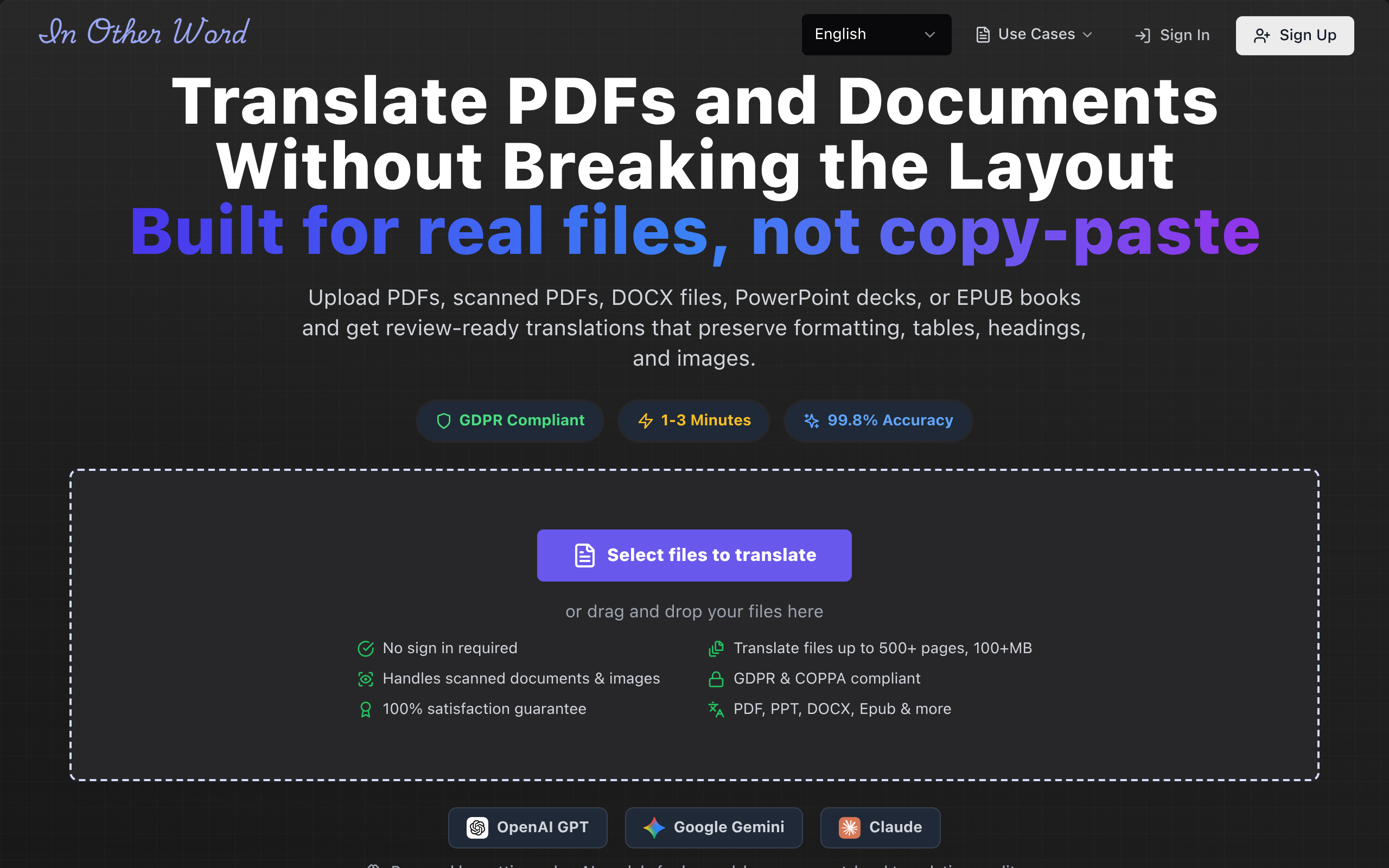
Write down the outcome before choosing a channel. A launch page, founder post, community listing, email, or paid campaign is only useful when it moves the selected audience toward that outcome.
Pitfalls to remove before promotion
- Do not target several unrelated customer types because each one “could use” the product.
- Do not make a waitlist the primary goal if the product is ready for people to use now.
- Do not promise an outcome your onboarding cannot support.
- Do not call every visitor a qualified lead; record the job they were trying to complete.
Illustrative starting policy: choose one primary audience, one primary action, and one learning question for the first launch cycle. Adjust that policy when conversations consistently reveal two genuinely different jobs, or when the chosen audience repeatedly completes a different action than the one you planned.
Build the proof and conversion path before announcing
Attention leaks when the announcement is stronger than the destination. Before posting, make the path from claim to evidence to action obvious. A visitor should be able to answer four questions quickly: what is this, who is it for, why should I believe it, and what happens if I click?
Your launch page does not need to be elaborate. It does need to be specific. Include:
- A headline naming the audience and job, not merely the product category.
- A short demonstration showing the workflow from input to result.
- One concrete example, screenshot, sample, or customer quote that supports the promise.
- A description of what happens after signup, including any manual or invitation step.
- A primary call to action that matches your launch outcome.
- A fallback contact option for people who have questions before trying the product.
Evidence should answer objections, not decorate the page. If a prospect worries that setup will take too long, show the setup. If they worry that the result will need heavy editing, show the result and the remaining human work. If they worry about giving you an important file, explain what the user should and should not upload without making unsupported security claims.
Use a message hierarchy:
- Job: “Prepare a localized sales deck for a new market.”
- Mechanism: “Upload the source file, review the translated content, and export the adapted presentation.”
- Proof: a short screen recording or sample showing the process.
- Action: “Try one presentation” or “Request an assisted setup.”
Make the page findable without turning it into a keyword pile
Search traffic can compound, but a launch page should still be written for a person who has a job to complete. Google’s SEO guidance recommends descriptive titles, useful content, and clear organization rather than writing for search engines alone; see the Google Search Central SEO Starter Guide. In practice, put the audience, problem, and product category in natural language, then answer the questions that would stop a qualified visitor from trying.
Create separate pages only when the intent is genuinely different. A page for “translate a sales presentation” may deserve a different example and call to action from a page for “localize customer support documents.” Duplicating one page with a changed keyword creates maintenance work without clarifying the product.
Use a launch-readiness check
- Can a first-time visitor explain the product after reading only the headline and first paragraph?
- Does the demonstration show the important moment, rather than only a dashboard?
- Is the call to action available without a sales conversation if the product is self-serve?
- Are limitations and manual steps visible before signup?
- Does the thank-you or welcome screen tell the new user what to do next?
Illustrative starting policy: ask three people who resemble the target audience to explain the page and next step without your help. Treat repeated confusion about the audience, promise, or action as a rewrite signal. Adjust the policy upward when the product is complex, expensive to adopt, or used by more than one role.
Recruit a small launch group before public distribution
A public announcement is a poor substitute for relationships. Before launch day, recruit people who can provide one of three things: a relevant use case, a credible observation, or access to other people with the same problem. The best early participants are not simply friends who will be polite. They have a current workflow that your product might improve.
Build a small prospect list from places where your audience already explains its work: founder communities, professional groups, niche newsletters, customer interviews, personal networks, and product discovery platforms. Contact people with a specific reason for reaching out. Mention the workflow you believe they have, show the smallest useful preview, and ask for a bounded response.
A good invitation might say:
“I’m preparing a tool for small SaaS teams that need to adapt sales presentations for a new market. I noticed you recently published materials for customers in two regions. Could I show you a two-minute workflow and ask where the process currently breaks? I’m looking for criticism, not a commitment to buy.”
Ask for a behavior or observation, not generic feedback. “What do you think?” produces opinions. “Which step would you avoid?” or “What do you use today when this file needs another language?” produces evidence about the existing workflow.
Separate participants by their job
| Participant type | What to ask for | Useful signal | Follow-up action |
|---|---|---|---|
| Potential user | Try the core workflow with a real or representative task | Where they stop, hesitate, or improvise | Fix the highest-friction step or clarify the promise |
| Practitioner with an audience | Critique the message and share it only if relevant | Whether they can name the right recipient | Rewrite the hook or provide a more specific example |
| Peer founder | Challenge the launch plan and measurement | Unnoticed assumptions about channel or readiness | Remove activities that do not produce learning |
| Early adopter | Compare the product with the current workaround | Why switching is or is not worth the effort | Improve onboarding, migration, or proof |
Do not manufacture enthusiasm with incentives you cannot sustain. A personal walkthrough, early access, or the chance to shape the workflow may be appropriate, but describe the arrangement honestly. If you publish a testimonial or recommendation tied to a material relationship, follow applicable disclosure rules. The U.S. Federal Trade Commission’s endorsement guidance explains why endorsements should not mislead people about the relationship or experience behind them.
Illustrative starting policy: recruit 10–20 relevant contacts before the public announcement and aim for several completed conversations rather than a fixed number of compliments. Adjust the range when the audience is unusually narrow, the workflow requires substantial setup, or participants are not reaching the core action.
Select channels by mechanism, not popularity
Every channel has a different mechanism. A founder post can create conversation and referral. A product directory can help people already browsing for tools. Search can capture an existing problem. Email can reactivate people who already gave permission to hear from you. Paid distribution can buy controlled exposure, but it cannot repair unclear positioning.
Choose a primary channel and one supporting channel for the first cycle. Score each candidate against four questions:
- Audience fit: do the people who can use the product actually spend attention there?
- Context fit: can you explain the problem naturally in that environment?
- Feedback quality: will replies reveal intent and objections, or only produce passive impressions?
- Operational cost: can you respond promptly and follow up without neglecting the product?
For SuperPublic’s audience, a product discovery submission can be one part of the launch system, especially when the objective includes finding early adopters and meeting other founders. You can submit your product launch when the page, demo, and follow-up path are ready. Treat the listing as a doorway to learning, not as a complete distribution strategy.
Match the message to the channel
On a founder community, explain the decision or painful trade-off behind the product. In a product directory, make the category and immediate value easy to scan. In a private email, personalize the reason you selected that person. In search content, answer a concrete task with enough detail to be useful even before signup.
Repurpose the underlying proof, not the exact copy. One product demonstration can become a short founder post, a visual comparison, a help article, and a direct message reference. The opening should change because the reader’s context changes.
If you use links in email or social posts, apply consistent campaign labels. Google’s official Campaign URL Builder provides fields for adding campaign parameters to URLs. Use a naming convention that records source, medium, campaign, and creative; otherwise, your analytics will contain a pile of inconsistent labels that cannot be compared later.
Do not buy reach before earning clarity
Paid promotion is most useful when you already know which audience and message deserve more exposure. Start with a small, controlled experiment only after the landing page has a clear action and the conversion event is recorded. If visitors click but do not complete the action, buying more traffic amplifies the gap.
Illustrative starting policy: use one primary and one supporting channel for the first two-week launch cycle, and publish two or three distinct message angles. Adjust when one channel produces qualified conversations while another produces only low-intent traffic, or when response volume exceeds your ability to follow up.
Run the launch as a sequence of moments
A launch is easier to manage as a sequence than as one dramatic announcement. The sequence gives people multiple chances to understand the product and gives you time to fix issues before more attention arrives.
- Preparation: confirm the page, analytics, onboarding, demo, support answer, and contact list.
- Private preview: share with selected participants and record objections, not just praise.
- Revision: update the headline, demonstration, onboarding, or FAQ based on repeated friction.
- Public release: publish the clearest version through the primary channel and respond while activity is fresh.
- Proof follow-up: share a useful example, answer recurring questions, and invite qualified people to try.
- Review: compare behavior by source and decide whether to improve, repeat, or stop the channel.
Prepare a response bank before publishing. It should contain short, truthful answers to the questions that will otherwise consume the entire launch day:
- Who is the product not for?
- What does a new user need before starting?
- Which part of the workflow is automated and which part requires review?
- Can someone test it with a small or non-sensitive example?
- What happens after the initial action?
- How can a user report a problem or request an improvement?
Keep the launch conversation useful
Respond to comments with specifics. If someone asks whether the tool supports a workflow, answer the workflow question and link to the relevant proof. If the answer is no, say so and record the request. A candid limitation can qualify the audience better than a vague claim.
When someone signs up, do not immediately ask for a review. First help them reach the moment where the product’s value can be judged. A useful follow-up asks what they were trying to complete, what they expected, and where they stopped. That information is more valuable than a rating detached from context.
Speed matters because context decays, but speed does not mean sending more messages. Set a response window that you can maintain during the launch. If you are solo, make the launch smaller rather than promising real-time support you cannot provide.
Illustrative starting policy: schedule a private preview 3–7 days before public release and reserve the launch day plus the following 48 hours for replies and fixes. These are starting policies, not universal benchmarks. Adjust based on how long users need to complete the core workflow and how quickly you can distinguish a product defect from a confused visitor.
Measure the funnel and turn evidence into the next iteration
Measure the path from exposure to meaningful use. A useful launch dashboard does not need dozens of metrics. It needs enough detail to identify where qualified people disappear.
| Stage | Question | Example event | Decision if weak |
|---|---|---|---|
| Reach | Did the intended audience encounter the message? | Qualified views or visits by source | Change the channel or audience targeting |
| Intent | Did the message earn a next action? | Click, signup, reply, or demo request | Rewrite the hook, proof, or call to action |
| Activation | Did the person reach the product’s first value moment? | Completed core workflow | Fix onboarding, setup, or unclear instructions |
| Quality | Was the user in the intended audience? | Role, use case, or problem recorded in a note | Narrow the message or qualify earlier |
| Continuation | Is there a reason to return or continue? | Second meaningful task or follow-up conversation | Improve the next step and outcome visibility |
Track source consistently. The source tells you where the visit came from; the message tells you what promise attracted it; the event tells you what happened afterward. Keep those dimensions separate so a high-performing message is not mistaken for a high-performing channel.
Google Search Console’s Performance report documentation describes how search data can be reviewed through measures such as queries, clicks, impressions, and click-through rate. Use those signals to identify search questions that deserve a better page, but do not treat impressions as product demand. A search impression is an opportunity to be seen, not evidence that someone has the problem urgently.
For paid acquisition, configure the event that represents real progress rather than optimizing around a shallow click. Google Ads’ conversion tracking documentation explains the role of conversion actions in measuring valuable customer activity. Choose an event your team can define consistently, such as a completed setup or qualified request, and verify that it fires once under the intended conditions.
Diagnose the shape of the failure
- Low qualified visits: the channel or audience selection is wrong, regardless of attractive creative.
- Many visits, few actions: the page may be unclear, the promise may be weak, or the action may ask for too much.
- Many signups, little activation: the acquisition message may be overpromising or onboarding may be too difficult.
- Activation without continuation: the product may solve a one-off task without making the next useful step visible.
- Positive replies without usage: people may like the concept but lack urgency, access, or confidence to switch.
Use qualitative notes alongside counts. Record the exact words prospects use for the problem, what they compare you with, and the moment they hesitate. A spreadsheet with a row per conversation can reveal a pattern that aggregate analytics hide.
Illustrative starting policy: review the funnel once after the private preview and again after the public cycle, using the same event definitions each time. Adjust the review cadence when traffic is high enough to create frequent decisions, or when the product has a long adoption cycle that makes immediate activation misleading.
Follow up, document the learning, and choose the next bet
The launch is not complete when the announcement stops circulating. Its commercial and product value comes from what you do with the people who showed intent. Send a context-specific follow-up: help the user finish the task, summarize a fix, ask permission to schedule a conversation, or explain why the product is not yet a fit.
Segment follow-up by behavior:
- People who visited but did not act need clearer proof or a lower-friction next step.
- People who signed up but stopped need help at the exact blocked step.
- People who completed the workflow need a reason to repeat it or share the result.
- People who requested an unsupported feature need a timeline only if you can responsibly provide one.
- People outside the audience should not be pushed through a sales sequence simply because they clicked.
Publish an honest update when the learning is useful to the community. Explain what changed, which workflow you now support better, and who should try it. This creates a second reason to contact the market without pretending that every iteration is a major launch.
Create a one-page launch record
Archive the launch while details are available:
- Original audience, problem, promise, and desired action.
- Channels, campaign labels, message variants, and dates.
- Visits, actions, activation events, and qualified conversations by source.
- Top objections, exact phrases, and unresolved questions.
- Changes made during the cycle and what evidence caused each change.
- One decision for the next cycle: repeat, narrow, redesign, or stop.
This record protects you from rewriting history around the loudest comment or the biggest traffic spike. It also helps a small team coordinate: product can see the friction, marketing can see the message gap, and founders can decide which uncertainty deserves the next week of work.
Stop channels deliberately. If a source brings attention from the wrong audience after several message adjustments, pause it. If a source brings a small number of highly relevant conversations, keep it even if its raw traffic is modest. The right comparison is not popularity; it is useful progress per unit of founder time.
Illustrative starting policy: choose one change to make immediately, one experiment for the next cycle, and one activity to stop. Adjust that limit when multiple independent signals point to the same issue, or when a regulatory, product, or customer-support constraint requires a faster response.
Do this first: write the launch brief before opening another channel
Open a blank document and write five lines:
- “We are launching for…” followed by one specific audience.
- “They currently struggle to…” followed by one job or workaround.
- “Our product helps by…” followed by the mechanism you can demonstrate.
- “After seeing the launch, we want them to…” followed by one measurable action.
- “We need to learn whether…” followed by one falsifiable question.
Then send that brief to three people who resemble the intended user and ask them where it is unclear. Revise the promise before designing more graphics, buying traffic, or posting everywhere. Once the page demonstrates the promise and records the primary action, choose one channel where the audience already discusses that job, publish the most specific version, and reserve time to respond.
SuperPublic is built for bootstrapped, pre-seed, and angel-funded founders who want to discover early products and connect with other builders. Use SuperPublic when you are ready to put a focused launch in front of an indie-founder and early-adopter community, then bring the resulting questions back into your next product decision.
Authored with NotFair SEO