Founder field note
Product Launch Excellence: A Practical Playbook for Indie Founders
Learn product launch excellence: a practical playbook for indie founders to validate demand, earn visibility, measure activation, and improve launches.
Product launch excellence is the discipline of turning a product release into a measurable learning and distribution system—not merely announcing that a new tool exists. For a bootstrapped founder, it means reaching the right early adopters, giving them a clear reason to try the product, removing friction from first use, and converting what happens after launch into better product and marketing decisions.
That distinction matters because a launch can look busy while producing little value. A founder may collect impressions, social reactions, or a temporary traffic spike without learning who needs the product, why they hesitate, or which users become active. Excellent launches connect audience, promise, experience, and evidence in one operating loop.
What Product Launch Excellence actually means
A product launch is a coordinated attempt to move a defined group from unfamiliarity to meaningful first use. Product launch excellence is the quality of that system. It is not a single channel, launch-day tactic, or universal checklist.
A useful working definition is:
Product launch excellence is the ability to create qualified attention, convert that attention into a valuable first experience, and use the resulting evidence to improve the next decision.
Each part is necessary. Qualified attention means the people arriving have a plausible problem your product solves. Valuable first experience means they reach a meaningful outcome rather than merely create an account. Usable evidence means you can distinguish a messaging problem from an onboarding problem, a weak market from a weak distribution channel, and curiosity from genuine demand.
The four connected layers
For a small software company, the launch system usually has four layers:
- Positioning: who the product is for, what job it completes, and why the approach is credible.
- Distribution: where those people already seek solutions, advice, tools, or peer recommendations.
- Activation: the shortest path from arrival to a result the user considers useful.
- Learning: the questions, behavioral signals, and conversations that guide the next iteration.
These layers constrain one another. A sharply positioned product can still fail if the founder promotes it to the wrong audience. A well-targeted launch can disappoint if the first-run experience asks users to configure five things before showing value. A strong activation flow can be wasted if nobody records what motivated signups or what caused abandonment.
What it is not
Launch excellence is not synonymous with a large audience, a polished announcement, or a one-day campaign. A small launch can be excellent when it produces high-quality conversations and clear next actions. A large launch can be poor when it attracts people who cannot use the product, creates support debt, or encourages the team to mistake exposure for demand.
For example, an AI writing assistant for independent consultants should not define success as “many visitors.” Its first useful outcome might be that a consultant turns one rough client brief into a reviewable proposal. That definition makes the launch more precise: the page must attract consultants, onboarding must accept a real brief, and measurement must distinguish proposal creation from account creation.
Why launch quality matters more for small teams
Large companies can absorb inefficient acquisition, unclear messaging, and support-heavy releases for longer. A bootstrapped or pre-seed team generally cannot. Every launch spends scarce founder time across product fixes, customer conversations, content, support, and distribution.
Launch quality compounds because each release can improve the assets used by the next one. A clear audience definition sharpens the landing page. Better onboarding produces more credible examples. Better examples make outreach more relevant. More relevant outreach creates conversations that refine positioning.
Attention is not the scarce resource; interpretation is
Early-stage founders often focus on obtaining more traffic before they can explain what existing traffic did. That reverses the order of operations. If a visitor lands on a page, starts signup, and leaves, the raw event does not tell you whether the issue was price, trust, relevance, confusing copy, or a missing feature.
A useful launch should answer a small set of decision questions:
- Which specific audience responded to the promise?
- Which use case caused people to start?
- Where did qualified visitors stop?
- What result did active users reach?
- What objection appeared repeatedly in conversations?
- What should change before the next promotion?
These questions turn launch activity into an operating asset. They also protect founders from premature conclusions. Ten signups from a broad social post do not establish product-market fit. Ten detailed conversations with the right buyers may be more strategically valuable, especially when they expose the same urgent workflow and objection.
Launches create a trust test
For an unknown product, the launch page is often the first place an early adopter evaluates risk. They are asking whether the product is understandable, whether the founder understands their problem, and whether trying it will cost them time or expose sensitive work.
Specificity lowers perceived risk. A focused statement such as “turn a client brief into a proposal outline in one workspace” is easier to assess than “the future of professional productivity.” Specificity also helps the wrong audience self-select out, which is useful when support capacity is limited.
Trust is built through details that can be checked:
- Show the starting situation and the resulting output.
- State who the product is not designed for when that prevents confusion.
- Explain what a new user can do before connecting data or inviting a team.
- Use real screenshots or a truthful product walkthrough rather than generic promises.
- Make the next step and its expected effort obvious.
Search visibility is another reason to make the page concrete. Google’s SEO Starter Guide advises creating helpful, reliable, people-first content and making it easy for search engines to understand a page’s subject; those principles support a launch page that clearly explains the product and its audience rather than stuffing it with broad keywords. Google’s official SEO Starter Guide is the relevant reference as of 2026.
How an excellent launch works, step by step
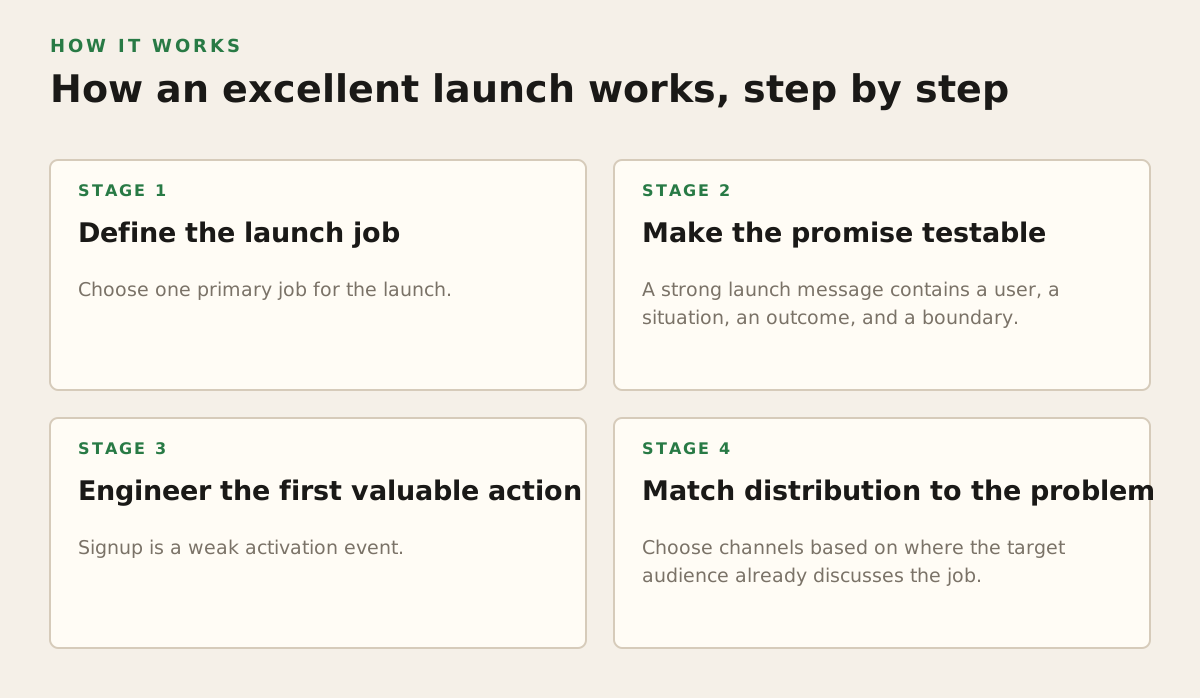
The mechanism is a sequence, not a burst: define the job, prepare the promise, create a low-friction first outcome, distribute to a plausible audience, observe behavior, and follow up with people who can explain the result.
1. Define the launch job
Choose one primary job for the launch. A pre-seed founder might need discovery calls, an indie hacker might need active testers, and an angel-funded team might need qualified waitlist signups in a particular segment. These are different jobs and require different calls to action.
Write the job in this format:
“For this launch, we want [specific audience] to complete [specific action] so we can learn [specific question].”
Illustrative example: “We want independent bookkeepers to import one sample CSV and produce a categorized expense report so we can learn whether the import workflow is understandable without assistance.” This is more useful than “get traction,” because the team can design the page, product, and follow-up around a visible behavior.
2. Make the promise testable
A strong launch message contains a user, a situation, an outcome, and a boundary. The boundary is important: it prevents the copy from promising every benefit to everyone.
| Weak launch statement | More testable statement | What it enables |
|---|---|---|
| “A smarter way to manage work” | “A lightweight client portal for solo designers who need approvals without email threads” | Targeted outreach and relevant onboarding |
| “AI for better sales” | “Turn discovery-call notes into a follow-up draft for small B2B sales teams” | A concrete first-use demonstration |
| “Analytics made easy” | “See which signup step loses trial users without building a custom dashboard” | A clear pain point and evaluation question |
The product does not need to serve only one type of customer forever. The launch does need one coherent entry point. If multiple audiences have different jobs, treat them as separate messages and, where practical, separate landing-page paths.
3. Engineer the first valuable action
Signup is a weak activation event. It indicates intent, but not value. Define the first action that demonstrates the product’s reason for existing. For a scheduling tool, that may be publishing an available booking page. For a research tool, it may be saving and retrieving a useful source. For a team product, it may be completing one shared workflow.
Activation should be observable. If the event cannot be seen in product data or confirmed in a conversation, it is difficult to improve. Google Analytics documents recommended approaches for collecting events and parameters in GA4; the official event documentation is a useful reference when deciding how to record meaningful actions rather than relying only on page views. Google’s GA4 event documentation explains the underlying implementation model.
A practical activation map might look like this:
- Visitor reads the launch page and selects the relevant use case.
- Visitor starts signup with a clear expectation of the first result.
- User supplies the minimum input required to demonstrate value.
- User receives or publishes the first useful output.
- User is asked one contextual question about what they wanted to accomplish.
Do not add onboarding questions merely because they are easy to collect. Ask for information that changes the product path, enables useful follow-up, or helps segment the learning. Every extra field competes with the first valuable action.
4. Match distribution to the problem
Choose channels based on where the target audience already discusses the job. A developer tool may benefit from a technical walkthrough and direct conversations with maintainers. A workflow product for agencies may benefit from practical before-and-after examples sent to agency operators. A consumer-facing utility may need demonstrations that make the result immediately legible.
Use a channel hypothesis rather than a channel habit:
- Audience hypothesis: “Independent consultants who currently assemble proposals manually.”
- Discovery location: communities, newsletters, search queries, or peer networks where that workflow is discussed.
- Message format: a short walkthrough, teardown, template, or invitation to try a specific workflow.
- Expected behavior: visit, activate, reply, book a conversation, or refer a peer.
- Learning signal: the language used in replies and the point where users stop.
Distribution should make the product easier to understand, not simply louder. A founder with a small network can often create a stronger launch by personally inviting a narrow set of plausible users and asking for a defined task than by broadcasting an unqualified announcement.
5. Close the loop after launch
Follow-up is where much of the learning occurs. Contact users while their experience is fresh, but do not ask a vague “What did you think?” Ask about the job they attempted and the moment that changed their confidence.
Useful prompts include:
- “What were you trying to produce when you opened the product?”
- “What did you expect to happen after this step?”
- “Where did you hesitate or need to make a guess?”
- “What would make this worth returning to next week?”
Keep observation and interpretation separate. “Three users stopped after connecting a data source” is an observation. “Users do not trust us” is an interpretation that requires further evidence. The distinction prevents a founder from rebuilding a roadmap around one dramatic comment.
Where launch excellence breaks down
Most launch failures are not caused by a missing growth trick. They happen when one part of the system contradicts another. The audience is wrong, the promise is too broad, the first action is too difficult, or the measurement cannot support a decision.
Broad positioning produces noisy feedback
“For anyone who wants to be more productive” attracts incompatible use cases. One visitor wants personal task management; another wants enterprise reporting; a third wants an automated assistant. Their objections cannot be combined into a coherent product lesson.
Narrow the entry point, not necessarily the company. You can serve additional segments later, but the first launch should make it obvious whose problem is being addressed now. If a founder cannot name the user’s current workaround, the launch is probably still too abstract.
Feature lists hide the value exchange
Feature lists make the founder’s work visible but often leave the buyer to infer the outcome. Replace “AI summaries, tagging, integrations, dashboards” with the workflow those capabilities enable. A useful feature earns space by explaining a user decision, reduced effort, or completed job.
For an early-stage product, this also limits support burden. Promising every possible use invites edge cases before the core workflow is stable. Promise the smallest credible outcome, then let usage reveal which adjacent needs deserve attention.
Vanity metrics obscure weak activation
Impressions, likes, and raw visits can be useful diagnostic context, but they are poor primary outcomes when the product requires actual use. A launch dashboard should connect acquisition to behavior.
Consider this illustrative example, not a universal benchmark:
- 1,000 launch-page visits
- 80 signup starts
- 50 completed accounts
- 18 users complete the first valuable action
- 6 users return to repeat that action within the following week
- 4 users agree to a product conversation
The important question is not whether 1,000 visits is good. It is where the largest decision-relevant loss occurs and whether the team knows why. If signup completion is strong but first action completion is weak, increasing traffic may magnify an onboarding problem.
Instrumentation becomes a substitute for judgment
Events do not explain motivation by themselves. A founder can track every click and still miss that users are arriving for a different job than the product supports. Combine behavioral data with a small number of conversations, support messages, and observed workflows.
Use a simple event vocabulary:
- Acquisition event: how the person arrived.
- Intent event: the action showing serious interest.
- Value event: the first completed outcome.
- Retention event: a meaningful repeat workflow.
- Voice-of-customer note: the language, objection, or request attached to that behavior.
Do not claim retention from a second login if the user did not complete a meaningful task. Define the event according to the product’s value exchange.
Promotional urgency damages trust
Artificial scarcity, exaggerated claims, and unclear data practices may create short-term curiosity while increasing long-term skepticism. If a launch uses email, the sender should understand applicable requirements. The Federal Trade Commission’s CAN-SPAM compliance guide covers commercial email obligations such as truthful headers and subject lines, identification of the message as an advertisement where required, and an opt-out mechanism. The FTC’s official CAN-SPAM guide is the appropriate starting point for U.S.-focused email practices as of 2026.
For product launches, the practical recommendation is straightforward: say what the message is about, contact people who have a legitimate reason to hear from you, and make unsubscribing easy. A founder’s reputation is a distribution asset; do not spend it to inflate one campaign.
How practitioners apply the discipline
Excellent launches are usually run as a series of constrained decisions. The founder decides what must be true, chooses the smallest test that can provide evidence, and gives the team a rule for what happens next.
Use a launch brief
Before promoting, write a one-page brief. It should be specific enough that another person could identify a suitable user and understand what success means.
- Target user: a role, context, and current workaround.
- Problem: the costly, frustrating, or repetitive job being addressed.
- Promise: the first result the product can credibly provide.
- Proof: a demo, example, explanation, or founder expertise that supports the promise.
- Activation event: the action that demonstrates initial value.
- Primary learning question: the uncertainty the launch must reduce.
- Stop or change rule: what evidence would cause a message, audience, or workflow change.
That final item is frequently omitted. Without a change rule, founders can continue promoting the same message indefinitely while explaining away weak results. An illustrative starting policy might be: after the first 20 qualified visitors or 10 serious conversations, review the top objections and change one element—not the entire product—before the next distribution push. This is a planning example, not a universal benchmark.
Sequence the launch in phases
A phased launch reduces the chance that a large audience encounters an avoidable problem.
- Private preparation: confirm the core workflow, copy, analytics, support path, and known limitations.
- Small release: invite a narrow set of plausible users and observe the first valuable action.
- Public discovery: publish the clearest explanation and invite a broader but still relevant audience.
- Evidence review: compare audience quality, activation, objections, and repeat use.
- Iteration: improve the highest-leverage constraint before repeating distribution.
The small release is not a ceremonial beta. Its purpose is to expose ambiguity while the founder can still respond quickly. If users repeatedly ask what the product is for, fix positioning. If they understand the promise but fail to complete the workflow, fix activation. If they activate and do not return, investigate whether the job is occasional, the result is weak, or the product has not earned a place in the workflow.
Build launch assets around decisions
Every asset should answer a question for a particular audience. A founder does not need a dozen disconnected promotional pieces. A compact set is often more useful:
- A launch page that states the audience, job, outcome, and next step.
- A short product walkthrough showing the first valuable action.
- One concrete example using a realistic input and output.
- A support or feedback path that reaches a human or a clearly maintained channel.
- A follow-up message that asks about the user’s attempted job.
- A changelog or update note that demonstrates how feedback is handled.
Performance and usability are part of launch quality, not merely engineering polish. Google’s Lighthouse documentation describes performance, accessibility, best-practice, and SEO audits for web pages; using those audits can help a founder identify preventable page-level friction before sending traffic. Chrome’s official Lighthouse overview documents what the tool evaluates and what it does not.
Make the public launch a community contribution
Early adopters are more likely to engage when the launch offers something useful beyond “please try my product.” A founder can publish a practical template, explain a workflow, share a transparent limitation, or ask a sharply bounded question. This creates a reason to participate even for people who are not ready to buy.
For indie founders, a launch platform can support this discovery loop when the submission is written as a useful product brief rather than a slogan. When your product is ready for public discovery, you can submit your product launch with the audience, problem, and first outcome stated plainly.
A specific operating recommendation for your next launch
Run the next launch as a seven-day evidence cycle, treating the schedule as an illustrative starting policy rather than a universal formula.
- Day 1: write the launch brief and select one audience, one promise, and one activation event.
- Day 2: test the message with five plausible users or peers who understand the target workflow; record their language without defending the product.
- Day 3: remove one onboarding obstacle and prepare the smallest useful walkthrough.
- Day 4: invite a narrow group through one relevant channel; personally observe where they hesitate.
- Day 5: publish the launch with one clear call to action and a defined feedback question.
- Day 6: review activation behavior, support questions, and source quality; separate observations from interpretations.
- Day 7: choose one change to positioning, distribution, onboarding, or product scope, and document why.
Use a simple review table after the cycle:
| Signal | Interpretation to avoid | Next decision |
|---|---|---|
| Many visits, few qualified conversations | “The product has no demand” | Check audience and message fit |
| Strong interest, weak first-use completion | “Users are not motivated” | Inspect setup, instructions, and time to value |
| Good activation, weak repeat use | “Retention is broken” | Determine whether the job is recurring and valuable enough |
| Repeated objection from qualified users | “They do not understand innovation” | Address the objection in the product or promise |
Change one major variable at a time when the sample is small. If you replace the audience, headline, onboarding flow, and pricing simultaneously, a better or worse result will not teach you which decision mattered. Early-stage work is uncertain enough without creating avoidable ambiguity.
Finally, keep a launch log. Record the exact message, audience, source, activation definition, notable objections, and next action. The log becomes especially valuable for founders running multiple launches, investors reviewing early signals, and teams deciding whether a promising feature deserves a standalone product.
Product launch excellence is therefore best treated as a repeatable practice: make a narrow promise, put it in front of a plausible audience, guide people to a real outcome, and let evidence determine the next move. If you want a focused place for early adopters and fellow founders to discover what you are building, SuperPublic offers a product launch submission and discovery community through SuperPublic.
Authored with NotFair SEO