Founder field note
Pre-seed Startup: What It Is, How It Works, and How to Launch Well
Learn how a pre-seed startup validates demand, chooses funding, launches to early adopters, and avoids the common traps that waste runway.
A pre-seed startup is an early company still converting a problem insight into repeatable evidence: a defined customer, a painful use case, a workable product, and a credible path to distribution. It may be bootstrapped, funded by founders and angels, or preparing for an institutional round; the label describes a stage of uncertainty more than a precise cheque size or legal category.
What a Pre-seed Startup actually is
“Pre-seed” is best understood as a company-building stage, not a formal corporate status. At this point, the founders are usually still answering questions that a later-stage startup is expected to have answered: who buys, why they buy now, how the product is delivered, what retention looks like, and which acquisition channel can scale without destroying margins.
That distinction matters because two companies can both call themselves pre-seed while having very different realities. A bootstrapped developer with paying users may be further along in customer evidence than a venture-backed team with a larger bank balance but no repeatable demand. Funding is an input; validated learning is the more useful measure of progress.
As of 2026, there is no single globally binding definition of “pre-seed” that determines how a company must raise money or report its stage. Fundraising instruments and investor eligibility can carry legal consequences, however. The U.S. Securities and Exchange Commission explains that private companies use different exemptions and that the requirements vary by offering type; founders should treat a funding label as insufficient legal guidance and review the applicable rules with qualified counsel. The SEC’s capital-raising guidance is a useful starting point for mapping those questions.
The four dimensions of the stage
A practical definition uses four dimensions rather than a fashionable label:
- Problem clarity: the team can name a narrow customer and describe the costly or frustrating situation the product addresses.
- Product reality: something usable exists, even if the service includes manual work, rough onboarding, or limited automation.
- Evidence quality: conversations, pilots, payments, usage, renewals, or referrals reveal whether the problem is real rather than merely interesting.
- Distribution uncertainty: the founders have hypotheses about acquisition but have not yet demonstrated a repeatable, economical channel.
A pre-seed company can therefore be “pre-revenue” without being “pre-learning.” It can also have revenue without having product-market fit. Early revenue from a founder’s network may prove that someone will pay; it does not automatically prove that strangers can be acquired, onboarded, retained, and served profitably.
What the label should not imply
Do not use the stage as a shortcut for quality. Pre-seed is not a promise of potential, a synonym for “small,” or evidence that an investor has vetted the business. It does not tell a prospective customer whether the product is reliable, a founder whether fundraising is wise, or an angel whether the valuation is sensible.
For an independent founder, the useful question is: What uncertainty must be reduced next? If the answer is customer selection, spend time on interviews and workflow observation. If it is activation, instrument onboarding. If it is distribution, run controlled channel experiments. Raising money before identifying the uncertainty often turns an ambiguous product problem into an expensive one.
Why the pre-seed stage matters to founders and early adopters
The stage matters because decisions made before product-market fit are unusually reversible—and unusually easy to obscure with activity. A founder can ship ten features, publish daily, and attend dozens of events while learning almost nothing about whether a specific customer will repeatedly choose the product.
Capital buys time, but evidence buys options
Money can fund engineering, design, support, legal work, or experiments. It cannot substitute for a sharp customer hypothesis. The strategic value of early capital is the ability to buy enough time to reach a decision-quality signal: evidence strong enough to continue, change direction, narrow the market, or stop.
For a bootstrapped maker, the same logic applies with personal savings and unpaid hours treated as capital. A founder should record what each experiment is intended to resolve and what result would change the next decision. This prevents “momentum” from becoming a reason to continue a weak idea.
Early-stage progress is not “more shipped.” It is fewer important assumptions left untested.
Illustrative example: suppose a founder believes independent agencies will pay for a reporting tool. A useful first experiment might target five agencies, ask each to complete one real reporting task, and request a paid continuation. The numbers here are a starting policy, not a universal benchmark. If none continues, the result does not prove the market is impossible; it does show that the current customer, promise, workflow, or price needs investigation.
The founder, customer, and investor see different risks
- Founders face execution risk: can they build and support the narrow product without overextending themselves?
- Customers face adoption risk: will switching, setup, training, or data migration cost more than the promised benefit?
- Investors face portfolio risk: can this uncertain company eventually become substantially more valuable, and is the ownership structure understandable?
- Communities face attention risk: is the launch useful enough to deserve scarce visibility, feedback, and referrals?
A strong launch message addresses the customer’s risk first. “We raised a pre-seed round” may interest investors but does not tell a buyer what improves in their work. A more useful message identifies the job, the input required, the output produced, and the limitation that still exists.
This is why discovery platforms and founder communities can be valuable even when they do not create immediate sales. A launch creates a concentrated opportunity to collect objections, observe language, find adjacent use cases, and recruit design partners. The value is in the quality of the feedback loop, not only in a traffic spike.
How a Pre-seed Startup turns uncertainty into a launch plan
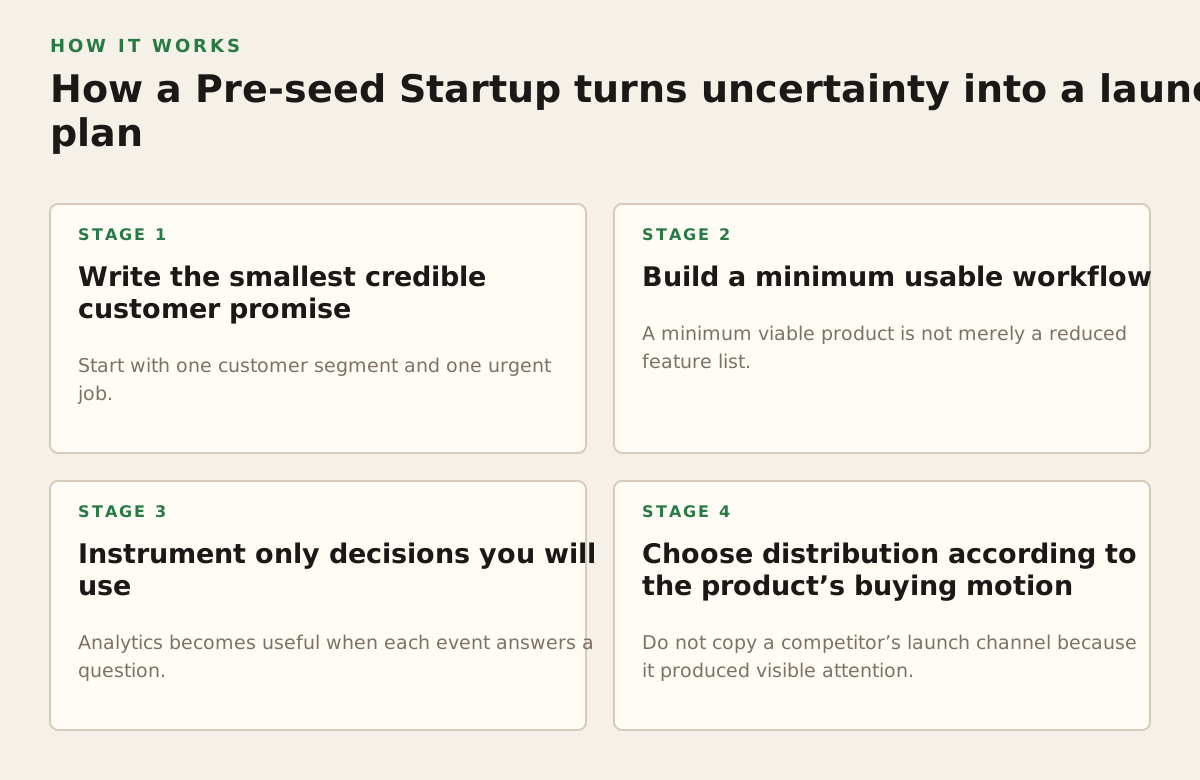
A launch should be treated as a sequence of evidence-generating steps, not a single announcement. The sequence below works for a SaaS product, developer tool, marketplace experiment, or service with software at its core.
1. Write the smallest credible customer promise
Start with one customer segment and one urgent job. Avoid “for everyone who needs productivity” positioning. A credible promise includes a situation, an action, and an outcome: “For small design agencies that assemble client reports manually, turn exported campaign data into a review-ready report without rebuilding the same spreadsheet.”
That sentence is not a slogan. It is a testable hypothesis. If visitors cannot recognize the situation, the audience is wrong or the language is vague. If they recognize it but do not care, the pain may be too weak. If they care but cannot act, the workflow or offer may be too demanding.
Before building a large site, use a website project configurator to plan the scope and requirements for the startup website, including the target customer, core pages, conversion path, and technical constraints. This helps translate a launch idea into a concrete website scope and conversion plan before development absorbs scarce founder time.

2. Build a minimum usable workflow
A minimum viable product is not merely a reduced feature list. It is the smallest complete customer workflow that can deliver a meaningful result. A dashboard with attractive charts may be less viable than a form, a manual back-office process, and a useful weekly output.
Define the workflow in observable stages:
- Acquisition: where does the customer first encounter the product?
- Activation: what action indicates that the customer has reached the product’s first value?
- Delivery: what result does the product produce, and how quickly?
- Retention: what recurring job brings the customer back?
- Expansion or referral: what makes continued use or recommendation rational?
Illustrative example: a lightweight contract-review tool may define activation as uploading one contract and receiving a categorized issue list, not merely creating an account. If ten invited users register but only two upload a document, the onboarding promise is not yet working. Those figures are an example of an activation definition, not a general target.
3. Instrument only decisions you will use
Analytics becomes useful when each event answers a question. Track the source of a visitor, the key action, the time to first value, and the point where users stop. Do not create dozens of events simply because a tool permits it.
Google’s official Analytics documentation describes events as interactions that can be measured and configured for reporting. Use the current documentation to confirm implementation details in 2026, especially when your product changes its analytics setup. Google’s event documentation supports the basic distinction between a visit and a meaningful interaction.
A practical early event map might include:
landing_page_view— the visitor reaches the focused product page.demo_requested— a qualified prospect asks for access or a conversation.workspace_created— the user completes the first setup step.core_action_completed— the product delivers its primary job.returning_core_action— the same user repeats the job later.
These names are illustrative. The important mechanism is to connect each event to a decision: change the headline, simplify setup, improve the output, or revisit the audience. A graph without a decision attached is decoration.
4. Choose distribution according to the product’s buying motion
Do not copy a competitor’s launch channel because it produced visible attention. A developer tool may spread through technical examples and repositories; a local service may need partnerships and direct outreach; a workflow product may require a founder-led demo. Distribution is part of the product design because the acquisition path changes what the customer expects before trying the product.
Search can compound, but it is rarely a substitute for learning customer language. Google’s SEO Starter Guide recommends creating helpful, reliable, people-first content and making pages understandable to search systems. Google’s official SEO guidance is relevant when an early founder decides whether a product page, comparison page, integration guide, or problem-focused article deserves priority.
For a problem with several related searches, a keyword clustering tool can help group customer terms by intent before you build an early content strategy. That makes it easier to separate technical SEO questions from buying-intent pages and educational content, rather than publishing disconnected articles with no conversion path.

5. Launch in a way that creates a second conversation
The launch page should make the next action obvious: start, request access, book a conversation, join a waitlist, or give feedback. The correct action depends on readiness. Asking for a purchase before the product can serve a customer creates refunds and distrust; asking everyone to join a vague waitlist produces a list with little learning value.
A launch package can include:
- A one-sentence problem and customer definition.
- A short demonstration of the complete workflow.
- One concrete example of the output or result.
- A transparent note about who the product is not for.
- A feedback question tied to a decision the founder must make.
- A clear route to support, access, or purchase.
When the product is ready for discovery by independent builders, founders can submit your product launch through SuperPublic. The useful objective is not to manufacture hype; it is to put the product in front of people who can become early adopters, give informed objections, or introduce a more precise audience.
Where pre-seed plans break
Most early failures are not caused by one dramatic mistake. They come from a chain of small mismatches: a broad audience, a vague promise, an incomplete workflow, an unmeasured launch, and a fundraising story that hides the unresolved questions.
Vanity traction replaces customer evidence
Impressions, followers, email signups, and launch-day visits can indicate interest, but they do not establish value. The more decision-relevant signals are actions that require commitment: a qualified conversation, a completed workflow, a payment, a renewal, a referral, or permission to integrate into an existing process.
Even these signals need context. A payment from a friend is not equivalent to a renewal from a stranger. A successful pilot that depends on founder intervention may not scale. A high activation rate from a tiny, carefully recruited group may be useful learning but not proof of broad demand.
Use a signal hierarchy to avoid overclaiming:
- Attention: someone saw or clicked the message.
- Intent: someone requested access, replied, or booked time.
- Value: someone completed the core job successfully.
- Commitment: someone paid, renewed, referred, or accepted a recurring workflow.
- Repeatability: the same outcome occurs across customers acquired through a process the team can repeat.
Fundraising becomes the product
Raising can be rational when capital accelerates a validated opportunity, gives founders time to build a necessary capability, or supports a market where speed matters. It is dangerous when the deck becomes a replacement for customer work.
Any financing instrument needs careful review. Y Combinator publishes standard SAFE documents and related explanations, but a standard document is not a universal answer for every jurisdiction, cap table, investor, or tax situation. The official YC documents page can help founders understand the instrument’s intended structure before obtaining legal advice.
Founders should model the consequences of a financing decision, not just the headline amount:
- Dilution: what ownership may be transferred now or later?
- Governance: what rights, approvals, or reporting expectations are introduced?
- Runway: which specific milestones can the capital fund before the next financing decision?
- Pressure: does the round create growth expectations that conflict with careful product learning?
- Optionality: could the company remain healthy if the next round never happens?
Use illustrative scenarios rather than pretending to know the future. For example, a founder might compare a 12-month hiring plan with a 6-month contractor plan and identify what evidence each would need to justify the next commitment. Those timelines are planning cases, not universal startup benchmarks.
Paid acquisition is tested without a measurement boundary
Advertising can generate learning, but only if the founder knows what a successful test is meant to establish. “Run ads” is not a strategy. Decide whether the test evaluates message-market fit, landing-page clarity, lead quality, or the economics of a specific conversion.
Google Ads’ official conversion-tracking guidance explains how advertisers can measure actions that matter to a business rather than treating every click as success. Google’s conversion-tracking documentation is the right place to verify setup details before judging an acquisition experiment.
If the team needs outside help setting up an initial channel test, performance marketing solutions can help compare acquisition services for search, Google Ads, Meta ads, SEO, and related growth work. Use that process to define the paid acquisition hypothesis, tracking ownership, audience, landing page, and stop condition before committing budget.
A sensible illustrative test brief might say: “Spend a limited, pre-approved amount to compare two problem statements for one audience, measure qualified demo requests, and stop if the traffic produces no sales conversations after the planned sample.” The amount and sample are policy choices, not promises of performance.
Operational trust is postponed until after launch
Early customers tolerate rough edges; they do not tolerate uncertainty about whether a founder will respond, preserve their data, or explain limitations. A product can be technically immature and still appear responsible if it has a clear support route, data-handling explanation, status communication, and recovery plan.
Do not claim security certifications, uptime, integrations, or compliance unless the company can substantiate them. Instead, state what is true: where support is provided, what data the product needs, how long a manual process may take, and which workflows remain unsupported. Specific limitations build usable trust because customers can decide whether the product fits.
How practitioners should apply the stage in 2026
The best operating system for a pre-seed company is a short cycle from assumption to evidence to decision. This is not a rigid startup methodology. It is a way to prevent the team from spending a quarter on work that answers no important question.
Maintain an assumption ledger
Write down the beliefs that must be true for the company to work. Separate them into customer, problem, product, channel, economics, and operations. Rank them by risk multiplied by uncertainty, then test the most dangerous belief with the cheapest credible experiment.
| Assumption | Evidence to seek | Decision rule |
|---|---|---|
| Small agencies lose meaningful time preparing reports | Observed workflow, current workaround, willingness to repeat a test | Narrow or change the customer if the pain is occasional and low-cost |
| Users can reach first value without a call | Completion of the core workflow from a cold or lightly guided setup | Improve onboarding or add service if users cannot complete the job |
| One acquisition channel reaches qualified buyers | Qualified conversations and completed workflows from that channel | Stop, reposition, or continue based on quality—not clicks alone |
| Customers will repeat the job | Return usage, renewal, or a recurring operational need | Revisit the job before adding expansion features |
The table uses illustrative examples. A founder should replace them with assumptions specific to the product and define what evidence would actually change the plan.
Run a weekly evidence review
A lightweight review can keep a small team aligned:
- What did a real customer do, not merely say?
- Which step in the workflow caused delay or confusion?
- What new evidence supports or weakens the current customer hypothesis?
- Which metric is being used as a proxy, and what stronger signal could replace it?
- What will be stopped, narrowed, or attempted next?
Keep the review separate from a status meeting. Status asks whether work was completed. Evidence review asks whether the company’s beliefs became more accurate. A founder who works alone can record a short weekly note with the same structure.
Use launch communities as research environments
When presenting to an indie-hacker or founder audience, do not optimize only for votes or comments. Ask for the kind of response your current uncertainty requires. A technical audience can expose setup friction. A founder community can reveal positioning gaps. Early adopters in the target segment can challenge whether the workflow deserves a budget.
Prepare three questions before publishing:
- Which part of this workflow would you replace with your current tool?
- What would prevent you from trying this with a real customer or project?
- What outcome would make you keep using it after the first session?
Then classify responses by evidence strength. A suggestion is useful product input; a completed trial is stronger; a paid continuation is stronger still. Do not dismiss qualitative feedback, but do not treat enthusiasm as retention.
Set a financing gate
Funding should follow a written milestone, even if the milestone is modest. The gate might be a set of recurring customers, a repeatable founder-led sales process, a validated technical constraint, or evidence that a particular market is worth pursuing. The exact gate depends on the business model.
For a bootstrapped SaaS, a reasonable illustrative policy could be: do not add a full-time role until the current workflow creates a measurable bottleneck and the company can explain which customer evidence that role will unlock. For an investor-backed company, the policy could be: do not expand acquisition spend until activation and retention definitions are stable enough to interpret. These are operating policies, not universal thresholds.
Document the downside too. If the next round does not happen, what can continue? If a channel fails, what remains? If the product must narrow to one customer type, does the company still have a coherent business? Resilience is not pessimism; it protects the founder’s ability to make honest product decisions.
Make the recommendation concrete
For most founders at this stage, the strongest next move is not “build more” or “raise now.” It is to choose one customer, one painful job, one complete workflow, and one measurable distribution experiment. Publish only when the product can produce a real outcome for that customer, then use the launch to collect evidence that changes the roadmap.
SuperPublic is designed for independent builders who want to launch products, gain visibility, and connect with other bootstrapped, pre-seed, and angel-funded founders. When the product and evidence are ready, SuperPublic is a practical place to turn that launch into a focused discovery and feedback opportunity.
Authored with NotFair SEO