Founder field note
One Page Marketing Plan Template for an Indie Software Launch
Use this one page marketing plan template to choose a launch audience, message, channels, metrics, and a practical 30-day execution plan for an early-stage prod
A one page marketing plan template is most useful when it helps an early-stage founder make trade-offs, not when it becomes a miniature business plan. If you are launching a bootstrapped SaaS product, an AI tool, or a narrowly focused developer product, the job is to decide who should notice first, what they should understand, where they can try it, and how you will learn from the response.
This guide turns those decisions into a compact operating document. It is designed for a founder with limited distribution, limited budget, and an unfinished product—not for a mature company with a brand team and a large advertising department. By the end, you should have a one-page plan that connects a specific audience to a message, a small set of channels, a measurable activation event, and a sequenced launch schedule.
1. Start with a narrow launch wedge
When it applies: Use a narrow wedge whenever your product could plausibly serve several audiences. A new project-management tool might appeal to agencies, internal product teams, freelancers, and student groups. Trying to address all four in the first launch usually produces vague copy and scattered outreach.
Why it works: Early visibility is more valuable when it creates useful conversations. A clearly defined audience gives you a sharper problem statement, more relevant examples, and a better reason for someone to share the product with a colleague. It also makes your launch easier to evaluate: you can distinguish “the wrong audience saw this” from “the audience saw it and did not care.”
Use a segment statement with five parts:
- Role or identity: who the person is, such as an independent consultant or a two-person SaaS team.
- Trigger: the event that makes the problem urgent, such as taking on a fifth client or adding a new data source.
- Existing workaround: the spreadsheet, manual process, competing tool, or ignored problem they use today.
- Desired outcome: the result they want, stated in operational language.
- Reachable location: where they already ask questions, publish work, or look for tools.
A useful first segment might be: “Solo consultants who send recurring client reports, currently assemble them manually, want to deliver them faster, and discuss workflow tools in professional communities.” That is more actionable than “small businesses that need better reporting.”
Failure mode: Choosing a demographic instead of a situation. “Founders aged 25–45” does not tell you what message to write or when the product becomes relevant. Another common mistake is selecting a segment solely because it is large. A smaller audience with a painful, frequent problem can provide better launch feedback than a broad audience with mild interest.
Turn research into a decision
For an early-stage plan, you do not need a perfect market-sizing exercise. You need enough evidence to select a first audience and identify the language they use. The U.S. Small Business Administration describes market research and competitive analysis as ways to understand customers and find a competitive advantage; use that principle as a prompt to investigate, not as permission to fill your plan with unsupported market-size figures. See the SBA market research guidance for the underlying framework.
- Review recent support requests, sales calls, or beta applications.
- Write down repeated words for the problem, workaround, and desired result.
- Interview people who did not activate, not only enthusiastic testers.
- Choose one segment for the launch plan and list adjacent segments as later experiments.
Implementation example: A bootstrapped invoice-follow-up tool chooses “freelance design studios with recurring retainers” instead of “service businesses.” Its first page headline, example invoice, onboarding checklist, and outreach list can now all reflect retainers and client approvals. The plan becomes narrower, but every asset becomes easier to produce and judge.
2. Convert the product into a specific promise
When it applies: Use this principle when your product has many features, uses unfamiliar technology, or is entering a crowded category. Founders often describe what they built because the features are concrete. Buyers care more about the situation those features change.
Why it works: A launch visitor is making a fast relevance judgment. Your promise should connect a recognizable problem to a meaningful outcome, while leaving enough detail for a skeptical early adopter to understand how the product delivers it. A useful formula is:
For [specific audience] dealing with [trigger or costly problem], [product] helps them achieve [observable outcome] by [distinctive mechanism]. Unlike [current workaround], it [important difference].
Do not treat this as final website copy. Treat it as a constraint for every marketing decision. If your chosen channel cannot reach the audience, or your product cannot yet produce the promised outcome, revise the promise before increasing promotion.
Separate the claim from the proof
Your one-page plan should contain a claim and at least one proof mechanism:
- Claim: the outcome the user should expect.
- Mechanism: the product behavior that creates the outcome.
- Proof: a walkthrough, example, transparent limitation, customer quote, sample output, or founder demonstration.
- Next step: the lowest-friction action that lets the visitor verify the claim.
Failure mode: Using inflated outcomes that are impossible to validate. “Never miss a deadline again” is difficult to trust and difficult to measure. “See every overdue client approval in one queue” is narrower and testable. Also avoid claiming that a tool “automates” a process when it merely provides a dashboard around a manual task.
Implementation example: An AI meeting-notes product aimed at independent recruiters might use: “Turn candidate interviews into structured hiring notes without rebuilding your template after every call.” Its proof is a redacted sample output and a two-minute screen recording showing the template being applied. Its call to action is “Generate a sample note,” not “Learn more.”
Keep your product description honest about its current stage. If an integration, export, or workflow is still on the roadmap, label it as planned rather than implying that it is available. Specific limitations often improve the quality of feedback because they attract people who understand the present product.
3. Choose channels by audience access and learning value
When it applies: Use this principle whenever you are tempted to list every possible channel: search, paid ads, communities, newsletters, partnerships, launch directories, social posts, and email. A one-page plan cannot support equal effort across all of them.
Why it works: A channel has two jobs at an early stage: create qualified visits and reveal whether your message resonates. A channel that produces attention but no useful conversations may be less valuable than a smaller source that brings people with the exact problem. Choose channels based on audience access, credibility transfer, feedback quality, and repeatability.
| Channel type | Use it when | Primary test | Starting action | Watch for |
|---|---|---|---|---|
| Founder-led outreach | You can identify people with the trigger | Do replies show problem recognition? | Send a short, personalized question before the pitch | Polite replies without a next step |
| Search content | The audience actively looks for the problem | Do visitors reach the relevant product action? | Publish one useful page for one task or question | Traffic with no activation |
| Community participation | You can contribute expertise without dropping a promotion | Do conversations create qualified follow-up? | Answer a specific problem and disclose the product only when relevant | Promotion overtaking contribution |
| Partner or newsletter placement | An adjacent operator already has audience trust | Does the referred audience fit the wedge? | Offer a useful artifact or focused demonstration | Large reach but weak relevance |
| Paid acquisition | The landing page and activation path are already understandable | Can you measure a qualified action at an acceptable test cost? | Run a tightly bounded experiment with one audience and message | Buying visits before proving conversion |
Search is not simply “free traffic.” Google’s documentation recommends making pages useful, understandable, and discoverable, and its SEO starter guide emphasizes helping search engines understand content and users find what they need. Apply that advice to a specific job-to-be-done rather than publishing generic startup content; consult the Google Search Central SEO starter guide when deciding how to structure a launch page or supporting article.
Failure mode: Confusing channel activity with distribution. Posting five times is not a strategy if the audience does not use that channel to solve the problem. Another failure is using paid acquisition to compensate for unclear positioning. Advertising can increase the number of visitors, but it cannot make an irrelevant promise relevant.
Implementation example: A browser extension for researchers selects three initial channels: direct messages to independent analysts, answers in research-workflow communities, and one search page targeting a specific citation task. It postpones broad paid ads until visitors complete the core workflow. The plan specifies one owner and one learning question for each channel.
4. Build a conversion path, not just a launch page
When it applies: Use this principle when people may discover your product through several routes or when the product requires explanation before signup. The page should work for a curious early adopter arriving from a founder post, a skeptical buyer referred by a peer, and a searcher who has never heard of you.
Why it works: Marketing breaks when attention has nowhere precise to go. A conversion path reduces the distance between the visitor’s problem and the first meaningful product experience. For a self-serve SaaS product, the path might be source → landing page → qualification → signup → activation → feedback. For a high-touch product, it might be source → use-case page → diagnostic call → guided setup.
Specify the page before writing it
- Above the fold: audience, problem, outcome, and primary action.
- Evidence section: sample output, workflow demonstration, or clearly labeled user experience.
- Fit section: who benefits now and who should wait.
- Objection section: setup effort, data handling, migration, price, or product maturity.
- Action section: one primary call to action and one secondary option for visitors who are not ready.
If you run paid search, relevance between the ad, keyword, and landing page matters. Google Ads’ official guidance discusses landing-page experience in relation to relevance, useful content, and ease of navigation; use the Google Ads landing-page guidance when evaluating whether a paid visitor arrives at the page that matches the promise they clicked.
Failure mode: Sending every visitor to the homepage. A homepage may need to explain the whole company, while a campaign or launch visitor needs one answer. Another failure is offering multiple equal calls to action—book a demo, join a waitlist, start a trial, read the blog, and follow an account—without identifying the intended next step.
Implementation example: A lightweight customer-feedback platform creates a page for “collect feedback from beta users.” The page shows the collection flow, a sample insight report, and a “Create a feedback board” button. Visitors who are not ready can download a question checklist. The founder can then distinguish product interest from interest in general customer research.
5. Define activation before you count success
When it applies: Use this principle when signups are easy to generate but difficult to interpret. A new product may collect email addresses from curious visitors who never experience its value. Your plan needs a behavioral definition of progress.
Why it works: An activation event links marketing to the product’s actual promise. It should be close enough to the first outcome that a user can complete it during an initial session, but meaningful enough to exclude accidental clicks. Examples include importing a first dataset, sending a first client report, inviting a collaborator, or generating a usable output.
Write the funnel in plain language:
- Qualified visit: the visitor matches the chosen audience or problem.
- Intent action: they click the relevant call to action or start setup.
- Activation: they complete the first valuable workflow.
- Return or response: they come back, share the result, invite someone, or provide feedback.
Do not assign universal conversion targets to these stages. Your initial purpose is to find where the path breaks. If many people click but few activate, inspect onboarding or promise clarity. If activation occurs but nobody returns, inspect the frequency and importance of the problem. If qualified visits are rare, revisit distribution or the segment.
Google Analytics documentation explains that events can capture interactions and that key events can be marked for important business outcomes. Use the official Google Analytics event documentation as a reference when instrumenting actions, but keep the event vocabulary understandable to the whole team.
Use a small measurement sheet
- Source or campaign name
- Audience segment
- Landing-page action
- Activation event
- Qualitative objection
- Next change and owner
Failure mode: Optimizing for impressions, followers, or raw signups because those numbers arrive quickly. These indicators can be useful for diagnosing reach, but they are not substitutes for product value. Also avoid changing the audience, message, page, and activation event simultaneously; you will not know which change mattered.
Implementation example: A team launching an automated report builder defines activation as “one report generated from a connected source and shared or exported.” It tags visitors by source and records the most common setup objection. The founder can now compare not just who visited, but whether each channel produced a first useful report.
6. Make the launch offer easy to understand and safe to try
When it applies: Use this principle when the product is new, unfamiliar, or asking users to change an established workflow. Early adopters may tolerate rough edges, but they still need to understand the commitment involved.
Why it works: An offer reduces perceived risk by making the first step concrete. It can be a guided setup, a sample workspace, a short founder-led walkthrough, a transparent trial, or a useful free tool. The offer should help the right person reach the first outcome; it should not merely attract anyone who wants something free.
Include these decisions in the plan:
- What can a visitor do before creating an account?
- What information must they provide, and why?
- What is the first successful output?
- Which limitation should be disclosed before signup?
- How will a founder or teammate respond to early questions?
Failure mode: Designing an incentive that attracts a different audience from the one you need. A generic giveaway may create a list of people interested in giveaways rather than people with the product problem. Another failure is hiding the product’s current limitations until after setup, creating disappointment that looks like weak demand.
Implementation example: A solo founder launching a client-portal product offers a prebuilt sample workspace for independent consultants. The visitor can inspect the client view before connecting real data. The page says that custom branding is not yet available and asks users to report which client handoff they want improved. The offer is modest, but it produces more relevant conversations than a broad contest would.
If email is part of the launch, keep consent and unsubscribe handling explicit. The U.S. Federal Trade Commission’s CAN-SPAM compliance guide describes requirements for commercial email, including identifying messages accurately and providing an opt-out mechanism. Treat compliance as part of the workflow design, not as a footer added later.
7. Turn the one-page plan into a constrained operating system
When it applies: Use this principle when a founder has more ideas than available time. The plan should be short because the team has to execute it, inspect it, and change it. Every row should answer who does what, for whom, by when, and what evidence would cause a change.
Why it works: Constraints prevent performative marketing. A plan that names one audience, two or three channels, one activation event, and a small number of experiments creates a manageable feedback loop. It also exposes resource conflicts early. If the founder is building features, answering support, writing content, and conducting outreach, the marketing plan must state what will not happen.
Use this one-page layout
- Audience: the first segment and triggering situation.
- Problem: the current workaround and its consequence.
- Promise: the outcome and mechanism.
- Proof: the asset or experience that makes the promise credible.
- Channels: the selected sources of qualified attention.
- Activation: the first valuable product action.
- Experiments: the changes you will make and what they test.
- Owner and cadence: who reviews evidence and when.
- Stop rule: what would make you pause, narrow, or replace a channel.
Use illustrative starting policies rather than pretending there is one correct launch schedule. For example, a solo founder might choose a 30-day plan with two channel experiments, one landing-page revision, and a weekly review. That is an example of a manageable constraint, not a universal benchmark. A funded startup with a marketing teammate may choose a different cadence, but it should still preserve the same decision structure.
Failure mode: Writing a plan that describes intentions but contains no falsifiable test. “Build awareness” cannot tell you what to do next. “Publish a use-case page, send it to 20 relevant operators as an illustrative starting policy, and record whether replies identify the problem” can.
Implementation example: A two-person startup chooses one audience, one launch page, three founder-written posts, and a short outreach list. Their review question is: “Do qualified visitors reach the setup step and describe the problem in the language we used?” If not, they revise the segment or promise before adding another channel.
Implement the plan in four deliberate passes
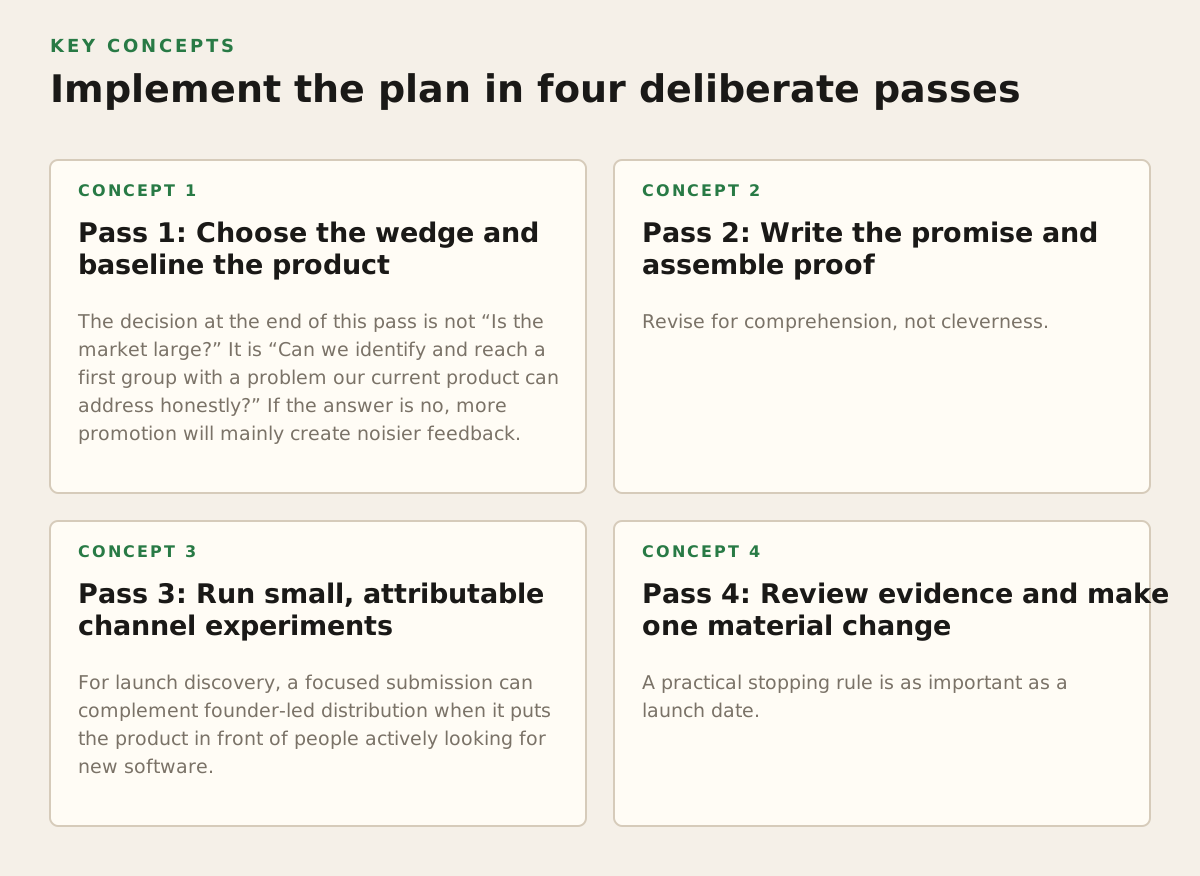
Do not wait until every feature is finished. Run the plan as a sequence in which each pass earns the next investment. The dates below describe an illustrative 30-day starting policy for a small early-stage team in 2026; adjust them to your product’s complexity and available time.
Pass 1: Choose the wedge and baseline the product
- Write three possible audience-and-trigger statements.
- Review interviews, support notes, beta applications, and failed signups.
- Select one segment and document two adjacent segments you are not targeting yet.
- Define one activation event that represents the first useful outcome.
- Record the current product limitations that could affect the promise.
The decision at the end of this pass is not “Is the market large?” It is “Can we identify and reach a first group with a problem our current product can address honestly?” If the answer is no, more promotion will mainly create noisier feedback.
Pass 2: Write the promise and assemble proof
- Draft the audience, problem, outcome, mechanism, and difference statement.
- Choose one proof asset: a sample output, walkthrough, before-and-after workflow, or transparent demonstration.
- Build one focused landing page with one primary action.
- Add the fit and limitation sections before asking for signup.
- Ask three people from the chosen audience what they think the product does after viewing the page.
Revise for comprehension, not cleverness. If people repeat the feature name but not the problem or outcome, the page may be describing the product without communicating its value.
Pass 3: Run small, attributable channel experiments
- Select no more than three starting channels based on audience access and learning value.
- Create a source label for each channel so visits and conversations can be recognized later.
- Prepare one useful contribution for each channel before making a product ask.
- Send or publish the same core promise with small, channel-appropriate adjustments.
- Record objections, questions, qualified visits, and activation—not just exposure.
For launch discovery, a focused submission can complement founder-led distribution when it puts the product in front of people actively looking for new software. If you are ready, you can submit your product launch with the same audience, promise, and activation language used in the plan.
Pass 4: Review evidence and make one material change
- Compare each channel’s audience fit and activation behavior.
- Group objections into message, product, trust, setup, and audience problems.
- Choose one material change: narrow the segment, revise the promise, improve the first workflow, or replace a channel.
- Keep the other variables stable long enough to interpret the change.
- Rewrite the one-page plan so it reflects what you now believe, not what you originally hoped.
A practical stopping rule is as important as a launch date. Pause a channel when it repeatedly produces attention without qualified conversations or activation, especially if the audience mismatch is clear. Keep a channel when the volume is modest but the feedback is specific and the users reach the intended first outcome. The point of the plan is not to make the launch look busy; it is to help the founder decide where the next unit of time should go.
Once the page, message, and activation path are coherent, publish the plan’s next experiment rather than expanding into every available channel. SuperPublic can give an early-stage product a place to be discovered by founders and early adopters; use SuperPublic as one part of a focused launch system, not as a replacement for learning from the people your product is built to serve.
Authored with NotFair SEO