Founder field note
Indie Startup: How to Launch, Learn, and Earn Early Users
Learn how an indie startup earns early users with focused launches, feedback, and practical distribution advice for bootstrapped and pre-seed founders.
An indie startup is a software company built by a small, independent team that keeps decision-making close to the founders and usually pursues a narrow customer problem before seeking large-scale funding. That definition includes a bootstrapped SaaS product, a solo founder’s AI tool, and a small pre-seed company with angel backing. It does not mean “amateur,” “tiny forever,” or “unfunded.” It describes an operating model: small team, direct customer contact, constrained resources, and deliberate growth.
For founders, the practical question is not whether the label sounds attractive. It is whether the model helps you decide what to build, who to serve, how to launch, and when to spend scarce time on distribution. This guide breaks down those decisions for bootstrapped founders, pre-seed teams, angel-funded builders, indie hackers seeking feedback, and early adopters looking for useful new software.
What an Indie Startup actually is
The phrase combines two ideas that are often blurred. “Indie” refers to independence in ownership, priorities, and execution. “Startup” refers to a company pursuing a repeatable product and customer model under uncertainty. An indie startup can therefore be small without being casual, and independent without rejecting ambition.
The operating characteristics
Most indie startups share several conditions, although no single condition is mandatory:
- Founder-led product decisions: the people closest to the customer can change the product without waiting through several management layers.
- A narrow initial wedge: the first version solves one expensive, frequent, or frustrating problem for a defined group.
- Capital discipline: hiring, infrastructure, paid acquisition, and feature work are treated as choices with an opportunity cost.
- Short feedback loops: conversations, usage data, support requests, and failed sales attempts influence the next product decision.
- Control over the growth path: the company may grow through revenue, a small funding round, partnerships, or a combination rather than following a predetermined venture timetable.
That last point matters. A bootstrapped founder may optimize for reliable owner income. An angel-funded founder may optimize for evidence that supports a later round. An indie hacker may want a profitable side business. The products can look similar from the outside, but their success criteria and acceptable trade-offs differ.
What it is not
An indie startup is not simply a company with a small headcount. A local services firm with no repeatable software product may be independent, but it is not necessarily a startup. Conversely, a five-person product company with outside capital can still operate like an indie startup if the founders retain close control and concentrate on a specific customer problem.
It is also not a synonym for “launch on a directory and wait.” A launch page creates an opportunity for discovery; it does not create product-market fit. The work is still to identify a reachable customer, deliver a useful outcome, and build a distribution system that can operate after launch day.
| Type of founder | Near-term objective | Useful evidence |
|---|---|---|
| Bootstrapped SaaS founder | Reach sustainable revenue with controlled costs | Paid conversions, retention, support load, and cash flow |
| Pre-seed team | Reduce uncertainty before raising or hiring | Repeated use by a defined segment and credible learning velocity |
| Angel-funded builder | Turn initial capital into stronger product and distribution evidence | Activation, customer conversations, sales cycle, and expansion signals |
| Indie hacker | Validate a focused product with limited time | Problem urgency, willingness to pay, and repeat usage |
Why the model matters for early-stage products
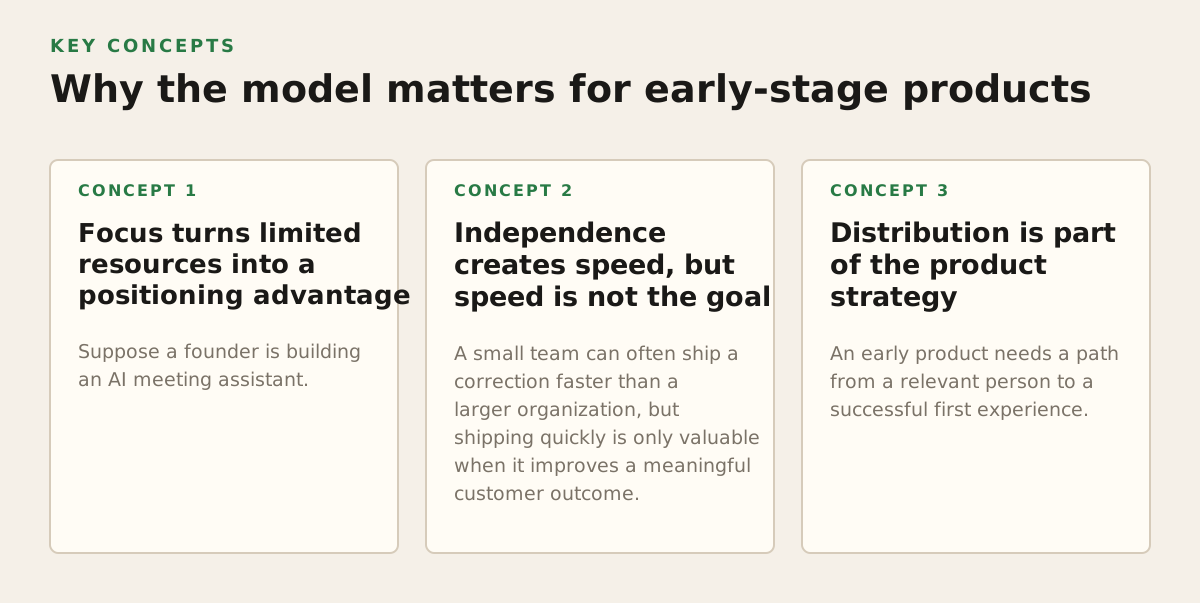
Large companies can compensate for weak focus with brand recognition, sales teams, and broad marketing budgets. A small product usually cannot. Its advantage is different: it can make a sharper promise, reach a specific audience, and change direction while the cost of being wrong is still manageable.
Focus turns limited resources into a positioning advantage
Suppose a founder is building an AI meeting assistant. “For every team that has meetings” is a large market description but weak launch positioning. “For independent recruiters who need searchable interview notes without adding an operations hire” gives the product a problem, audience, and context. The narrower claim may reduce the theoretical audience while increasing the chance that the right visitor recognizes a current need.
Specificity lowers the cost of being understood. It helps a visitor answer three questions quickly:
- Is this for someone like me?
- What painful task does it remove or improve?
- Why should I try it instead of continuing with my current workaround?
This is particularly important when the product is new and has little reputation. A launch cannot rely on accumulated trust, review volume, or a familiar brand. The page must make the product legible through the problem it solves and the proof available at that stage.
Independence creates speed, but speed is not the goal
A small team can often ship a correction faster than a larger organization, but shipping quickly is only valuable when it improves a meaningful customer outcome. The useful loop is:
- State a specific customer assumption.
- Put a small product or message in front of that customer.
- Observe behavior and ask what prevented completion.
- Make one material change.
- Repeat until the evidence supports a larger investment.
The loop protects founders from two opposite mistakes. The first is building for months without contact with prospective users. The second is treating every comment as a requirement and creating a product shaped by the loudest visitor.
Feedback is evidence, not a voting system. A request becomes more compelling when it appears in repeated conversations, blocks activation, or is attached to a credible buying signal. A request from one person may still be valuable, but it should be classified as a hypothesis rather than immediately added to the roadmap.
Distribution is part of the product strategy
An early product needs a path from a relevant person to a successful first experience. That path may include a founder post, a community launch, search traffic, a partner, a direct introduction, or a product directory. Each channel imposes different demands on the product and message.
For example, search traffic rewards clear answers to a known problem, while a community launch rewards a timely story and easy conversation. A partner channel may require integrations or a different onboarding flow. Choosing a channel before defining the customer can produce activity without useful learning.
Google’s documentation describes Search Console as a way to monitor search performance and indexing, while its sitemap guidance explains how a sitemap can help search engines discover a site’s URLs; neither is a guarantee of rankings or traffic (Google Search Console documentation; Google sitemap documentation). For an early founder, the practical lesson is to make the product and its problem understandable to search engines and humans, then measure whether the resulting visitors are relevant.
How an Indie Startup launch works
A launch is best understood as a coordinated learning event, not a single announcement. It should create a concentrated window in which the team can explain the product, invite the right people, watch what happens, and follow up while the context is fresh.
1. Define the launch job
Before writing copy, choose the job the launch must perform. Common jobs include:
- Finding the first ten people willing to use a rough workflow.
- Testing whether a specific audience understands the positioning.
- Collecting objections before opening paid access.
- Generating qualified conversations with potential design partners.
- Creating a durable page that can be shared after launch day.
These jobs require different calls to action. “Join the waitlist” is appropriate when access is genuinely limited or the product is not ready. “Start a workspace” is more useful when the product can deliver value immediately. “Book a conversation” may be the right action for an operational tool that needs setup help.
One launch should have one primary conversion. Secondary actions can exist, but sending visitors toward a demo, newsletter, social account, waitlist, and community simultaneously makes the learning harder to interpret.
2. Build a credible launch page
A useful launch page does not need every feature. It does need enough information for a qualified visitor to decide whether the next step is worth taking. Include:
- A headline naming the audience and job, not just the product category.
- A short explanation of the current workflow and the costly friction.
- A product view or concrete example of the output.
- The setup required, including any manual step or access limitation.
- A clear next action and what happens after it.
- A way to contact the founder or report a problem.
Do not hide important constraints behind enthusiastic language. If the product only supports one file type, needs an invitation, or works best for a particular workflow, say so. Constraints filter out poor-fit signups and make the feedback from good-fit users more useful.
3. Instrument the path to value
Traffic is not the same as progress. Track the smallest set of events that explains whether a visitor became a user and whether that user reached the product’s intended outcome. Google Analytics 4’s official guidance treats events as interactions that can be collected and analyzed, which is a useful model for defining product-specific actions rather than relying only on pageviews (Google Analytics event documentation).
A basic event map might include:
- Landing-page visit: someone reached the explanation.
- Intent action: someone selected signup, demo, or access.
- Activation: someone completed the first meaningful setup step.
- Core action: someone used the feature tied to the promise.
- Return or paid action: someone came back, invited a teammate, or started checkout.
Illustrative starting policy, not a universal benchmark: if 100 relevant visitors arrive, a founder might aim to learn why 30 click the primary action, why 15 complete setup, and why 5 reach the core outcome. The numbers are placeholders for a measurement plan, not a performance standard. The important question is where the path breaks and whether the people who complete it resemble the intended customer.
4. Use the launch to collect structured feedback
Unstructured praise is emotionally useful but operationally weak. Ask questions that map to decisions:
- What were you trying to accomplish before you opened this?
- What did you expect to happen next?
- Where did you hesitate or stop?
- What workaround do you use today?
- Would solving this be worth changing your current process?
Tag responses by customer segment, use case, obstacle, and buying intent. A spreadsheet is sufficient at the beginning. The purpose is not to create a sophisticated research system; it is to distinguish a confusing page from an unwanted product and a missing feature from a trust problem.
Where the Indie Startup model breaks
Independence gives founders control, but it also removes some buffers. The same habits that protect focus can become liabilities when applied without review.
Founder preference replaces customer evidence
A founder often has strong taste because the original insight came from personal frustration. That is useful for forming the first hypothesis, not for proving it. If the product is built around the founder’s own workflow, recruit people with similar constraints but different habits. Ask them to complete the task without coaching and watch where their mental model diverges.
Personal pain starts discovery; observed behavior earns investment. A prospect saying “that sounds useful” is weaker evidence than a prospect sharing a real file, connecting a real account, returning to the workflow, or asking how to pay.
Revenue pressure distorts the roadmap
Bootstrapped products face a real tension: a small custom request can produce immediate revenue, while generalized product work may create a larger future opportunity. Neither option is automatically correct.
Evaluate custom work against four questions:
- Will the capability serve several customers with similar needs?
- Can the request be delivered without creating a permanent support burden?
- Does the customer provide access to a valuable segment or workflow?
- What product principle would be weakened if this exception becomes standard?
If the answer is mostly no, price the work as a service or decline it. If the answer is mostly yes, define the reusable part before committing. Custom revenue is helpful only when its hidden maintenance cost is visible.
Growth tactics outrun product readiness
Paid acquisition can expose a weak activation flow quickly, but buying more visits does not repair unclear positioning or missing value. Retargeting and conversion campaigns also require careful consent, implementation, and interpretation. Meta’s developer documentation describes the Meta Pixel as a way to measure actions on a website and support advertising-related use cases; its presence does not establish that a campaign will be profitable (Meta Pixel documentation).
Use paid distribution only when you can answer:
- Which audience and problem does the campaign target?
- What action counts as success?
- How will you separate curious clicks from qualified users?
- What is the maximum illustrative test budget and stopping rule?
Illustrative policy: a founder could set a fixed seven-day test, a capped budget, and a requirement that every lead be reviewed for fit before increasing spend. That is a starting control system, not a universal recommendation. If the team cannot explain why a visitor should activate, more traffic usually creates more noise.
Reliability and trust are treated as later problems
Early users accept rough edges when the value is clear. They are less tolerant of unclear data handling, lost work, broken exports, or support silence. The level of trust required depends on the job. A disposable writing utility and a tool handling sensitive business records do not face the same adoption barrier.
Write down what the product stores, what it sends to third-party services, how users can retrieve their work, and how they can contact the team. Do not make security or compliance claims unless they are accurate and documented. Trust is a conversion feature and a retention mechanism, especially when the product enters an existing operational workflow.
How practitioners apply the model
The best application of the indie startup model is a sequence of constrained decisions. The founder is not trying to look large. The founder is trying to make the next important uncertainty cheaper to resolve.
Choose a wedge with an observable outcome
A good first segment is not merely a demographic. It is a group that encounters the same job in a recognizable context and can tell whether the job improved. “Small businesses” is broad. “Independent accounting firms that spend Monday mornings chasing missing client documents” is more actionable.
Score potential wedges using factors such as:
- Problem frequency: does it occur often enough to create a habit or recurring purchase?
- Problem cost: does the current workaround consume time, revenue, attention, or risk?
- Reachability: can the founder identify and contact these people without an expensive channel?
- Authority: can the person experiencing the problem influence the purchase?
- Proof: can the product demonstrate a better result within one session or short workflow?
Use a simple scorecard rather than pretending to know the precise market size. A segment with fewer theoretical buyers can be the stronger starting point if the pain is visible and the route to those buyers is practical.
Design a launch sequence, not a launch moment
A useful sequence has four stages:
- Preparation: recruit a small set of relevant testers, clarify the promise, and prepare the page and measurement.
- Release: publish where the target audience already discusses the problem, with a specific request for feedback.
- Follow-up: respond to comments, contact qualified signups, and help users complete the first meaningful task.
- Revision: publish what changed, update the page, and continue distribution with a sharper message.
Submitting your product launch to an indie-focused discovery platform can create a public reference point and put the product in front of founders, early adopters, and other people who understand unfinished software. You can submit your product launch when the page, onboarding path, and feedback request are ready—not merely when the idea exists.
Do not measure the launch only by its peak of attention. Record which audiences appeared, which questions repeated, which objections blocked action, and which users progressed beyond curiosity. A quiet launch with five strong conversations may be more valuable than a visible launch with hundreds of unqualified visits.
Price according to the job and the learning stage
Pricing is not only a monetization decision. It signals who the product is for and forces the founder to learn whether the problem has economic weight. Early access can be free, paid, manually delivered, or negotiated, but each choice changes the evidence.
For a workflow product, ask:
- Is the buyer paying to save time, reduce errors, increase revenue, or gain capability?
- Does the current plan match the unit of value: user, workspace, project, usage, or outcome?
- What support or onboarding is included at the current stage?
- What would make a customer continue after the novelty disappears?
When payments are involved, use a reliable checkout flow and explain what happens after payment. Stripe’s official Checkout documentation describes a hosted or embedded payment page for collecting payment details and completing payments, but founders still need to define fulfillment, access, refunds, and support around that transaction (Stripe Checkout documentation).
Turn discovery into a repeatable operating rhythm
A founder community is most valuable when it improves the quality of decisions, not when it supplies applause. Share a concrete problem, a short product demonstration, and a question that another founder or early adopter can answer. Return the favor by offering specific feedback on other launches.
An illustrative weekly rhythm could look like this:
- Monday: review activation failures and support questions.
- Tuesday: speak with two prospective or current users.
- Wednesday: ship one change tied to a documented problem.
- Thursday: publish one useful explanation, example, or customer workflow.
- Friday: review channel quality, revenue signals, and the next experiment.
This is not a productivity benchmark. It is a lightweight cadence that keeps customer contact, product work, and distribution connected. Adjust it when the product’s stage demands more support, sales, or engineering, but preserve the underlying loop.
A practical recommendation for your next launch
Start by writing a one-sentence wedge: “We help [specific customer] complete [specific job] without [painful workaround].” Then choose one measurable next action, one discovery channel, and one reason a visitor should trust the product today. If you cannot explain those three choices, more features or more traffic are unlikely to resolve the uncertainty.
For the launch itself, publish enough product detail to qualify the audience, instrument the path to the first meaningful outcome, and reserve time for direct follow-up. Treat every result as a decision signal:
- Many views but few intent actions may indicate weak relevance or unclear positioning.
- Many intent actions but little activation may indicate onboarding friction, trust gaps, or a mismatch between promise and product.
- Strong activation but weak return usage may indicate that the problem is occasional, the outcome is incomplete, or the workflow is not yet embedded.
- Repeated usage but no payment may indicate pricing friction, weak economic value, or a buyer who cannot authorize the purchase.
Keep the product narrow until the evidence asks for breadth. An independent team wins by learning faster than its resources disappear, not by imitating the surface area of an established competitor. Make the next launch a sharper experiment, document what changed, and let the customer’s workflow—not founder anxiety—set the roadmap.
SuperPublic gives bootstrapped, pre-seed, and angel-funded founders a place to submit launches, gain visibility, discover other early-stage products, and connect with a founder community. When your product is ready for a focused public test, SuperPublic is a practical next step.
Authored with NotFair SEO