Founder field note
How to Plan a Product Launch That Earns Early Users
Plan a product launch with clear positioning, early-user signals, launch channels, and a measurement system built for bootstrapped founders.
A successful product launch is not a single announcement; it is a controlled way to turn a specific problem into qualified conversations, trials, and useful product feedback. This guide gives bootstrapped and pre-seed founders a practical launch system: define the buyer, validate the message, build a reachable audience, coordinate launch-day distribution, and decide what to change when the signals disagree.
The goal is not maximum traffic. It is to create enough qualified attention that you can identify who cares, why they care, where they hesitate, and what would make them return. The policies and thresholds below are illustrative starting policies for 2026, not universal benchmarks. Adjust them when your sales cycle, price, audience size, or product category produces a different signal.
Define the launch outcome before you promote anything
Founders often begin with a channel question: “Should we launch on a discovery site, buy ads, or post on social media?” That is backwards. First choose the business outcome and the evidence that would count as progress. A launch for a self-serve SaaS product should not be judged by the same signal as a launch for an enterprise workflow tool that needs security review and a sales call.
Choose one primary conversion and two supporting signals
Your primary conversion should be the action closest to genuine product value. It might be an activated workspace, a completed workflow, a qualified demo request, or a paid subscription. Avoid using pageviews as the main outcome unless your immediate job is audience discovery.
Use two supporting signals to explain the primary result:
- Intent signal: an email signup, demo request, waitlist response, or launch-page click from a clearly defined audience.
- Activation signal: a meaningful first-use event, such as importing data, inviting a teammate, publishing an output, or completing the core workflow.
- Quality signal: a reply, interview, referral, repeat visit, or support question that reveals a real problem rather than casual curiosity.
An illustrative starting policy is to choose one primary conversion, two supporting signals, and one disqualifying signal before launch. For example, a founder might define success as “five activated teams,” support it with “twenty qualified signups” and “ten problem-specific replies,” and disqualify traffic that produces visits without any meaningful product interaction. Adjust this policy if activation requires a long implementation period or if your audience is too small for those counts to be informative.
Write a launch scorecard that prevents vanity metrics
Put the scorecard in a document your collaborators can see. Include the audience, promise, conversion event, owner, measurement method, and decision rule. A simple scorecard makes it harder to celebrate a spike in impressions while ignoring an onboarding failure.
| Decision area | Starting policy | Signal to monitor | Adjustment if the signal is weak |
|---|---|---|---|
| Primary outcome | One action closest to product value | Completed activation or qualified sales action | Shorten the path or redefine activation around the first useful outcome |
| Audience | One narrow buyer profile for launch week | Replies and signups that mention the target problem | Rewrite the message or narrow the segment further |
| Traffic quality | Prioritize qualified visits over raw volume | Source-level activation and return behavior | Reduce low-intent distribution and invest in higher-context channels |
| Feedback | Collect objections in a shared log | Repeated questions, drop-off points, and requested workarounds | Fix the repeated obstacle before adding more reach |
Do not set a revenue target without recording the assumptions underneath it. If you expect revenue, state the assumed visitor mix, conversion path, sales capacity, and refund or churn risk. A launch target that depends on several unverified assumptions is a forecast, not a plan.
Turn the product into a precise launch message
Discovery platforms and founder communities reward clarity because people make a fast decision about relevance. “An all-in-one platform for modern teams” gives a visitor no reason to continue. A useful message names the user, the painful job, the mechanism, and the result without promising an outcome your product cannot yet prove.
Use the problem-mechanism-proof sequence
Draft your core message in four parts:
- Specific user: identify the role, company stage, workflow, or context.
- Expensive problem: describe what is slow, risky, confusing, or repeatedly abandoned.
- Distinct mechanism: explain what your product does differently enough to matter.
- Available proof: show a workflow, sample output, customer quote, founder expertise, or transparent limitation.
For example, imagine a bootstrapped product called QueuePilot. It helps small software teams turn support conversations into a prioritized product backlog. A weak launch message would be “AI feedback management for teams.” A stronger version is: “For small SaaS teams losing feature requests in support inboxes, QueuePilot groups recurring requests, links them to customer context, and creates a reviewable backlog without replacing the team’s judgment.” The second version gives a visitor a way to self-identify and a reason to inspect the workflow.
Make the first screen answer five buyer questions
Your launch page, directory profile, and announcement should make these answers easy to find:
- Is this for me? Name the role or operating context rather than using “everyone.”
- What changes after I use it? Describe the first valuable result in concrete language.
- Why this approach? Show the mechanism, not just a category label.
- What will I have to do? Set expectations about setup, imports, integrations, or human review.
- What can I do next? Use one primary call to action and make its consequence obvious.
Keep message and product reality aligned. If the product currently works best for a narrow workflow, say so. A broader claim may increase clicks but attract people who cannot succeed with the current experience, creating support load and negative word of mouth.
Use language from real problem conversations, but do not manufacture customer quotes. If you have no customer evidence yet, present the claim as a hypothesis and invite the right people to challenge it. This is especially important for pre-seed teams whose positioning is still changing.
Build a small evidence base before launch day
A launch announcement should not be the first time you discover whether the problem matters. Before public distribution, recruit a small set of people who match the intended audience and ask them to react to the problem, message, and workflow. The aim is not to collect compliments; it is to expose confusion and identify the moment when value becomes visible.
Recruit for problem experience, not friendliness
Choose participants who recently experienced the problem or currently use a workaround. A useful conversation asks:
- What triggered the problem most recently?
- How do you handle it today?
- What does the current workaround cost in time, money, risk, or attention?
- What would stop you from trying a new solution?
- What would make the first successful use unmistakable?
Do not lead with a product tour. If you show the solution too early, participants may evaluate your execution instead of revealing their existing behavior. Start with the situation, then ask them to interpret the message, then observe the first-use path.
Use a reversible validation sequence
An efficient sequence is:
- Send a short problem statement without the full product explanation.
- Ask the participant to describe their current workflow in their own words.
- Show the proposed message and ask what they think the product does.
- Offer a limited product task and observe where they hesitate.
- Ask what would make them return or recommend it.
An illustrative starting policy is to speak with eight to twelve relevant people before a broad launch. This is not a statistical proof of demand; it is a way to find repeated language and obvious usability barriers. If responses are highly inconsistent, increase the variety of participants or narrow the audience. If the same obstacle appears repeatedly, fix or explain it before buying reach.
Early validation is strongest when it can change the launch plan. If every answer merely confirms what you already want to believe, the questions are probably too leading.
Record evidence in three columns: observed behavior, stated preference, and founder interpretation. Treat observed behavior as the strongest of the three, but still note the context. Someone may say they want automation while repeatedly choosing a manual process because the manual process feels safer.
Prepare the conversion path and launch assets
Attention is perishable. When a person discovers your product through a community post, a founder recommendation, or a search result, the next steps should be obvious and consistent. A polished announcement cannot compensate for an unclear signup flow, an empty dashboard, or a first task that requires a long explanation.
Design for the first valuable action
Map the path from source to value:
- Source: where the person discovered the product and what promise they saw.
- Landing context: the page that repeats the relevant problem and sets expectations.
- Commitment: signup, booking, installation, or another action appropriate to the product.
- First task: the smallest input that lets the user experience the core mechanism.
- Value moment: the output or decision that proves why the product exists.
- Follow-up: a useful next step, not a generic newsletter message.
Keep the promise consistent across every handoff. If a launch post says the product turns meeting notes into assigned tasks, the first screen should help the user import or paste meeting notes. Do not send them to a general dashboard where they must infer what to do.
Use a launch asset checklist
Prepare assets that answer different levels of intent:
- A one-sentence description for discovery feeds and social posts.
- A short product walkthrough showing the core workflow.
- A problem-focused landing page for people who need context.
- An onboarding path with a visible first task.
- An objection document covering setup, data handling, pricing structure, limitations, and support expectations.
- A feedback form or reply mechanism that routes useful objections to the founder.
- A tracking plan that distinguishes launch traffic from existing traffic.
When using analytics, define events around behavior rather than collecting every possible click. Google’s documentation explains that Analytics events can be used to measure interactions and parameters, so use a small event vocabulary that maps to decisions, such as signup_started, activation_completed, and demo_requested (Google Analytics event documentation). The exact event names are your implementation choice; the important constraint is that each event must answer a launch question.
Use separate campaign parameters for each source and message. Do not create so many variations that you cannot interpret the results. An illustrative starting policy is to use one campaign label per channel and one content label per major message angle. Increase granularity only when you have enough conversions to compare variants without mistaking random noise for a winner.
Coordinate distribution without confusing reach for demand
Launch distribution works best as a sequence of contextual invitations, not as a single blast. The same person may ignore a generic announcement but respond to a concrete example, a founder conversation, or a short demonstration tied to a problem they already recognize.
Match the channel to the decision required
Use channels according to the kind of evidence you need:
- Founder communities: useful for direct objections, workflow language, and early adopters who enjoy trying unfinished products.
- Product discovery platforms: useful for introducing a clear product to people actively looking for new tools.
- Existing relationships: useful for warm introductions, design partners, and referrals where context matters.
- Search content: useful when the problem is already expressed as a recurring question.
- Paid acquisition: useful when you can define a qualified audience, a measurable conversion, and a learning budget.
Do not ask every channel to perform the same job. A community post can generate nuanced feedback, while a search page may capture people with immediate intent. A product discovery listing can create awareness, but your onboarding must still prove value after the click.
Use paid traffic only when the funnel can teach you something
Paid campaigns are tempting because they create immediate volume, but volume without diagnosis can hide a weak message or onboarding path. Before spending, specify the audience, ad promise, landing page, conversion event, and stop condition. Google’s Ads documentation describes conversion tracking as a way to measure actions that matter to a business, which is why a launch campaign should optimize around a defined action rather than impressions alone (Google Ads conversion tracking documentation).
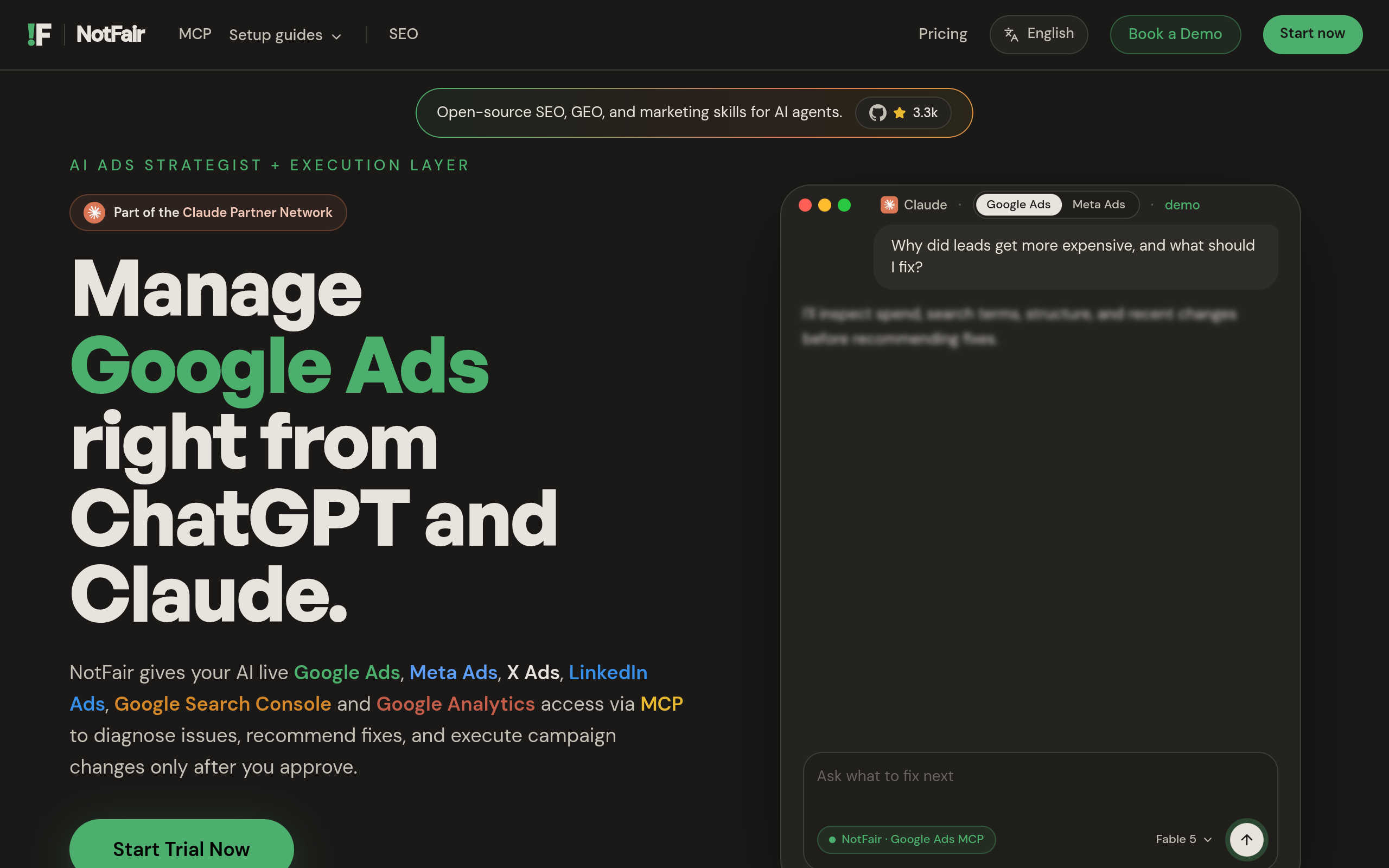
If you need help setting up and managing paid search during the launch, AI-powered Google Ads management can help you organize campaigns, audience signals, analytics, and marketing automation; following it helps you set up and manage paid Google Ads campaigns for qualified launch traffic: AI-powered Google Ads management
An illustrative starting policy is to test one audience, two message angles, and one conversion event before expanding. Set a modest budget you can afford to lose while learning, and define the maximum amount of spend without a qualified action. Adjust the policy when the campaign produces enough conversion data to distinguish a creative problem from a landing-page or product problem. If the audience clicks but does not activate, more spend is not the first fix.
Paid social can also be useful when the product has a visual or identity-driven use case, but the same discipline applies. Meta’s business documentation describes its Conversions API as a way to connect marketing data and improve measurement resilience across the customer journey (Meta Conversions API documentation). Treat tracking infrastructure as support for judgment, not as proof that a campaign is profitable.
Choose partners based on the work they will actually do
A marketing partner should be evaluated by the bottleneck they can remove. Ask whether they will clarify positioning, create channel-specific assets, manage media buying, improve conversion paths, or build durable search authority. Request the proposed measurement plan and the assumptions behind it before agreeing to activity.
If you need a partner to plan and optimize acquisition across brand, performance, creative, and conversion work, digital marketing services may help you choose a launch partner; following it helps you evaluate customer acquisition planning and optimization for the launch: digital marketing services
For organic discovery after the initial announcement, authority-building work should be relevant to the audience and transparent about sponsorship or relationships. If you pursue external articles, ask for editorial fit, real audience relevance, and a clear link policy rather than purchasing a large number of unrelated placements.
Guest posting services can help founders secure relevant guest posts and authority backlinks after launch; following it helps you plan organic discovery, link building, and digital PR that support long-term search visibility: guest posting services

Run launch week as an operating system
Launch week becomes chaotic when the founder treats every notification as equally important. Assign roles and create a response rhythm before the announcement goes live. Even a solo founder can use a simple schedule: monitor comments at defined times, reserve blocks for support, and protect time for product fixes.
Sequence the announcement instead of repeating it
A practical launch sequence might include:
- Preparation: confirm the landing page, tracking, onboarding, support route, and response templates.
- Context: publish the problem and the founder’s reason for building, without asking for a signup immediately.
- Launch: share the product, ideal user, core workflow, limitations, and one clear action.
- Demonstration: show a real use case or before-and-after workflow based on the launch audience.
- Conversation: answer objections publicly when appropriate and privately when sensitive.
- Follow-up: summarize what you learned, what changed, and who should try the product next.
Never hide material limitations to protect launch momentum. If the product is only suitable for one workflow, lacks a requested integration, or requires manual review, explain that plainly. Expectation management protects activation because the people who convert are more likely to understand the conditions for success.
Route feedback into decisions
Create labels for feedback such as onboarding confusion, missing capability, wrong audience, pricing objection, bug, and strong use case. Add the source and user type to every entry. This lets you distinguish a common product obstacle from a loud but isolated request.
- Fix immediately if it blocks the primary activation event and is feasible without destabilizing the product.
- Explain clearly if it is a limitation that does not invalidate the main use case.
- Queue for research if it appears repeatedly but serves a different segment.
- Decline or defer if it conflicts with the product’s intended focus.
An illustrative starting policy is to review feedback twice daily during the first three launch days and publish one internal decision log per day. Adjust that cadence if support volume threatens response quality or if your product has a slower buying cycle. The point is not constant monitoring; it is a short feedback loop with an owner and a decision.
Read the results and choose the next experiment
At the end of launch week, do not ask only whether the launch “worked.” Ask which part of the system was constrained: reach, relevance, trust, activation, or retention. The same number of signups can represent very different situations depending on what happened after registration.
Diagnose the funnel by failure pattern
| Observed pattern | Most likely constraint | Next experiment |
|---|---|---|
| Few qualified visits | Weak distribution, narrow reach, or unclear audience targeting | Test a more specific channel and rewrite the opening message |
| Many visits but few signups | Promise mismatch, weak trust, or unclear call to action | Align the page with the source message and remove competing actions |
| Signups but little activation | Onboarding friction or weak first-use value | Shorten setup and guide users to the core workflow |
| Activation but little return behavior | Low recurring need or missing habit trigger | Interview activated users about when the problem reappears |
| Strong interest from the wrong segment | Message is attracting a broader or different use case | Choose whether to narrow positioning or deliberately serve the new segment |
Compare sources by qualified activation, not traffic volume. A smaller community may produce more useful users than a larger feed if its members have stronger problem context. Also compare the language of activated users with the language used in your page. The gaps often reveal your next positioning improvement.
Set a post-launch decision window
An illustrative starting policy is to conduct a first review after three days for obvious blockers and a second review after fourteen days for repeat usage, referrals, or sales progression. These are starting policies, not benchmarks. Adjust them to your product’s natural usage frequency: a daily workflow can reveal retention quickly, while a quarterly planning product needs a longer observation period.
Choose one next experiment, not ten. Examples include:
- Replace a broad headline with a role-specific promise.
- Remove one onboarding step before the first useful output.
- Publish a case walkthrough for the highest-quality segment.
- Change the call to action from “learn more” to a concrete first task.
- Test a channel where the audience already discusses the problem.
Document the hypothesis, change, audience, primary signal, and stopping rule. A useful experiment states what result would support the change and what result would make you abandon it. This prevents endless polishing of a landing page when the real issue is that the product does not yet solve a frequent enough problem.
Start with one audience, one promise, and one measurable action
Your first move should be to open a launch scorecard and write one sentence in each of these fields: target user, urgent problem, product mechanism, primary conversion, supporting signals, and disqualifying signal. Then interview a small group that matches the audience, revise the message using their language, and prepare the shortest path to the first valuable action.
When the page, tracking, and onboarding are ready, you can submit your product launch to SuperPublic for discovery among independent builders and startup enthusiasts: submit your product launch
SuperPublic is designed for bootstrapped, pre-seed, and angel-funded founders who need a focused place to launch products, gain visibility, and connect with independent builders. Use it as one part of a measured distribution system, then let qualified activation and repeated user behavior determine what you improve next. SuperPublic
Authored with NotFair SEO