Founder field note
How to Compare Founder Communities For SaaS Launches
Compare founder communities for saas launches by launch visibility, customer feedback, peer support, and fit—then choose a channel for your next milestone.
To compare founder communities for saas launches, match each option to the job you need done: product discovery, customer feedback, ongoing peer support, or startup learning and co-founder matching. A launch platform can give your product a place to be presented and browsed; a founder network is better suited to discussion over time. Neither format, by itself, proves demand or guarantees customers. Choose the one that serves your next milestone, then judge it by what relevant people actually do.
For a bootstrapped founder, that distinction matters. A launch can create a reason for people to look at your product, while a focused conversation can reveal that your onboarding or positioning is unclear. Those are different contributions, so compare them separately instead of treating “exposure” as a complete launch plan. The framework below distinguishes community formats, helps you assess audience fit, and gives you a practical way to decide what to try.
Compare communities by the job your SaaS needs done
Start with the next decision, not a broad goal such as “get traction.” A useful goal describes something you can observe: whether a target user understands the product page, whether a relevant founder can help you reason through a pricing decision, or whether people looking for new software can find your launch. The more specific the job, the easier it is to rule out communities that cannot reasonably help.
Keep four jobs distinct. Discovery is about making a product findable and understandable. Feedback is about learning from someone’s response to a product, message, or task. Peer support is about discussing operating decisions with other founders. Founder formation covers learning startup fundamentals or connecting with a potential co-founder. A community may cover more than one job, but its label alone is not evidence that it does.
- For visibility: Look for a product listing, launch page, or browsing experience where someone can encounter your software without already knowing your name.
- For customer learning: Check whether you can reach people who resemble your intended users, not only people who enjoy trying new products.
- For founder advice: Look for a way to share context, ask follow-up questions, and learn from peers with relevant constraints.
- For learning or matching: Confirm that the program’s stated purpose is education or co-founder connection, rather than product promotion.
SuperPublic describes itself as an indie product launch and discovery platform, with launch submissions, launch-page publishing, browsing of newly launched products, product search, rankings, and founder community participation. Those capabilities make it relevant when your job is to present an early-stage product and make it available for discovery; they do not establish how many suitable buyers will see a particular launch or what response it will receive. SuperPublic’s site is the place to review the platform’s stated role.
Make a short comparison before investing time. For each option, write down its stated audience, its main participation format, and the evidence you would need to call it useful. This prevents a visible launch feed from being mistaken for customer research, or a friendly founder discussion from being treated as proof that buyers want the product.
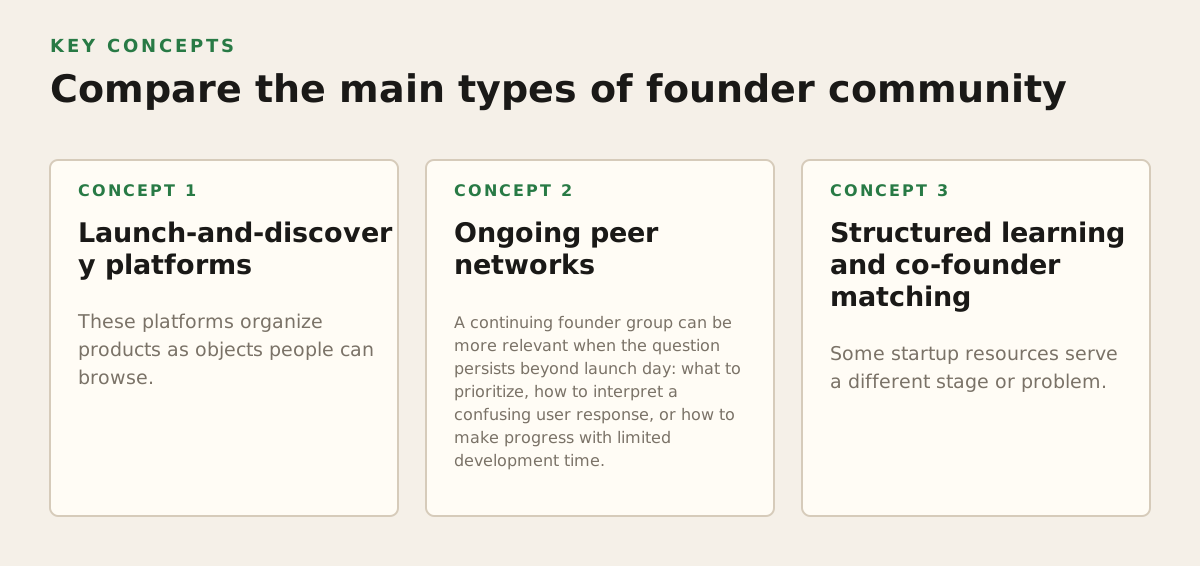
Compare the main types of founder community
Launch-and-discovery platforms
These platforms organize products as objects people can browse. They suit founders whose product is ready to explain clearly and whose immediate job is to put a launch in front of potential early adopters. The practical value depends on whether a visitor can understand the intended user, problem, and next step—not simply on whether a page exists.
Before submitting, review the page format and the products or launches that are visible. Ask whether the audience and categories plausibly overlap with your market, and whether a visitor can take a useful next action. A listing can act as a presentation surface and a discovery opportunity. It is not, by itself, evidence of qualified traffic, product use, or revenue.
Ongoing peer networks
A continuing founder group can be more relevant when the question persists beyond launch day: what to prioritize, how to interpret a confusing user response, or how to make progress with limited development time. Its value depends on the fit between members’ experience and your operating model. Advice for a bootstrapped SaaS may not transfer neatly to a team pursuing a different financing or growth path.
MicroConf describes its community around bootstrapped SaaS founders, which signals a potentially relevant audience for founders working on sustainable software businesses. That description does not establish how active a particular discussion is, whether it covers your exact issue, or what participation involves. Check the current details on MicroConf’s community page before deciding whether its format fits your needs.
Structured learning and co-founder matching
Some startup resources serve a different stage or problem. YC describes Startup School as a free online program for startup founders; that makes it worth considering when structured learning is the goal, not when your main need is a product listing or launch audience. Review Startup School’s official page for its current program information rather than assuming its format or terms.
YC’s co-founder matching service is directed at connecting prospective co-founders, not promoting a SaaS launch. That distinction matters if you are already operating a product: a matching service is not a substitute for a customer-feedback process or a channel for product discovery. Its current workflow and eligibility details are described on YC’s co-founder matching page.
Use format as a first filter, then compare the specific audience and participation rules. For example, a founder who has a working product but no clear route to early users should first assess discovery options. A founder with a steady stream of user conversations but a difficult prioritization choice may get more from peers who understand the business model. A person still exploring a founding team has a different job again.
Check audience fit before treating feedback as evidence
A community’s stated audience is a clue, not proof that its members are your buyers. Other founders may be able to spot confusing copy or a broken first-run experience, but they may not buy software for the role or workflow you serve. For a SaaS aimed at finance teams, for example, a founder’s reaction to the landing page can inform clarity; it does not establish that a finance decision-maker would purchase the product.
Write a one-sentence description of the target user and the problem before you post. Then compare that description with the community’s public conversations, product listings, or stated focus where available. Look for meaningful overlap: people discussing the problem, using adjacent tools, or operating at a similar stage. If you cannot assess that overlap from public information, ask the organizers how discovery or participation works instead of guessing.
Ask for a response tied to a decision. “Thoughts?” gives people little direction and leaves you with reactions that are hard to interpret. A bounded request tells them what to examine and what kind of feedback would help. Make clear whether you want a reaction to the message, a usability observation, an operating perspective, or a customer conversation.
- For page clarity: Ask which part of the description makes the intended user or problem unclear.
- For usability: Give someone a specific task and ask where they hesitated or expected a different result.
- For positioning: Ask which of two descriptions better explains the product to the target role.
- For founder advice: State the constraint behind the decision, such as limited build time or a narrow initial segment.
Suppose you are building appointment-reminder software for small clinics. Another founder may tell you that the setup instructions are confusing; that is useful usability feedback. A clinic administrator who explains how the reminders fit into their actual workflow can provide more relevant customer context. Keep those contributions separate in your notes, and do not present one as a replacement for the other.
Record who responded and what they did, not just whether the launch received positive comments. A page view, a question, a product trial, a completed workflow, and a conversation with a plausible buyer are different signals. Their meaning depends on the person and the action. Audience fit changes the weight of feedback: a response from outside your target market may still improve the product, but it cannot establish the same thing as a response from a likely user.
Assess the effort, format, and limits before participating
Communities require different kinds of work. A launch page needs a concise explanation and a clear destination. A peer group requires enough context for members to understand the decision and may be more useful when you participate in discussion rather than appear only to promote. A structured learning program asks for attention to its learning format. Compare that effort with the job you want done, and confirm current requirements with the organization itself.
Prepare a reusable launch brief with the intended user, the problem, what the product does, its current stage, and one specific request. Adapt the wording to each community’s norms. The underlying facts can stay consistent, but a product listing, a request for founder advice, and a usability test should not be presented as if they were the same post.
Before you join or submit, check the details that determine whether you can use the channel:
- What audience does the community say it serves, and can you see signs of that audience in its current public activity?
- Is the main format browsing, discussion, a learning program, or matching?
- What information or preparation does participation require?
- Can you make a clear request that fits the format without turning it into an unfocused promotion?
Do not assume that a platform controls what happens after a launch is published. A discovery page can make a product available to browse, but audience fit, product explanation, and follow-through still affect whether a visitor takes a meaningful next step. Likewise, peer advice can help you frame a decision, but you remain responsible for checking whether the advice applies to your users and constraints.
If a platform shows rankings or engagement signals, treat them as context about activity on that platform, not as a verdict on product quality or market demand. A product that attracts visible interest may serve a different audience from yours. A less prominent discussion may still surface a useful objection. Evaluate each signal against the question you set before participating.
Choose a community mix for your next launch milestone
Choose one primary option based on the milestone in front of you, then add a second only if it serves a distinct purpose. A bootstrapped team preparing a clear product page can prioritize discovery. A founder struggling with a product decision can seek a peer group that understands the operating context. Someone still learning startup basics or exploring a co-founder relationship should look at resources designed for those jobs.
Use a simple review after participating. Compare what you hoped to learn with what actually happened, and identify whether the people who responded were relevant to that goal. If the aim was customer learning, note whether anyone matching the target user tried the product or described their workflow. If the aim was founder support, note whether the discussion helped you make a decision or clarified what evidence you still need.
- For a launch milestone: Use a discovery-oriented format when the product is ready to explain and you want it available for browsing.
- For a product question: Bring a bounded request to peers, then validate customer assumptions with people who match your intended users.
- For founder formation: Choose learning or matching resources when education or a potential co-founder is the actual need.
- For a continuing channel: Keep using it when its contribution is specific and useful enough to justify the preparation and attention it requires.
For a launch-ready indie product, SuperPublic’s stated capabilities—launch submissions, launch-page publishing, and discovery of newly launched products—align with the job of making a product available for discovery. If that fits your next milestone, submit your product launch and evaluate the responses against your intended audience and goal. Explore SuperPublic for indie product launches, discovery, and founder community participation.
Authored with NotFair SEO