Founder field note
Founder Community: How Early-Stage Startups Build Useful Networks
Learn how a founder community helps indie startups earn feedback, users, partnerships, and visibility through practical, repeatable participation.
A founder community is a working network of startup builders who exchange feedback, introductions, knowledge, and attention around the difficult stages of creating a company. It is more useful than a promotional audience because members are expected to contribute context, not merely consume announcements. For a bootstrapped founder, that distinction affects where to launch, what to ask for, how to follow up, and how to tell whether participation is producing progress.
The strongest communities are not defined by a chat room, newsletter, or directory. They are defined by repeated exchanges between people with overlapping problems and complementary capabilities. A pre-seed team might need technical hiring advice, an indie hacker might need five honest onboarding sessions, and an early adopter might want access to tools before they become widely known. A functioning network creates a credible path between those needs.
What a Founder Community actually is
The term is often used for any group that contains founders, but that is too broad to guide decisions. A useful founder community has four properties: a recognizable member profile, a reason to return, a mechanism for useful exchange, and norms that reduce low-quality promotion. Without those elements, a group may still be pleasant, but it is not necessarily helping members build companies.
Membership is a role, not a title. A founder community can include bootstrapped operators, angel-funded teams, solo developers, early employees, advisors, investors, and customers. What matters is whether each person has a relevant reason to participate. A community for makers shipping software every week should not be judged by the same standard as a private network for venture-backed founders preparing a financing round.
Value moves in several directions. Founders may contribute product feedback and operational lessons while receiving distribution, referrals, or implementation help. Early adopters contribute attention and usage observations while receiving access to new tools and a chance to influence product direction. Investors may contribute pattern recognition or introductions, but their presence should not turn every discussion into fundraising theater.
A practical way to define the concept is:
- Shared context: members understand the constraints of early-stage work, such as limited time, incomplete data, and changing priorities.
- Recurring exchange: people have a reason to return after one launch, question, or introduction.
- Visible contribution: useful answers, feedback, launches, or experiments are easier to see than empty self-promotion.
- Trust mechanisms: members can judge relevance through history, specificity, and follow-through.
- Actionable outcomes: participation can lead to a user interview, product improvement, introduction, or qualified discovery.
That definition separates a community from a broadcast channel. A social profile can distribute an announcement. A founder network can help decide whether the announcement is ready, place it in front of relevant people, explain objections, and create a second conversation after launch.
Audience, network, and community are different assets
An audience is primarily one-to-many: a founder publishes and others read. A network is a set of possible relationships. A community adds shared norms and repeated interaction. These assets overlap, but they produce different jobs.
| Asset | Primary job | Useful startup question |
|---|---|---|
| Audience | Reach a known group with a message | Can the right people see this launch? |
| Network | Find relevant people and paths | Who can explain, introduce, test, or challenge this? |
| Community | Create repeated, trusted exchange | Will members return and help one another next month? |
This distinction matters when choosing a launch destination. A large audience may create impressions but little learning. A smaller, well-matched community may produce fewer visits and more useful conversations. For an early product, those conversations can expose positioning problems before the founder spends money on acquisition.
Why it matters before and after a launch
Early-stage companies usually have more uncertainty than resources. A founder community does not remove that uncertainty; it can make the next unknown cheaper to investigate. The benefit comes from shortening the distance between a question and someone who has relevant evidence.
Feedback becomes more specific when context is shared. “Would you use this?” is a weak request because it invites politeness and hypothetical answers. “Which step in this three-minute workflow would stop you from inviting a teammate?” gives a member a concrete observation to make. Communities can improve the quality of the question because members recognize common research mistakes.
Visibility is useful only when it reaches a plausible user. A founder of an internal documentation tool does not need every visitor to become a customer. They need operators who manage distributed teams, developers who maintain projects, or companies already feeling the cost of scattered knowledge. A launch post should therefore state the user, painful job, current workaround, and requested response.
Trust compounds through observable behavior. A founder who gives thoughtful feedback on three other products has created evidence that their own request is not purely extractive. This is not a manipulation tactic; it is how members assess whether an exchange is likely to be worthwhile. Specific contributions also give future partners a better basis for deciding whether to respond.
For a bootstrapped founder, community participation can support several jobs:
- Validate whether a problem is urgent enough to pay to solve.
- Recruit a small set of design partners without presenting a polished but untested story.
- Find implementation patterns for billing, onboarding, support, analytics, or distribution.
- Compare positioning against adjacent products and competing workarounds.
- Find collaborators, contractors, advisors, or potential early employees through demonstrated work.
- Build a durable source of referrals that does not depend on one algorithmic feed.
Search can extend the life of a useful launch discussion. Google’s documentation explains that descriptive titles, clear page content, and links help search systems understand and discover pages; it does not promise that a community post will rank. For a founder, the practical implication is to write a durable explanation of the problem rather than an announcement made only of slogans. See Google’s SEO Starter Guide for the underlying guidance.
Community participation lowers some research costs, not all business risk
A founder network can make recruitment and learning easier, but it cannot prove retention, willingness to pay, or a sustainable acquisition channel by itself. Members are often unusually helpful compared with the general market. That makes them valuable for discovery and potentially misleading for forecasting.
Use community feedback to answer narrow questions:
- Which phrase makes the problem recognizable?
- What workaround does the target user use today?
- Where does the first-use experience create hesitation?
- What evidence would make a buyer trust the product?
- Which integration, export, or collaboration need blocks adoption?
Then validate the most important answers outside the community. A founder should separate learning evidence from market evidence. Five detailed interviews can reveal a workflow flaw. They do not establish that thousands of similar buyers will purchase. That separation protects an early team from turning enthusiastic comments into an unsupported forecast.
How a Founder Community creates value
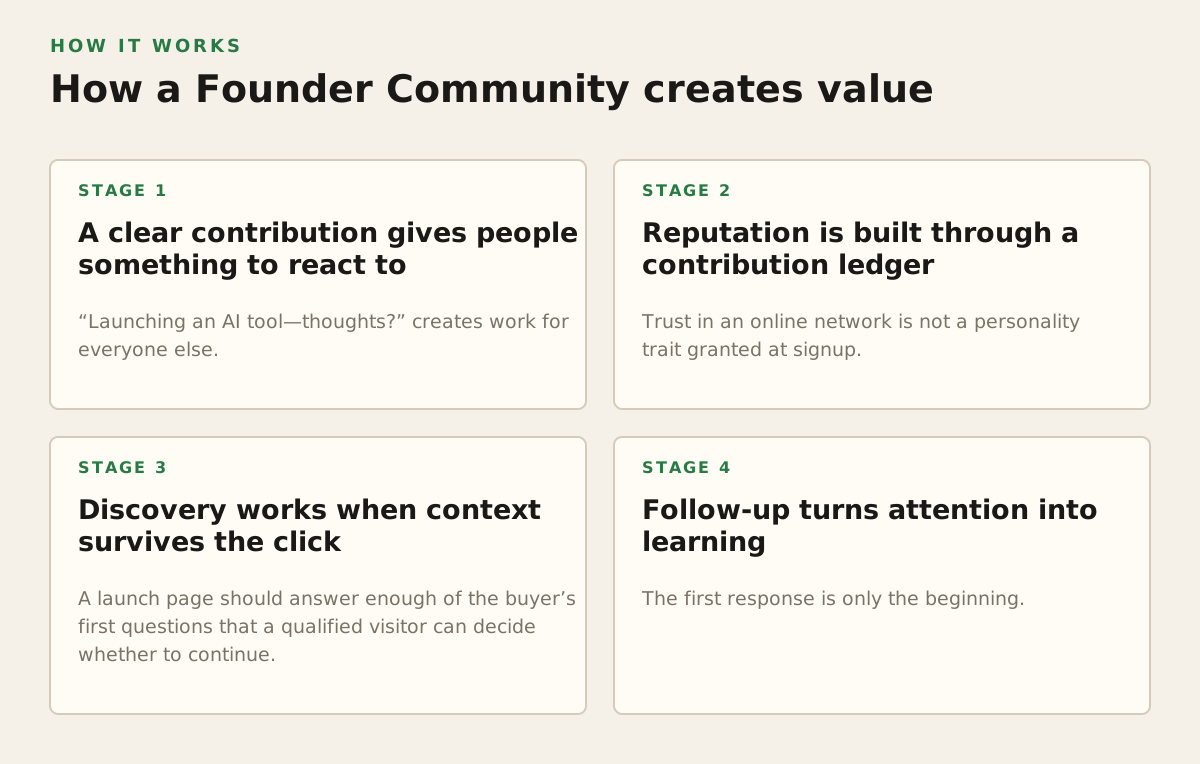
The value is produced by a sequence, not by membership alone. Someone brings a relevant problem or artifact; other members respond with information; the original contributor acts on it; the result becomes visible enough to help the next person. When this sequence breaks, participation feels like posting into a void.
1. A clear contribution gives people something to react to
“Launching an AI tool—thoughts?” creates work for everyone else. A better contribution names the audience, the workflow, and the decision where help is needed. For example: “I built an approval queue for small agencies that currently manage client revisions in email. I am deciding whether the first screen should prioritize due dates or unresolved comments. Which signal would your team need first, and why?”
Specificity reduces response friction. It tells members what kind of expertise is useful and prevents vague praise from becoming the default. It also makes responses comparable: several people can answer the same question from different contexts.
2. Reputation is built through a contribution ledger
Trust in an online network is not a personality trait granted at signup. It is an accumulation of observable actions. A simple contribution ledger can track:
- Feedback given that was specific enough to act on.
- Questions answered with links, examples, or relevant caveats.
- Introductions made only after confirming mutual relevance.
- Follow-up notes showing what changed after advice.
- Launches or experiments shared with honest results and limitations.
This ledger does not need to be public or formal. Its purpose is to stop the founder from treating community work as random posting. A useful starting policy for an illustrative example is to make two substantive contributions before asking for a launch review, then return with a follow-up within seven days. That is a policy to test, not a universal community rule.
3. Discovery works when context survives the click
A launch page should answer enough of the buyer’s first questions that a qualified visitor can decide whether to continue. At minimum, include:
- Who the product is for and who it is not for.
- The painful job or recurring workflow it addresses.
- What the user can do after signing up.
- What is unfinished, limited, or intentionally out of scope.
- The one action requested: try, critique, refer, or compare.
Google describes structured data as a way to provide explicit clues about the meaning of a page, while also noting that it does not guarantee enhanced search results. The lesson is modest but important: make the product, organization, and content understandable in the page itself rather than relying on community context alone. Google’s structured data introduction explains that distinction.
For early adopters, good discovery reduces the cost of evaluating an unfamiliar tool. For investors, it makes the company’s wedge easier to understand. For founders, it creates a public record of the problem and product that can keep working after the initial announcement loses attention.
4. Follow-up turns attention into learning
The first response is only the beginning. A founder should capture recurring objections, classify them, and decide what deserves action. A practical classification might include:
- Comprehension: people do not understand the product or its audience.
- Relevance: the problem is clear but not painful for this segment.
- Trust: buyers need proof, references, data handling details, or a safer trial.
- Usability: the product does not make the promised job easy enough.
- Distribution: the product works, but the discovery path reaches the wrong people.
Do not solve every comment. The goal is to detect patterns and choose a next action. A founder might rewrite the landing page after repeated comprehension issues, schedule interviews after relevance concerns, or instrument a key event after usability reports.
When measuring behavior, define the event before looking at the number. Google Analytics documentation distinguishes events as interactions or occurrences measured on a site or app, which is useful here because “engagement” is too vague to guide a decision. A founder can review Google’s Analytics events documentation when translating a launch goal into measurable actions.
How to participate without becoming promotional noise
Most communities do not reject promotion because launches are inherently bad. They reject promotion that extracts attention without adding information. The remedy is not to hide the product; it is to present the product as a relevant case study and make the requested exchange explicit.
Lead with the problem and evidence. Describe the workflow, the failed workaround, and what changed in the product. Avoid implying that a small amount of interest proves product-market fit. A credible launch can say, “The prototype handles the core workflow; reporting is still manual; I need feedback from teams with more than one approver.” That honesty helps the right people self-select.
Match the ask to the member. An early adopter can comment on usability. A founder may help with onboarding or pricing research. An investor may recognize category dynamics but may not be a suitable product tester. Asking every member for “feedback” produces shallow responses because the requested expertise is undefined.
Make the response easy and bounded. Three focused questions are usually easier to answer than a request for a complete review. If the founder needs a screen recording, five-minute call, or trial, state the expected effort and what will happen with the input.
An illustrative launch brief can use this structure:
- Audience: “Small software agencies with 5–20 active client projects.”
- Problem: “Revision requests are scattered across email and chat.”
- Change: “The product turns comments into a shared approval queue.”
- Evidence: “Three design partners completed the workflow; this is an early signal, not a market estimate.”
- Request: “I want six operators to identify the missing step before public launch.”
- Follow-up: “I will publish which objections changed the next release.”
The numbers in that example are illustrative planning values, not benchmarks. The important mechanism is the conversion of a broad launch into a defined exchange. A founder can change the quantities while preserving the structure.
Contribute before asking, but do not perform generosity
Thoughtful participation is not a points system. Ten shallow replies are less useful than one careful answer that helps another founder avoid a costly mistake. Good contributions often include a boundary: “This worked for a B2B workflow with a short sales cycle; I would not assume it applies to regulated buyers.” Caveats improve the information value of advice.
Members should also protect their time. Before giving feedback, ask what decision is pending and what the founder has already tried. Before making an introduction, confirm that both parties want it and explain why the match is relevant. Relevance is a form of respect; indiscriminate introductions damage trust for everyone involved.
GitHub’s official documentation describes Discussions as a place for questions, information sharing, announcements, and conversations within a repository community. That model illustrates a useful operating principle for startup networks: separate durable questions and knowledge from fast-moving chat where possible. The details differ by platform, but the distinction between searchable discussion and ephemeral conversation is practical. See GitHub’s documentation on Discussions.
Use a repeatable launch cadence
A community launch should have preparation, release, and follow-through. A starting policy for an illustrative example:
- Seven days before: ask one narrow problem question and note the language members use.
- Three days before: share the workflow or prototype and request objections, not applause.
- Launch day: publish the audience, use case, limitations, and one clear action.
- Within 48 hours: answer every substantive question and group similar objections.
- Within 14 days: report what changed, what did not, and what the next test will be.
This cadence is not a promise of reach or conversion. It is a way to prevent the common failure in which the founder disappears after asking for help. A short follow-up can be valuable even when the launch produced few signups because it shows what was learned and gives members a reason to engage with the next experiment.
Where founder communities break down
Communities fail for predictable reasons. The failure is often blamed on low engagement, but the underlying problem is usually a mismatch between incentives, audience, and operating rules.
Promotion overwhelms contribution
If every post is a launch and every comment says “great product,” the network stops producing useful information. Founders then leave for channels where they believe they can get better feedback, which makes the remaining content even more promotional. Moderators can interrupt this loop by requiring a concrete question, limiting repeated asks, and highlighting detailed replies rather than raw announcement volume.
The members are too similar
A group of founders can be supportive while still giving incomplete product advice. Founders tend to notice positioning and distribution questions; buyers notice procurement, workflow fit, and switching costs; technical users notice reliability and integration friction. A healthy network needs enough role diversity to challenge the builder’s assumptions without becoming so broad that context disappears.
People confuse popularity with validation
Likes, comments, and visits are signals of attention. They are not interchangeable with activation, retention, revenue, or referrals. A launch may perform well because the story is interesting while the product remains difficult to adopt. Conversely, a niche product may receive little public reaction and still earn a few serious evaluations.
Choose one decision per measurement window. If the question is whether the message is clear, track qualified clicks and the percentage of visitors who reach the relevant explanation. If the question is onboarding, observe completion of the first meaningful task. If the question is willingness to pay, ask for a concrete commitment rather than collecting compliments.
When using advertising or paid distribution to amplify a launch, do not confuse platform reporting with business truth. Google Ads explains that conversion tracking requires defining conversions and implementing measurement for the actions that matter; the platform’s reported conversions still need to be interpreted against the company’s own product data. The official Google Ads conversion tracking guide is a useful reference for that implementation distinction.
Privacy and confidentiality are treated casually
Early-stage founders often want rapid feedback, but a community is not automatically a safe place for unreleased customer information, private metrics, credentials, or proprietary code. State what can be shared and remove identifying details from examples. Members should never be pressured to disclose employer information or customer data to make a discussion more interesting.
Use a simple boundary checklist:
- Is the material public, deliberately shared with this group, or confidential?
- Does the example contain customer names, internal data, or personal information?
- Would the customer or teammate be comfortable seeing this exact wording?
- Can the question be answered with an anonymized workflow?
- Who owns the decision about publishing the follow-up?
Founders ask for outcomes the community cannot control
No community can guarantee users, investment, press coverage, or a successful launch. It can improve the quality of discovery and increase the number of relevant opportunities, but external decisions remain external. Promising certainty creates distrust and encourages members to optimize for appearances.
Set expectations in operational language: “We are seeking five qualified evaluations,” “We need objections from agency operators,” or “We want two introductions to teams with this workflow.” These are clearer than “Help us go viral.” They also let the founder judge the result without moving the goalposts.
How practitioners should apply a Founder Community in 2026
The right approach depends on the company’s current constraint. A founder with no clear user should not begin with a launch blast. A team with strong usage but weak distribution may need discovery and referrals. A product with repeated onboarding failures needs observation, not more reach.
Start with the bottleneck, not the platform. Write one sentence naming the constraint, the evidence available, and the next decision. For example: “We have trial users but do not know why solo consultants fail to complete setup; we need eight workflow observations before changing acquisition.” This sentence determines who belongs in the conversation and what request to make.
Then choose a community whose member roles match that bottleneck. A software launch and discovery platform can be useful when the need is to place an early product in front of founders, makers, and early adopters who understand incomplete products. A technical forum may be better for implementation questions. A customer-specific group may be better for workflow research. There is no reward for using the most famous channel if its members cannot answer the question.
A practical operating system for founders
Use a lightweight record for every meaningful community interaction. It can live in a spreadsheet or project system and contain:
- Member role and likely relevance.
- Question asked and evidence supplied.
- Founder hypothesis affected.
- Next action and owner.
- Date for follow-up.
- Whether the relationship should continue, pause, or become a customer conversation.
Review the record weekly. Look for repeated language, not merely high activity. If several independent members describe the product using the same unexpected phrase, consider whether that phrase improves positioning. If members consistently ask for a feature that does not fit the target segment, ask whether the segment or promise is wrong before adding scope.
A starting scorecard for an illustrative 30-day cycle might include the following concrete targets:
- Publish 4 useful contributions unrelated to your own launch.
- Request 6 qualified conversations tied to one product question.
- Record 12 recurring observations, separating compliments from objections.
- Ship 2 changes that directly address repeated friction.
- Report 1 follow-up update showing what changed and what remains uncertain.
Those figures are an example starting policy, not a universal benchmark. A solo founder with limited time might halve them; a team preparing a major release might increase them. The non-negotiable element is traceability from contribution to decision.
Apply different tactics by startup stage
Pre-idea or problem discovery: ask about current workflows, workarounds, and moments of urgency. Do not lead with a solution that forces people to approve your premise. Capture exact language and identify which respondents have actually experienced the problem recently.
Prototype stage: show one workflow and request observed behavior. Ask the tester to narrate what they expect before explaining the intended design. At this point, a community is most valuable as a source of contradiction and edge cases.
Early launch: state the product’s audience, current limitations, and requested action. Invite qualified users to try the core job, not merely visit the homepage. Track whether the right people understand the promise quickly enough to continue.
Early traction: share what is working without turning the community into an investor update stream. Seek referrals, integration advice, hiring connections, and explanations for churn. Members can help interpret patterns, but customer interviews and product analytics should remain the source of truth for customer behavior.
Expansion: protect the original norms as the audience grows. Add structure before noise becomes the default: topic labels, launch guidelines, searchable archives, and clear expectations for promotional frequency. Growth that removes trust is not necessarily community progress.
Use SuperPublic as one part of the loop
A launch should be treated as an experiment with a public artifact, a defined audience, and a follow-up plan. Founders who want to make the artifact discoverable can submit your product launch while clearly stating what stage the product is in and what kind of response would help. The goal is not to claim readiness that does not exist; it is to make the product legible to the people most capable of giving useful attention.
For early adopters and startup researchers, evaluate a launch by the quality of the problem description, the specificity of the product, and the founder’s response to criticism. For founders, prioritize communities where your contribution can be seen over time and where a serious conversation can continue after launch day.
In 2026, use a founder community as a feedback and relationship system, not as a substitute for customer research or distribution strategy. SuperPublic offers a focused place for indie founders to share early products, discover other launches, and connect with relevant builders; when that fits your bottleneck, SuperPublic.
Authored with NotFair SEO