Founder field note
Early Stage Startup: A Practical Guide to Validation, Launch, and Traction
Learn how an early stage startup can validate demand, choose launch channels, track traction, and avoid costly growth mistakes with confidence.
An early stage startup is a young company still proving that a specific group of customers has a painful problem, wants a particular solution, and will consistently exchange money, time, or access for it. It may have no revenue, early revenue, angel funding, or a profitable bootstrapped operation. Its defining condition is not age or fundraising status; it is unresolved business risk.
That distinction matters for founders launching software, AI tools, and subscription products. A polished product can still be searching for a repeatable customer, while a rough product with a handful of paying users may have stronger evidence of demand. The work at this stage is therefore not “look like a big company.” It is to reduce uncertainty in the right order, without spending scarce cash or engineering time on assumptions that have not earned investment.
What an Early Stage Startup actually is
Startup labels are useful only when they describe the company’s current job. “Pre-seed,” “seed,” “bootstrapped,” and “angel-funded” describe financing or ownership context. “Early stage” describes the company’s level of proof. A two-person SaaS company with 40 paying customers can still be early stage if it does not yet know which segment converts reliably or retains over time.
A practical definition has four parts:
- A narrow customer hypothesis: the team can name who has the problem, in what situation, and what they use today.
- A testable product promise: the product claims a concrete outcome rather than a broad category such as “better productivity.”
- Incomplete evidence: customer interviews, signups, usage, payment, retention, or referrals exist, but they do not yet form a predictable growth system.
- High-leverage decisions: a choice about audience, onboarding, pricing, or distribution can change the company’s trajectory more than incremental optimization.
Separate the company’s stages from its product stages
Founders often confuse a product being new with a company being early. A new feature inside a mature business is not necessarily an early-stage startup. Conversely, an established founder may create a genuinely early venture when the customer, product, and distribution assumptions are still unproven.
Use three questions to locate the business:
- Problem proof: Do target users repeatedly describe the problem without being prompted?
- Solution proof: Can users reach the promised outcome with the current product, even if the workflow is manual?
- Business proof: Can the company acquire similar customers through a channel at an economically sensible cost?
These questions prevent a common category error: treating a launch announcement, a waitlist, or a funding round as evidence that the business model works. Those events can create access to evidence. They are not evidence by themselves.
A useful risk map
For a bootstrapped founder, the biggest risk may be building for a problem people describe but do not pay to solve. For an angel-funded team, it may be spending a larger budget before discovering which audience responds. For an indie hacker, it may be mistaking enthusiastic feedback from peers for demand from the intended buyer.
Write the main uncertainty in one sentence:
“We do not yet know whether [specific customer] will use [product] to achieve [measurable or observable outcome] often enough to [pay, renew, refer, or switch].”
That sentence becomes the filter for launch activity. If the uncertainty is willingness to pay, collect payment or a serious buying commitment. If it is activation, observe users completing the core workflow. If it is discoverability, test a channel with a defined audience rather than posting everywhere.
Why this stage matters more than apparent momentum
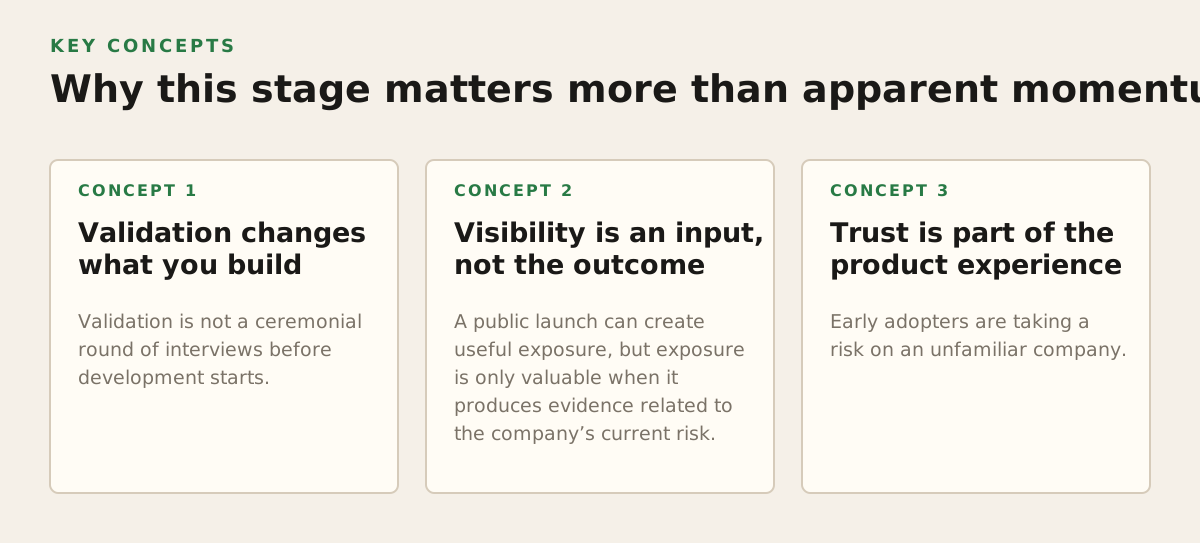
Early companies operate under compounding constraints: limited runway, incomplete data, small teams, and a product that may still change substantially. A wrong decision in this period can create months of work around the wrong customer or acquisition channel. The goal is not maximum activity. It is maximum learning per unit of scarce resource.
Validation changes what you build
Validation is not a ceremonial round of interviews before development starts. It is a sequence of tests that can change the product, audience, price, or launch plan. A strong test has a predicted result and a decision attached to it.
For example:
- If five of eight target operators independently describe the same weekly reporting problem, keep the problem hypothesis and test a workflow.
- If users request an export but do not complete the core action, investigate whether the product’s primary value is misunderstood.
- If free users activate but nobody accepts a paid pilot, question the buyer, urgency, or economic value rather than immediately adding features.
- If one niche converts while a broader audience ignores the product, narrow the positioning before increasing traffic.
These are decision rules, not universal benchmarks. The numbers above are an illustrative starting policy for a small team; the appropriate sample depends on the customer type, sales cycle, product complexity, and cost of reaching each participant.
Visibility is an input, not the outcome
A public launch can create useful exposure, but exposure is only valuable when it produces evidence related to the company’s current risk. A founder seeking early adopters might value qualified signups and completed workflows. A B2B founder may value three relevant discovery calls more than hundreds of casual visits. An investor researching emerging companies may care about the clarity of the customer problem, founder insight, and quality of early usage signals.
Build a launch objective around the next decision:
- Audience discovery: identify which segment responds to the problem statement.
- Activation: learn whether new users reach the first meaningful outcome.
- Conversion: test whether the value is strong enough for a paid action.
- Retention: determine whether the problem recurs and the product becomes part of the workflow.
- Referral: see whether users naturally bring in colleagues or peers.
Do not optimize all five at once. A product with unclear positioning can generate misleading activation data because the wrong people are arriving. A product with strong use but no retention may have solved a one-time task rather than an ongoing problem.
Trust is part of the product experience
Early adopters are taking a risk on an unfamiliar company. They need enough information to judge whether trying the product is safe in the practical sense: Will it waste time? Is the promise specific? Can they get help? What happens to their data? A clear launch page, founder identity, support route, and honest product boundaries often matter more than a long feature list.
Marketing claims also need discipline. The U.S. Federal Trade Commission says advertising claims must be truthful, not misleading, and supported by evidence where required; its guidance is available in the FTC’s online advertising and marketing guidance. For a new software company, that means replacing “save hours every week” with a precise explanation of what the product automates unless the stronger claim has appropriate substantiation.
How an early-stage company turns uncertainty into evidence
A useful operating system has four linked loops: understand the customer, deliver a first outcome, measure behavior, and make a focused distribution experiment. The loops should be short enough to repeat and explicit enough that the team can tell whether a result supports or weakens the original hypothesis.
1. Write a falsifiable customer and outcome hypothesis
Start with a sentence that includes the customer, trigger, current workaround, product action, and expected result:
“Independent design studios with three to ten active client projects will use [product] after a project handoff to turn scattered feedback into an approved task list within one working session.”
This is stronger than “Our tool helps teams collaborate” because it specifies a moment and an observable behavior. You can now recruit the right people, design the first-run experience, and decide what counts as activation.
Record assumptions in a table or simple document:
| Assumption | Evidence to collect | Decision if weak |
|---|---|---|
| The buyer experiences the problem weekly | Recent examples, workaround cost, urgency | Change segment or problem framing |
| The first workflow creates value | Completion and user-described outcome | Remove setup friction or narrow use case |
| The buyer can approve payment | Paid trial, invoice, or purchasing commitment | Change buyer, packaging, or price test |
| The channel reaches similar prospects | Qualified conversations and product starts | Stop the channel or alter the message |
2. Use the smallest credible test
A concierge workflow, clickable prototype, spreadsheet, manual report, or limited-access beta can answer a question before a full build. This does not mean pretending a manual service is a finished product. It means isolating the risky part. If the value depends on a report being accurate, produce the report manually for a few target users before building an automation engine.
Choose a test according to the uncertainty:
- Problem interviews: best for understanding triggers, alternatives, and consequences; weak for proving payment.
- Prototype walkthroughs: best for comprehension and workflow design; weak for proving repeated use.
- Paid pilot: best for urgency and buyer commitment; requires a clear scope and support expectation.
- Product launch: best for collecting qualified attention and comparing messages; weak if the audience is undefined.
- Retention observation: best for recurring value; requires a meaningful event and enough time for the use case to recur.
For an illustrative launch experiment, a founder might define a two-week policy: one audience, one promise, two distribution channels, and one activation event. The policy is not a market law. Its value is that it limits variables, making the result easier to interpret.
3. Define activation as an outcome
“Signed up” is usually a weak measure for a software startup. Activation should represent the first moment at which a user experiences the product’s promised value. For a meeting assistant, it might be generating and sharing a usable summary. For an invoicing tool, it might be sending a real invoice. For an AI research product, it might be producing a cited brief that the user uses in a decision.
Instrument the path with a small number of events:
- Account created or access granted
- Setup completed
- Core action started
- Core outcome completed
- Outcome shared, exported, paid for, or repeated
Google Analytics documentation describes events as interactions that can be measured, including user actions beyond page views; see the official Google Analytics events documentation. The technical tool is less important than event naming that maps to a business question. “Button clicked” rarely explains value; “first report delivered” can.
4. Treat launch distribution as a controlled experiment
Prepare a launch asset that makes the product legible in seconds:
- Who the product is for
- Which recurring problem it addresses
- What the user can do immediately
- What is deliberately not supported yet
- How to start and how to give feedback
Then choose channels based on audience behavior. A founder tool may reach users through maker communities, targeted newsletters, direct outreach, or a founder-focused product launch platform. A vertical operations product may need partnerships, specialist communities, or direct conversations with buyers. The channel is not “where founders post”; it is where the intended customer already has a reason to pay attention.
Founders can submit your product launch as one part of this discovery process, but the submission should support a broader experiment rather than replace one. A launch page is most useful when it gives visitors enough context to self-select and gives the founder a clear next step, such as trying the workflow, joining a pilot, or describing a comparable problem.
Where early-stage startup plans break
Most failures in this phase are not caused by a lack of effort. They come from treating a weak signal as strong evidence, changing too many variables at once, or optimizing a visible metric that is disconnected from the business decision.
Vanity traction disguises product risk
Traffic, impressions, waitlist entries, social reactions, and launch-day comments can be encouraging. They become useful only when connected to behavior that matters. A visitor who reads a page has shown interest in a message. A user who completes the core workflow has shown more. A customer who returns for the recurring problem has shown stronger evidence still.
A practical signal hierarchy is:
- Attention: the person notices or visits.
- Intent: the person requests access, replies, or books time.
- Activation: the person reaches the first meaningful outcome.
- Value exchange: the person pays, signs a serious pilot, or commits internal resources.
- Durability: the person repeats the behavior, renews, or refers a comparable user.
Do not skip directly from attention to a growth forecast. Each step filters out a different kind of uncertainty.
Broad positioning creates expensive confusion
“For anyone who wants to work smarter” may sound expansive, but it forces every visitor to translate the product into a use case. Early products benefit from a narrower promise because a specific audience can recognize relevance quickly and give more precise feedback.
Narrowing does not permanently limit the company. It creates a beachhead where the team can learn vocabulary, workflow, objections, and buying triggers. Expand only when the adjacent audience shares enough of the problem and the product’s delivery mechanism still works.
Feature requests can pull the roadmap apart
Early users are valuable, but every request is not a roadmap priority. A request may indicate:
- A missing capability required by the core segment
- A workaround for confusing onboarding
- A need from a different customer type
- A preference that does not affect the buying decision
- An integration demanded by one high-value account
Ask what job the request supports, how often the job occurs, and whether it affects activation, payment, retention, or expansion. Keep a request only when its evidence connects to the current strategy. Otherwise, record it without promising delivery.
Acquisition can outpace learning
Paid traffic, launch promotions, and broad partnerships can bring visitors before the product is ready to explain or support them. This creates noisy feedback and can exhaust a small team. Before increasing acquisition, check whether a new user can reach the core outcome without founder intervention and whether support requests reveal a fixable pattern.
When using advertising, landing-page relevance is a material part of the experience. Google’s official Google Ads guidance on landing-page experience emphasizes relevance, useful content, and navigability as considerations. The operational lesson is simple: send a specific audience to a page that continues the promise they just saw, not to a generic homepage with every feature.
Security and reliability are postponed too literally
A small startup does not need every enterprise control on day one, but it does need to understand what data it handles and what promises it makes. A product storing customer documents, financial information, health-related content, or private company data should treat access control, deletion, backups, incident response, and vendor dependencies as product decisions—not paperwork for later.
The baseline can be proportionate:
- Document what data is collected and why.
- Limit internal access to what the team needs.
- Provide a reliable way to remove accounts or data where appropriate.
- Separate test data from live customer data.
- State unsupported security or compliance claims plainly.
For a security planning framework, the NIST Cybersecurity Framework organizes cybersecurity work around identifying, protecting, detecting, responding, and recovering. It is not a shortcut to compliance, but it is a useful way for a small team to identify neglected operational risks.
How practitioners apply the model in 2026
The best early-stage operating plan is a sequence of constrained bets. Each bet has an owner, a timebox, a success signal, and a next action. This keeps the founder community, product team, and potential investors focused on evidence rather than activity theater.
For a bootstrapped SaaS founder
Protect cash by prioritizing the customer segment that can be reached and supported without a large sales operation. Start with a workflow where the founder can observe the outcome directly. If users need substantial setup, sell a guided pilot rather than hiding the effort behind a free signup.
An illustrative 30-day plan might look like this:
- Days 1–7: interview recent users and non-users in one narrowly defined segment; document the current workaround.
- Days 8–14: remove one onboarding obstacle and define one activation event.
- Days 15–21: publish a focused launch page and invite qualified prospects through two selected channels.
- Days 22–30: review completed outcomes, paid commitments, support friction, and repeat usage; choose one change for the next cycle.
This is an illustrative starting policy, not a universal timeline. A product with a long implementation cycle should use milestone completion rather than daily activation, while a lightweight consumer tool may learn faster from repeated sessions.
For a pre-seed team seeking visibility
Make the launch useful to three groups without writing three unrelated messages:
- Potential users: need to recognize the problem and understand the first action.
- Potential supporters: need a clear reason to share or introduce the product.
- Potential investors: need to see what has been learned, what remains uncertain, and why the next experiment matters.
Prepare a compact evidence brief before announcing the product. Include the target user, problem trigger, current workaround, product promise, activation definition, known limitations, and the next test. Avoid unsupported market-size claims or inflated forecasts. A candid “we are testing whether operations leads will replace a spreadsheet workflow” is more informative than a claim to transform an entire industry.
Use launch feedback diagnostically. Separate comments about the idea from behavior inside the product. Ask people who praise the concept what they would replace, when they would use it, and who controls the budget. Those questions turn applause into a qualification signal.
For an angel-funded founder
Funding gives a team more time and capacity; it does not remove the need to identify a repeatable customer. Create an explicit spending gate for each major investment:
| Investment | Evidence to require first | Risk if premature |
|---|---|---|
| Additional engineering capacity | Repeated demand for the same core workflow | Faster delivery of an unclear product |
| Paid acquisition | Defined conversion and activation path | More expensive noise |
| Enterprise features | Multiple target accounts with the same requirement | Custom work that fragments the product |
| Full-time sales hire | Repeatable pitch, buyer, and qualification criteria | Scaling an unproven sales motion |
The thresholds should be set by the team as a starting policy and revisited as evidence changes. The important practice is not a particular number; it is refusing to turn a single enthusiastic prospect into a company-wide roadmap.
For an indie hacker launching an AI or software tool
Lead with the job completed, not the underlying technology. “Generate a draft client brief from three source files” is easier to evaluate than “AI-powered knowledge assistant.” If the output can be wrong, disclose where review is required and design the workflow around verification.
Track the difference between a generated output and a useful output. A useful output may be edited, exported, shared, or used in a downstream task. That distinction protects the product from optimizing generation volume while customers still perform the difficult work manually.
For discoverability, make the launch page concrete:
- Show the input and resulting output using safe sample data.
- Name the intended user and the task’s trigger.
- State the current limits, including formats, workflows, or review requirements.
- Offer one feedback route with a specific question.
- Invite users who match the target profile, not every curious visitor.
For early adopters evaluating a new product
Early adopters can give founders better feedback by describing the job, not merely requesting features. Explain what you tried before, how often the problem occurs, what a successful result looks like, and what would make the product worth continuing to use.
Before committing sensitive work, check the product’s data practices, support expectations, export options, and failure modes. A small product may be a strong fit for experimentation while still being unsuitable for confidential or business-critical workflows. That is not a criticism; it is a deployment decision.
A specific operating recommendation for the next launch
Run your next launch as a learning instrument with a business outcome, not as a popularity contest. Choose one customer segment, one recurring problem, one activation event, and one decision that the launch must inform. Publish a precise promise, disclose meaningful limits, and direct qualified visitors into a workflow where their behavior can teach you something.
Before launch, write down the following:
- The customer you want to attract and the customer you will politely discourage.
- The event that proves the visitor reached the first meaningful outcome.
- The evidence that would make you narrow, change, or continue the current positioning.
- The support capacity you can actually provide during the launch window.
- The next product or distribution decision that depends on the result.
After launch, review evidence in order: qualified attention, intent, activation, value exchange, and durable use. If attention is high but activation is low, fix the message or first-run experience. If activation is high but payment is weak, investigate urgency, buyer authority, and packaging. If payment occurs but use does not repeat, examine whether the product solves a recurring problem or merely delivers a one-time convenience.
That sequence gives a bootstrapped founder a disciplined way to spend cash, a pre-seed team a credible story about learning, an angel-funded company a basis for investment gates, and early adopters a clearer way to discover products worth trying. SuperPublic supports that process by helping founders launch and helping people discover new indie products; when you are ready, SuperPublic can be a practical next step for putting a focused launch in front of a relevant founder audience.
Authored with NotFair SEO