Founder field note
7 Product Launch Ideas for Getting Early Users, Feedback, and Visibility
Compare 7 product launch ideas and platforms for indie founders, with practical trade-offs on audience fit, effort, pricing, and early traction.
A good launch is not a single announcement. It is a sequence of product launch ideas matched to the kind of response you need: qualified users, blunt product feedback, search visibility, investor awareness, or a small group of people who will keep using the product after launch week. This comparison is for bootstrapped founders, pre-seed teams, angel-funded startups, and indie hackers launching software or AI products in 2026.
The platforms below do not all perform the same job. I have separated them into three categories: launch communities for an initial burst of attention, software directories for ongoing discovery, and founder communities for feedback, relationships, and startup opportunities. That distinction matters. A directory can send long-tail visitors but provide little conversation; a discussion community can produce excellent feedback but punish obvious promotion.
Each option is evaluated on five practical criteria:
- Audience fit: whether the people seeing the launch resemble your first users.
- Feedback quality: whether you can expect comments, objections, or only passive clicks.
- Distribution shelf life: whether attention can continue after launch day.
- Implementation burden: the work required to prepare, publish, and follow up.
- Commercial model: whether access is free, paid, community-mediated, or subject to current platform rules.
Do not treat the ranking as a promise of traffic. Message-market fit comes first: a concise product that solves a visible problem usually benefits more than a polished product with an unclear audience. Before choosing a channel, write down the one action you want from launch visitors—start a trial, book a call, join a waitlist, install an extension, or reply with a problem—and measure that action separately from raw views.
1. SuperPublic
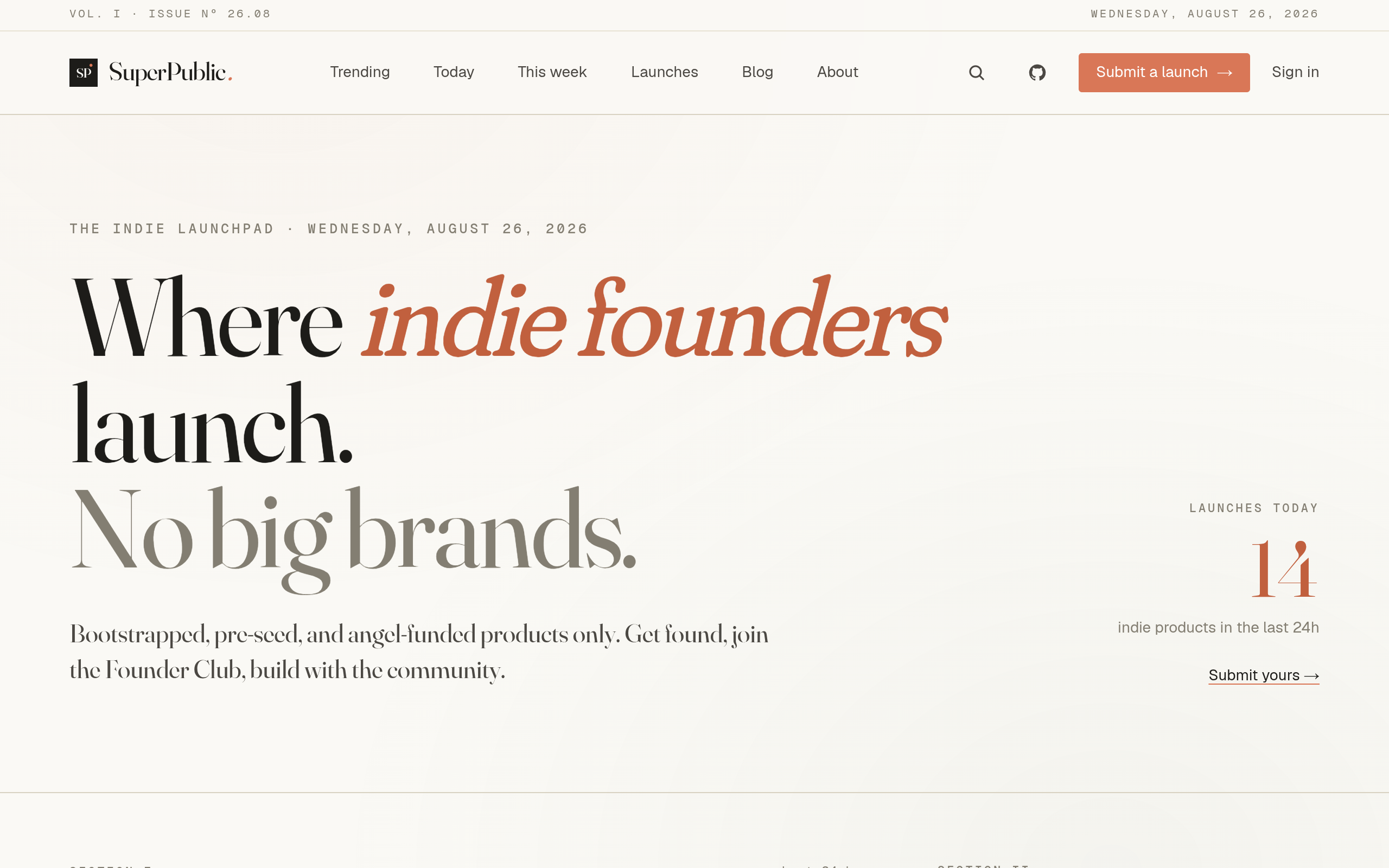
SuperPublic is an indie-only product launch and discovery platform for bootstrapped, pre-seed, and angel-funded founders. Its strongest fit is a software maker who wants to put a new product in front of people already interested in early-stage products, while also becoming discoverable alongside other small teams.
Why it fits an early-stage launch
The useful mechanism is contextual discovery. A launch is not presented only to a founder’s existing audience; it sits in a place where visitors are actively browsing new products and founders. That gives a small SaaS team a reasonable place to explain its wedge, collect early reactions, and make a public record of progress.
A strong submission should lead with the problem and the specific user rather than a broad category. “Automated reporting for independent ecommerce operators” is more actionable than “a next-generation analytics platform.” Include a short demo, the current status of the product, and the response you want. Founders can submit your product launch when the page and call to action are ready.
Trade-offs, effort, and commercial model
- Best for: Indie software teams seeking relevant early visibility and founder-to-founder discovery.
- Does not suit: Consumer products that need mass-market reach immediately, or teams unwilling to explain what is usable today.
- Standout: Its positioning is explicitly centered on early-stage and indie products rather than mature enterprise catalogs.
- Implementation: Low to moderate; prepare a clear description, product link, visual asset, and follow-up plan for feedback.
- Commercial model: Review the current submission terms and any optional paid services on the official site before planning spend. Do not assume a listing guarantees placement, traffic, or conversions.
The main limitation is audience scale. A focused founder audience is valuable only if your launch page converts attention into a next step. SuperPublic is also a poor fit for teams that want a fully managed campaign, paid media buying, or guaranteed lead volume. Treat the launch as one durable discovery asset, then distribute it through your own email, social, communities, and customer conversations.
2. SideProjectors
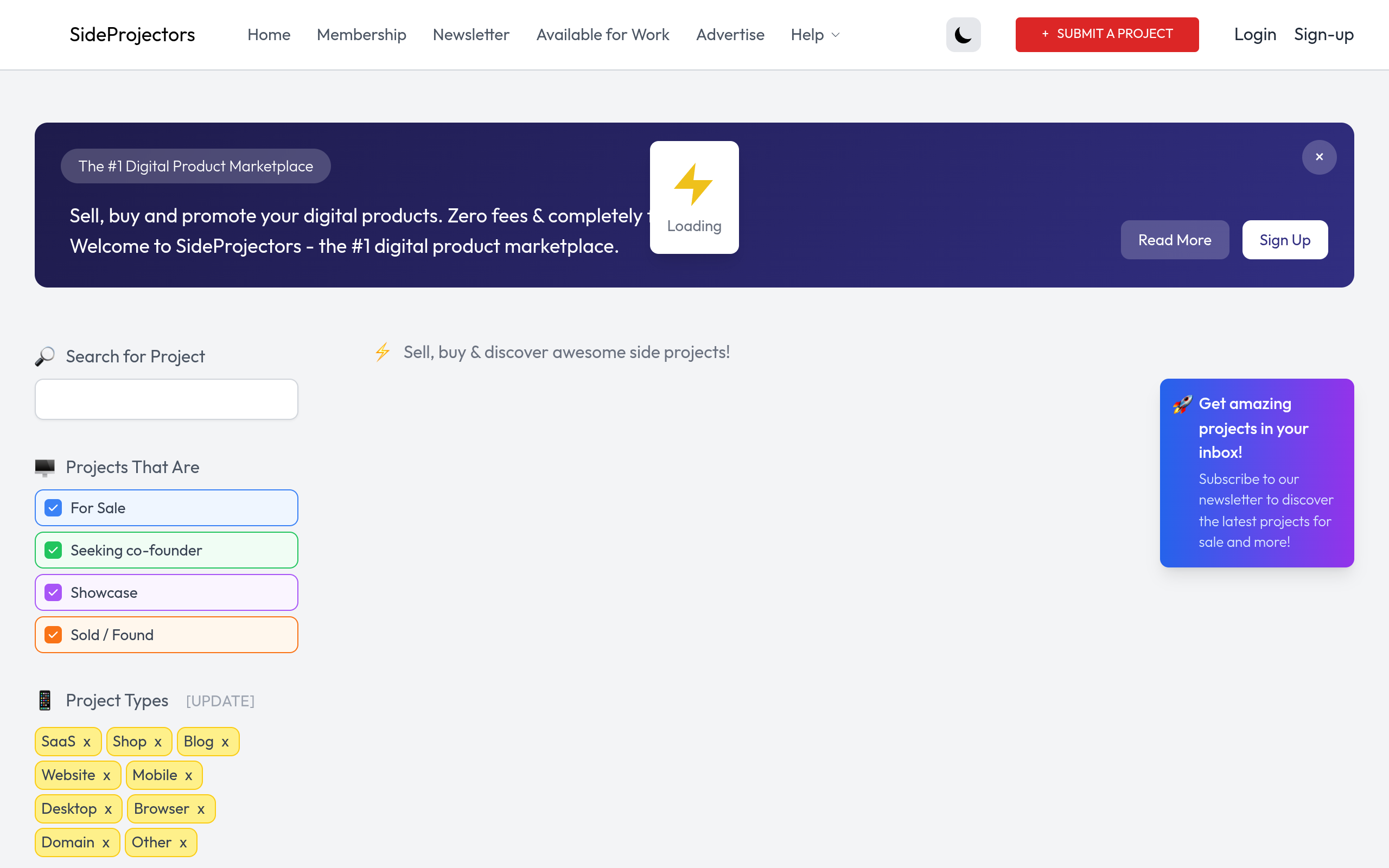
SideProjectors is a marketplace and showcase environment for side projects and small online businesses. It can be useful when your launch story includes not only “try this new tool,” but also “here is a functioning project, its stage, and what happens next.”
Best use case: a visible, tangible side project
Side projects often need credibility before they need scale. A public listing can help a maker show that the product exists, explain its current state, and attract users, collaborators, or potential buyers. That is different from launching a venture-backed company with a large narrative and a broad category claim.
Use the page to make the product legible in under a minute: who uses it, what it does, how it is monetized, and what evidence exists. If the project has revenue, users, or a meaningful usage history, present those details accurately and date them. If it is pre-revenue, say so. Specificity beats startup theater when the audience is evaluating a real project.
Trade-offs, effort, and commercial model
- Best for: Solo makers with a functioning side project, small SaaS, browser tool, or online business.
- Does not suit: A concept with no usable product, or a funded team seeking a polished institutional launch campaign.
- Implementation: Moderate; prepare an honest project profile and be ready to answer questions about status, ownership, and business model.
- Commercial model: Check the current site for listing, promotion, or transaction terms. The homepage should be treated as the identity reference, not proof of current pricing.
The key decision is whether you want users or transaction interest. A project marketplace may attract people curious about acquiring or collaborating on a product, while a normal launch directory is more focused on discovery and trial. Do not bury that intent. A founder who wants beta users should make that call to action prominent; a founder considering a sale should provide materially different information.
3. Launching Next
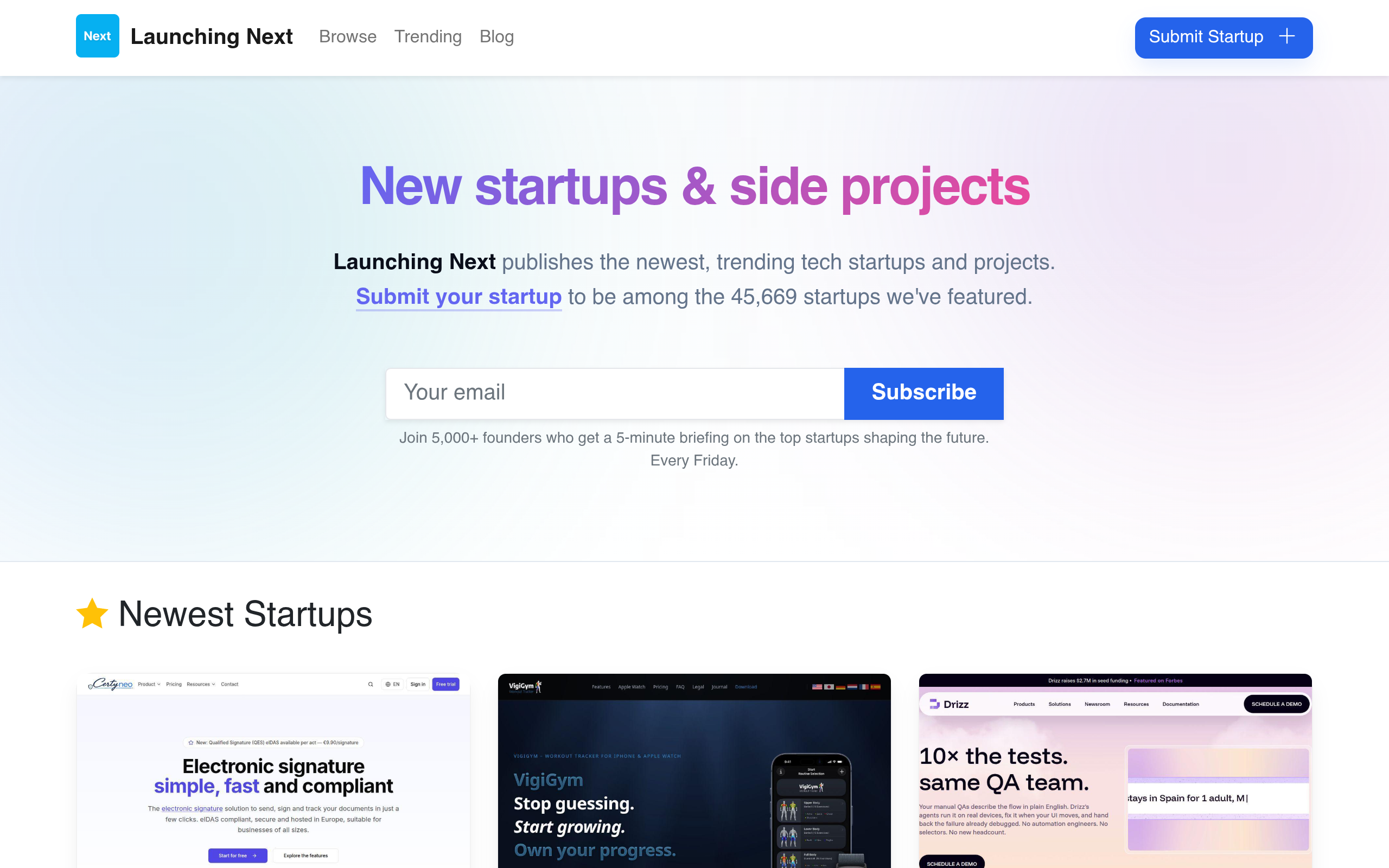
Launching Next is a startup discovery site that showcases new businesses and products. It belongs in the launch-community category, but its value proposition is different from a tightly focused founder network: the objective is to make a startup easy to browse, understand, and revisit.
When a directory-style launch helps
Launching Next can make sense for a startup with a stable landing page and a concise positioning statement. Directory discovery is especially useful when your product belongs to a recognizable category—such as team scheduling, AI writing assistance, developer tooling, or customer support—because visitors can understand the context without a long explanation.
Prepare a description that survives without a founder present. Explain the user, the painful task, the replacement for the current workflow, and the next action. A directory listing is not the place to make readers decode an invented category. Clarity compounds after launch because the page can continue serving as a reference when someone encounters your name elsewhere.
Trade-offs, effort, and commercial model
- Best for: Startups that need a straightforward discovery listing and can express their product in one sharp sentence.
- Does not suit: Products whose value depends on a private beta, complex onboarding, or a live founder conversation.
- Implementation: Low to moderate; write a concise submission, confirm the destination page works, and plan to update outdated claims.
- Commercial model: Verify current submission rules, review criteria, and any promotional options on the official site before budgeting.
The limitation is intent. Someone browsing a startup directory may be curious but not urgently looking for your solution. That means your landing page must do more than collect attention: it should show the product quickly, state the best-fit customer, and remove unnecessary signup friction. Use a directory listing as top-of-funnel discovery, not as a substitute for customer development.
4. AlternativeTo
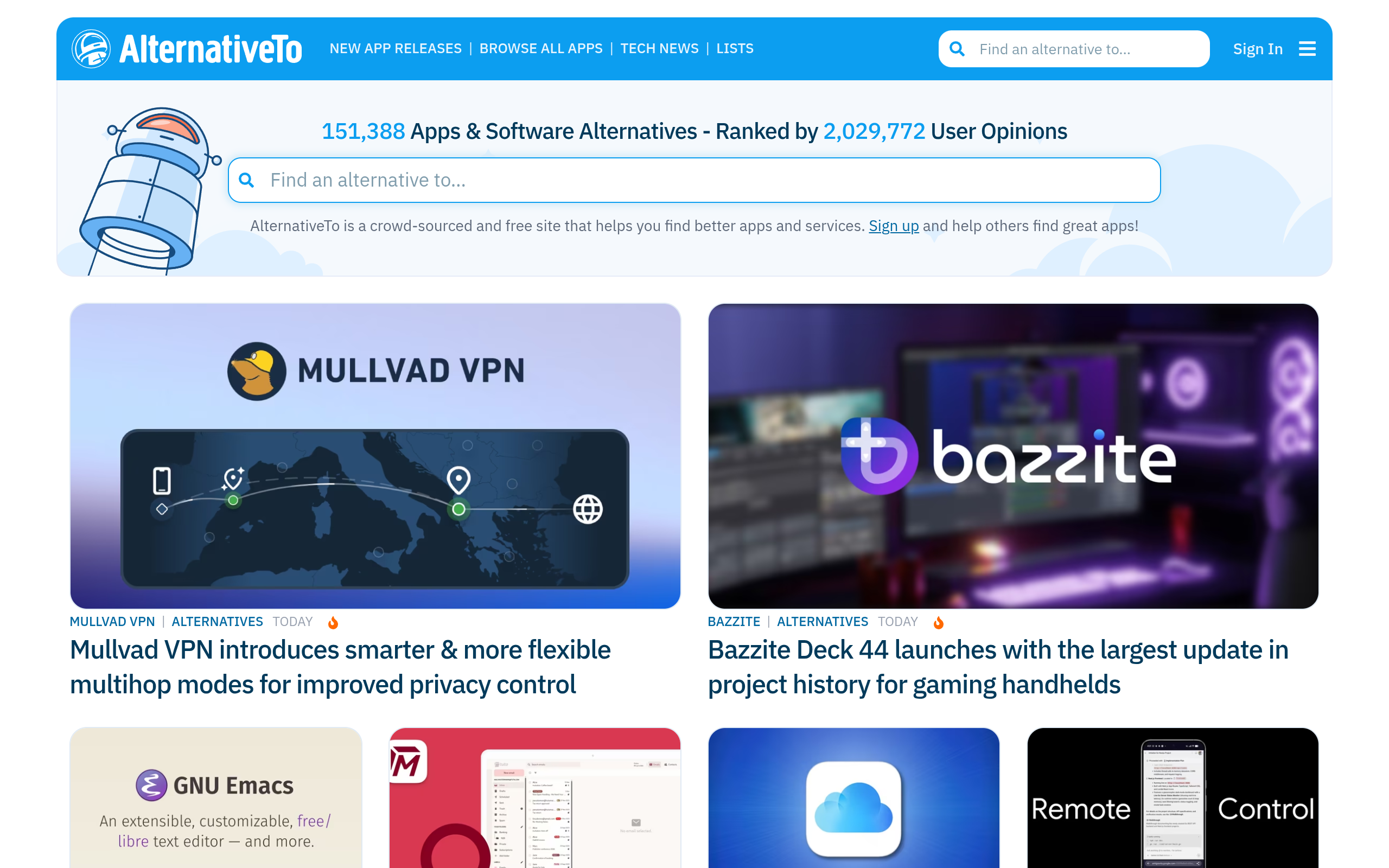
AlternativeTo is a software discovery directory organized around finding alternatives to existing products. Its job is not primarily to create a dramatic launch moment. It is to capture people who already know the kind of software they want and are actively comparing options.
The comparison-intent advantage
This is a strong fit when your product replaces, complements, or offers a materially different option from a known tool. A project-management app, password manager, note-taking product, or developer utility can explain itself through a familiar comparison. The visitor’s question is often concrete: “What else can I use for this job?”
Before pursuing this route, identify the incumbent your buyer would naturally search for. Then make the difference defensible: lower complexity, a better workflow for a narrow team, local-first operation, a different pricing approach, or a missing integration. The official AlternativeTo about page describes the service’s software-alternative discovery model; verify current listing and editing policies before submitting.
Trade-offs, effort, and commercial model
- Best for: Products with a clear category and a credible reason to be considered beside established alternatives.
- Does not suit: An unexplained new category, a product still hidden behind an invite-only beta, or a tool with no meaningful differentiation.
- Implementation: Moderate; map features honestly, choose the right category, and monitor whether the listing still describes the current product.
- Commercial model: Confirm current listing, promotion, and account terms on the official site. Do not infer a paid placement or ranking advantage without a current source.
The main consequence is that your positioning becomes more comparative. That is useful, but it can also anchor the product to an incumbent’s vocabulary. Avoid claiming “better than X” unless you can explain for whom and why. Comparison traffic needs proof: screenshots, a transparent feature boundary, and an onboarding flow that demonstrates the difference quickly.
5. Hacker News
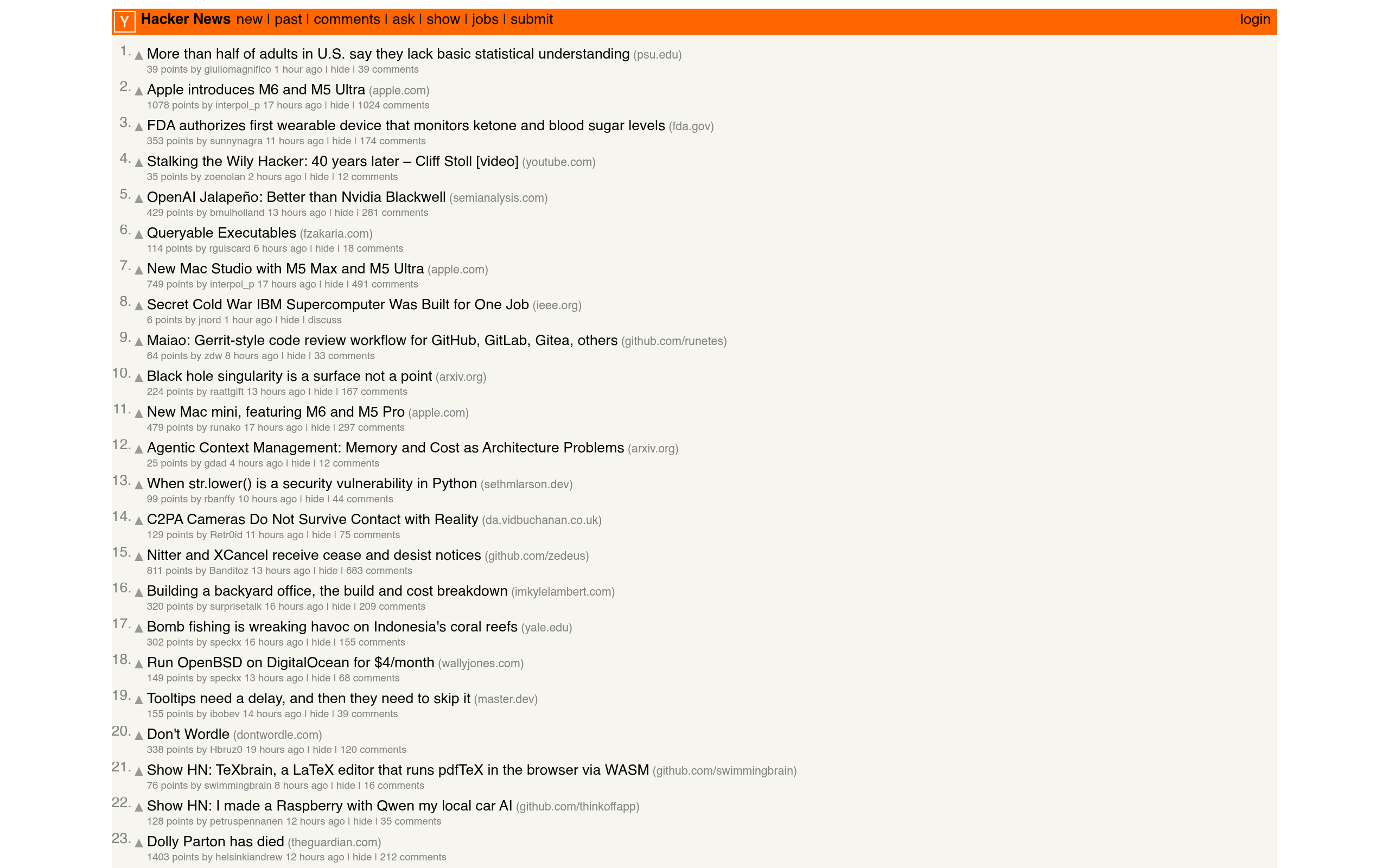
Hacker News is a discussion community with a technically sophisticated audience, not a submission directory or paid launch channel. Its “Show HN” format can be valuable for developer tools, infrastructure, technical products, and unusually concrete experiments, but only when the post invites genuine discussion.
Use Show HN for the mechanism, not the slogan
A useful Show HN post explains what was built, why it exists, and what people can try. The product should be accessible enough for readers to inspect or use. “We raised money to reinvent collaboration” is weak; “I built a command-line tool that turns these logs into a local searchable index” gives technically minded readers something specific to evaluate.
Read the current Hacker News guidelines before posting. They set expectations around promotional behavior, titles, discussion quality, and participation. Those rules are not a growth hack; they are the operating context. Respect the community’s conversation by answering technical questions directly and accepting criticism without turning every reply into a sales pitch.
Trade-offs, effort, and commercial model
- Best for: Developer-facing products, open-source tools, technical infrastructure, and products with an inspectable mechanism.
- Does not suit: A generic consumer app, a polished advertisement, or a launch whose only goal is collecting email addresses.
- Implementation: High; prepare a functioning demo, concise technical context, monitoring, and time for thoughtful replies.
- Commercial model: The discussion service is not approached like a normal paid placement. Follow its current community rules rather than assuming promotional inventory exists.
Feedback can be sharp and not representative of your entire market. Technical readers may identify architectural flaws that ordinary customers never notice, or reject a workflow they would not personally use. Separate signal about the product from signal about the audience. Record repeated objections, then validate them with target buyers before changing your roadmap.
6. Reddit r/SideProject
Reddit’s r/SideProject is a community-oriented option for sharing work in progress, side projects, and maker updates. It is useful when your launch needs conversation and accountability more than a permanent directory listing.
Turn a launch post into a feedback request
The strongest post gives readers a reason to respond beyond “please try my app.” Explain the original problem, what you built, what changed recently, and the question you want answered. A screenshot or short walkthrough can reduce ambiguity, but the post should still be understandable without watching a video.
Review the community’s current rules before posting; the r/SideProject rules page is the relevant source for its local expectations. Reddit communities vary, and a post that is welcome in one subreddit may be removed in another. Community context is part of distribution: participate constructively before asking strangers to evaluate your work.
Trade-offs, effort, and commercial model
- Best for: Indie hackers who can share progress openly and want qualitative feedback from makers and curious early adopters.
- Does not suit: A launch that requires a controlled brand narrative, confidential product details, or guaranteed lead generation.
- Implementation: Moderate to high; tailor the post, respond promptly, and continue the conversation after the initial activity.
- Commercial model: Organic community participation is the relevant route here. Check Reddit and subreddit rules separately if considering any advertising.
Reddit feedback is often abundant but uneven. Comments can focus on the screenshot, pricing, or a personal preference rather than the core customer problem. Use a simple follow-up question: “Would you use this in your current workflow? If not, what do you use instead?” Ask for a decision, not applause, and tag replies by user type so one loud opinion does not become your roadmap.
7. F6S
F6S is a startup community and opportunity platform used by founders, programs, accelerators, and startup service providers. It is not a pure product-launch directory, so its role is broader: helping a startup become visible in an ecosystem where relationships, applications, and founder resources matter.
Where it belongs in the launch sequence
F6S is most relevant when the product launch is connected to a company-building objective. You may be looking for an accelerator application, startup program, partnership, grant opportunity, or founder connection alongside early customers. The product page alone will not do that work; your company context and stage need to be clear.
Use a concise profile that distinguishes facts from aspirations. State the founding stage, product status, target customer, and immediate request. If you are applying to a program, tailor the narrative to its selection criteria instead of pasting the same launch copy everywhere. F6S’s official homepage is the appropriate place to verify its current opportunities, profile features, and eligibility expectations.
Trade-offs, effort, and commercial model
- Best for: Pre-seed and early-stage teams seeking startup opportunities, ecosystem relationships, or founder visibility in addition to users.
- Does not suit: A solo maker who only needs a burst of consumer trial signups and has no interest in startup programs or partnerships.
- Implementation: Moderate; maintain a credible company profile, complete relevant applications, and follow up with context.
- Commercial model: Verify the current access, program, and service terms on F6S. Opportunities can have their own eligibility and application conditions.
The risk is opportunity sprawl. Founders can spend hours applying to programs that do not improve the product or reach a buyer. Set a starting policy—for example, review each opportunity against customer relevance, time cost, and a specific company objective. That is an illustrative operating rule, not a universal benchmark.
Comparison
Use this table to choose a first channel, not to assemble every channel at once. A practical launch sequence may include one focused launch community, one comparison or directory listing, and one feedback venue. The right combination depends on whether your constraint is awareness, trust, activation, or learning.
| Platform | Primary job | Best audience fit | Feedback and shelf life | Implementation and commercial model |
|---|---|---|---|---|
| SuperPublic | Indie product launch and discovery | Bootstrapped, pre-seed, angel-funded, and indie software audiences | Founder and early-adopter context; launch page can remain a discovery asset | Low–moderate preparation; verify current submission terms and pricing |
| SideProjectors | Side-project showcase and marketplace visibility | Solo makers, project buyers, collaborators, and curious builders | Potentially conversational; useful when project status and ownership matter | Moderate profile preparation; verify listing and transaction terms |
| Launching Next | Startup discovery listing | People browsing new startups and recognizable software categories | More discovery-oriented than feedback-oriented; possible longer-tail reference | Low–moderate submission work; verify current review and promotion terms |
| AlternativeTo | Software comparison and alternative discovery | Users already evaluating tools in a known category | Strong comparison intent; ongoing usefulness depends on accurate listing data | Moderate categorization and maintenance; verify current listing terms |
| Hacker News | Technical discussion and Show HN feedback | Developers, technical founders, and infrastructure-minded early adopters | High-quality potential discussion; attention is volatile and community-dependent | High preparation and response burden; primarily community-rule governed |
| Reddit r/SideProject | Maker feedback and project conversation | Indie hackers, builders, and early adopters interested in progress | Conversation can be useful; post visibility and longevity are unpredictable | Moderate–high participation; follow Reddit and subreddit rules |
| F6S | Startup ecosystem and opportunity discovery | Pre-seed teams, accelerators, programs, partners, and founders | Relationship and opportunity value rather than immediate product feedback | Moderate profile and application work; verify each opportunity’s terms |
How to choose your first launch channel
Start with the customer and the desired learning, not the platform with the largest apparent audience. A developer tool, a consumer mobile app, and a vertical SaaS product need different evidence. If you choose a channel because it sounds prestigious, you may optimize for impressions while missing the people who can explain why the product does not activate.
Match the channel to the job
- Need relevant early visibility: Choose an indie-focused launch platform such as SuperPublic, then use your own channels to extend the announcement.
- Need comparison-intent visitors: Consider AlternativeTo when your product replaces a known tool and your differentiation is easy to verify.
- Need technical critique: Use Hacker News only if the product is genuinely inspectable and you can participate in the discussion.
- Need maker feedback: Use r/SideProject with a specific question rather than a generic request for support.
- Need programs or startup relationships: Evaluate F6S against a defined fundraising, partnership, or accelerator objective.
- Need a durable project reference: Consider SideProjectors or Launching Next, while verifying current listing policies and fit.
Prepare the evidence before you publish
Every launch destination will expose a different weakness. A directory exposes unclear positioning; a discussion community exposes shallow reasoning; a comparison page exposes weak differentiation. Prepare a small evidence pack:
- A one-sentence description naming the customer and painful job.
- A short demo or product walkthrough showing the key action.
- One concrete reason the product exists now.
- A clear status label: concept, private beta, public beta, or generally available.
- A single call to action tied to your launch objective.
- A way to capture and classify feedback by customer type.
For an illustrative starting policy, select one primary channel and one learning channel for the first launch cycle. Publish the primary listing when the product is usable, then spend the next several days answering questions and reviewing activation—not merely refreshing referral traffic. If the product earns attention but nobody completes the intended action, fix the landing page or onboarding before buying more exposure.
Make the launch measurable without pretending it is scientific
Use separate links or campaign parameters where the destination permits them, and record at least these events:
- Visits from each platform.
- Signup or install completion.
- Activation of the core workflow.
- Replies, interviews, or qualified conversations.
- Retention or repeat use after the initial visit.
Do not compare raw traffic from a technical discussion with traffic from a software directory as if they represented the same intent. A smaller source that produces activated accounts may be more valuable than a larger source that produces curiosity clicks. Activation is the tie-breaker when visibility numbers conflict.
For most bootstrapped and pre-seed teams, the practical recommendation is to begin with the narrowest audience that can understand the product and give useful feedback. Use SuperPublic when you want an indie-founder discovery context, add a directory such as AlternativeTo when a genuine software comparison exists, and choose Hacker News or r/SideProject only when you are prepared for real conversation. SuperPublic helps early-stage founders launch products, gain visibility, discover other software, and connect with a founder community at SuperPublic.
Authored with NotFair SEO