Founder field note
6 Launch Platforms for Early Stage Startup Companies in 2026
Compare 6 launch platforms for early stage startup companies, with audience fit, implementation effort, pricing models, and practical launch advice.
For early stage startup companies, a launch platform is not just a place to post a logo. It is a distribution choice: you are deciding where to find early adopters, what kind of feedback to request, how much preparation a launch requires, and whether the attention can turn into activated users. This comparison covers six credible platforms for bootstrapped, pre-seed, and angel-funded software teams that want visibility and useful conversations rather than a vague spike in traffic.
The buyer job is specific: get a new software product in front of relevant early adopters and founders, then give those people a clear path to try it, respond, or share it. These platforms are not interchangeable. Some are launch-day communities, some are product directories, and some are founder networks where the relationship matters more than the announcement.
How this comparison works
A launch platform should be judged against the stage and constraint of your company, not against the biggest possible traffic number. A solo founder with a usable beta may need conversation and product feedback. An angel-funded team with a polished SaaS product may need a coordinated launch day. A developer tool may benefit from technical credibility more than general browsing volume.
I use five criteria throughout the list:
- Audience fit: Are the people likely to understand, try, and recommend an early product?
- Launch mechanics: Does the platform support a concentrated launch, an evergreen listing, or ongoing founder discussion?
- Implementation burden: How much work is required before and during publication?
- Commercial model: Is the core route community-led, directory-led, paid, or a mixture that needs current verification?
- Conversion usefulness: Can you learn who arrived, what they wanted, and whether they reached activation?
Use the list as a route-selection tool, not a promise of traffic. Platform audiences, policies, ranking systems, and pricing can change. Before committing a launch date, check each official site for its current submission rules and commercial terms.
1. Product Hunt
Best use: a concentrated public launch for a polished product
Product Hunt is the strongest fit here when your product can be explained quickly, demonstrated visually, and supported by a team ready to answer questions on launch day. Its format encourages a burst of public attention around a product page, maker profile, comments, and community reactions. The official launch area is the right place to review the current process before preparing assets: Product Hunt’s launch page.
The mechanism is concentration. You are not merely publishing a directory entry; you are arranging a moment in which the product, maker, supporters, and visitors interact. That creates upside for a compelling product, but it also exposes weak positioning. If the headline is unclear or the onboarding is unfinished, more visitors simply create more evidence of the problem.
For a project-management SaaS, for example, the launch should show the specific workflow it replaces, identify the intended team size, and make the first-use path obvious. “A better productivity tool” is too broad. “Turn customer interview notes into assigned follow-ups” gives the visitor a reason to click.
Operational fit and limitations
- Best for: A product with a credible demo, clear visual assets, and founders available for same-day replies.
- Does not suit: A private beta that cannot show enough of the experience, or a team seeking only quiet, one-to-one research conversations.
- Standout: The concentrated launch format makes positioning feedback visible and immediate.
- Watch: Supporters should understand the product and use it honestly; manufactured activity can damage trust.
Implementation burden is medium to high. Prepare a concise description, product images or video, maker information, a landing page, onboarding, analytics, and a response plan. Treat launch day as customer support plus research, not as a scheduled social post. Tag campaign links so you can separate Product Hunt visitors from direct traffic; Google’s official Analytics guidance explains how campaign parameters are used for attribution at Google Analytics Help.
The commercial model is primarily community and platform exposure, with current product terms and any optional promotional services requiring verification on the official site. It does not suit founders who cannot monitor comments or who are still changing the core promise every few days. If the product needs a narrow professional audience rather than broad tech discovery, a smaller, more targeted route may produce better conversations.
2. BetaList
Best use: introducing an early product before it is fully mature
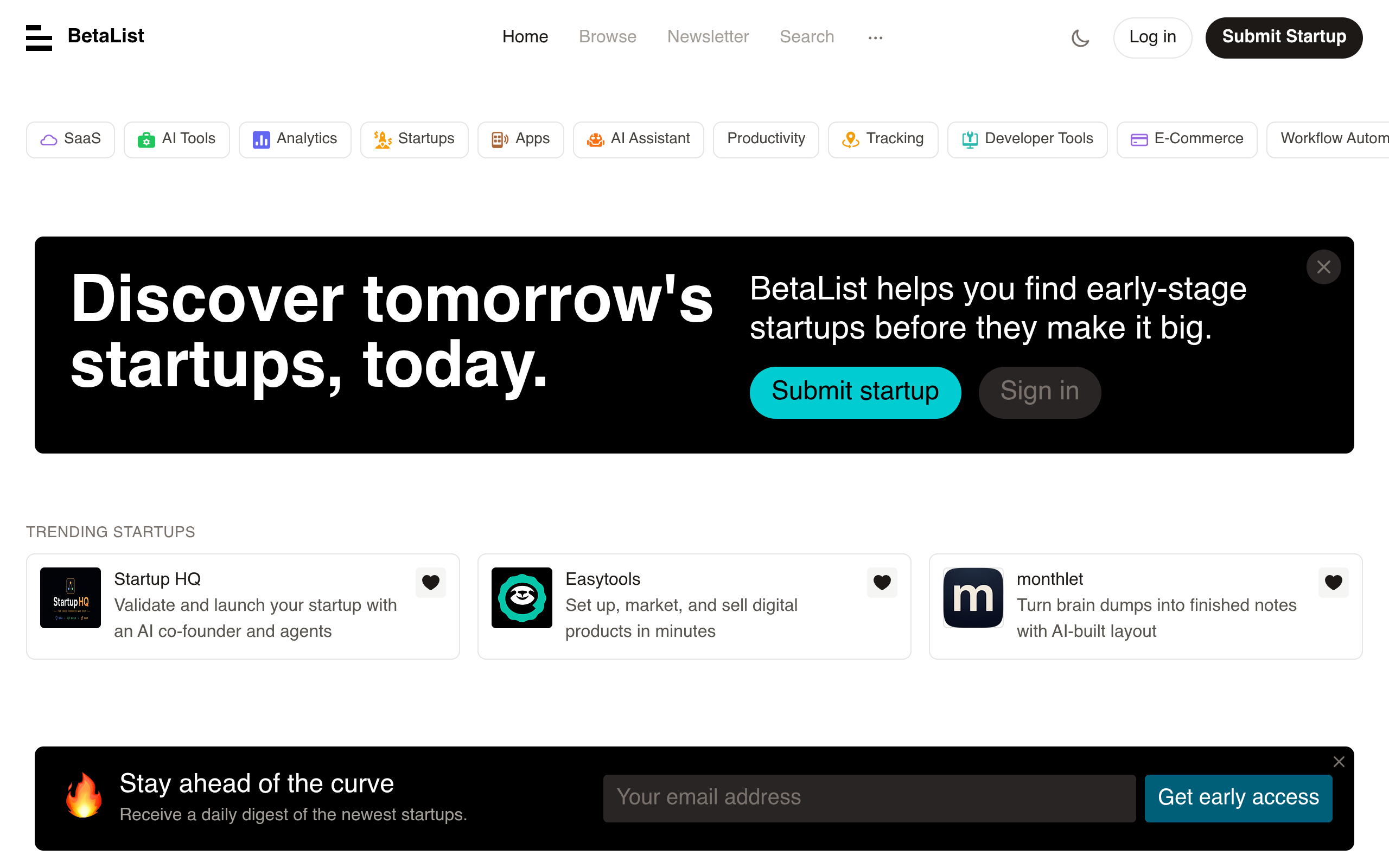
BetaList is designed around discovering startups and new products, making it a natural fit for teams that want early adopters while the product is still developing. Its positioning is particularly relevant when you need people willing to try something new, tolerate rough edges, and provide feedback rather than expect a finished enterprise buying process. Review the current submission route at BetaList’s official submission page.
The important distinction is timing. A BetaList-style listing can work before a major public launch, when the goal is to build an initial waitlist or recruit testers. That means your call to action should not pretend the product is ready for every customer. Ask for the right next step: join the beta, request access, or try the working workflow.
A founder building an AI research assistant might use the listing to recruit users who regularly conduct interviews, then ask each signup what “research” means in their job. The learning comes from comparing promised use cases with actual activation, not from counting email addresses alone.
Operational fit and limitations
- Best for: A pre-launch or beta-stage product with a credible signup path and a clearly stated access status.
- Does not suit: A mature sales-led company that needs procurement conversations, security reviews, or account-based targeting.
- Standout: The audience expectation is compatible with products that are still inviting early users.
- Watch: A waitlist without a follow-up experiment becomes a vanity asset rather than a learning channel.
Implementation burden is moderate. You need a concise listing, a strong product explanation, a usable signup flow, and an email sequence that tells accepted users what happens next. Create one feedback question tied to the product’s riskiest assumption. For example, if the risk is setup complexity, measure how many invited users complete setup rather than asking whether they “like” the idea.
The commercial model can include submission or promotional options, so verify current eligibility, review requirements, and pricing directly on BetaList before treating it as a budget line. The platform does not suit teams with no capacity to onboard beta users. Early adopters are not a substitute for QA, documentation, or customer support; if you cannot respond to their friction, the listing may produce disappointment instead of advocacy.
3. Indie Hackers
Best use: founder-led distribution, accountability, and product discussion
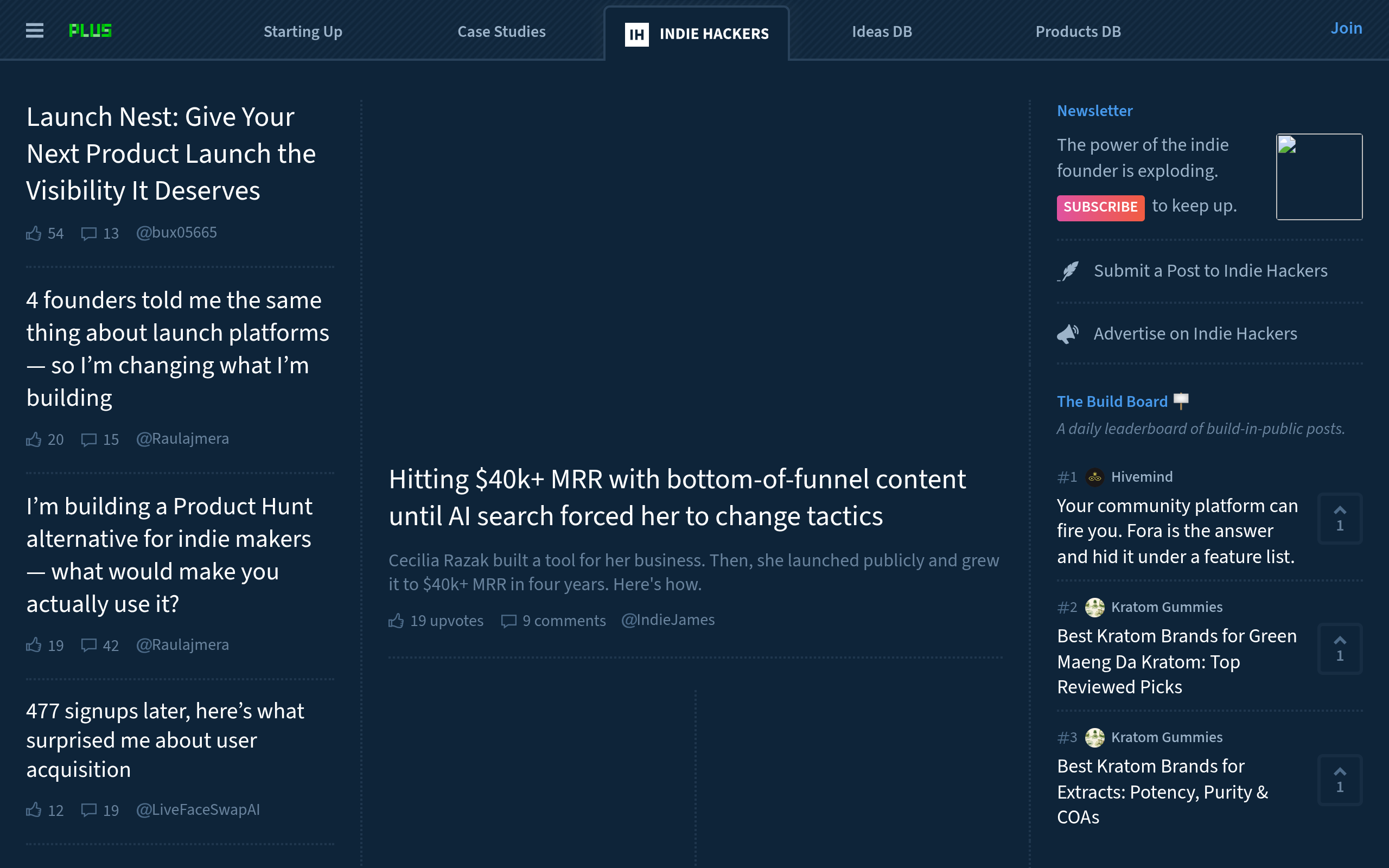
Indie Hackers is a founder community rather than a conventional launch-day ranking site. Its value is strongest when the founder wants to explain the problem, share progress, ask for informed feedback, and build relationships with people who understand bootstrapping and early revenue constraints. The official products area is available at Indie Hackers Products.
This route rewards context. A post that says “I made an app, try it” gives the community little to respond to. A post that explains the customer, the failed workaround, the decision behind the first version, and the exact feedback needed gives other founders something useful to evaluate.
It can also support a longer launch arc. A solo founder may share the initial problem, publish an early version, report what users did, and return with a revised onboarding flow. That sequence creates more opportunities for useful discussion than a single announcement, provided each update adds evidence rather than recycled promotion.
Operational fit and limitations
- Best for: Bootstrapped founders who can share decisions transparently and participate in ongoing discussion.
- Does not suit: Teams wanting a one-click promotional blast with little founder involvement.
- Standout: The community context can make qualitative feedback more actionable than anonymous reactions.
- Watch: Founder-to-founder interest does not automatically equal buyer demand in your target market.
Implementation burden is moderate but sustained. The difficult part is not creating a profile; it is showing up with a useful question, responding to comments, and distinguishing advice from evidence. Build a small tracking sheet with the commenter, their role, the problem they recognized, their next action, and whether they match your intended customer.
The commercial model is community-led, with current posting and product-profile rules best verified on the official platform. Indie Hackers does not suit a founder who wants to outsource distribution entirely or who cannot tolerate public discussion of unfinished work. It is also a weak primary channel if your buyers are not founders or adjacent makers; use the conversations to sharpen the product, then validate demand with the people who actually pay.
4. Uneed
Best use: directory discovery for a focused software launch
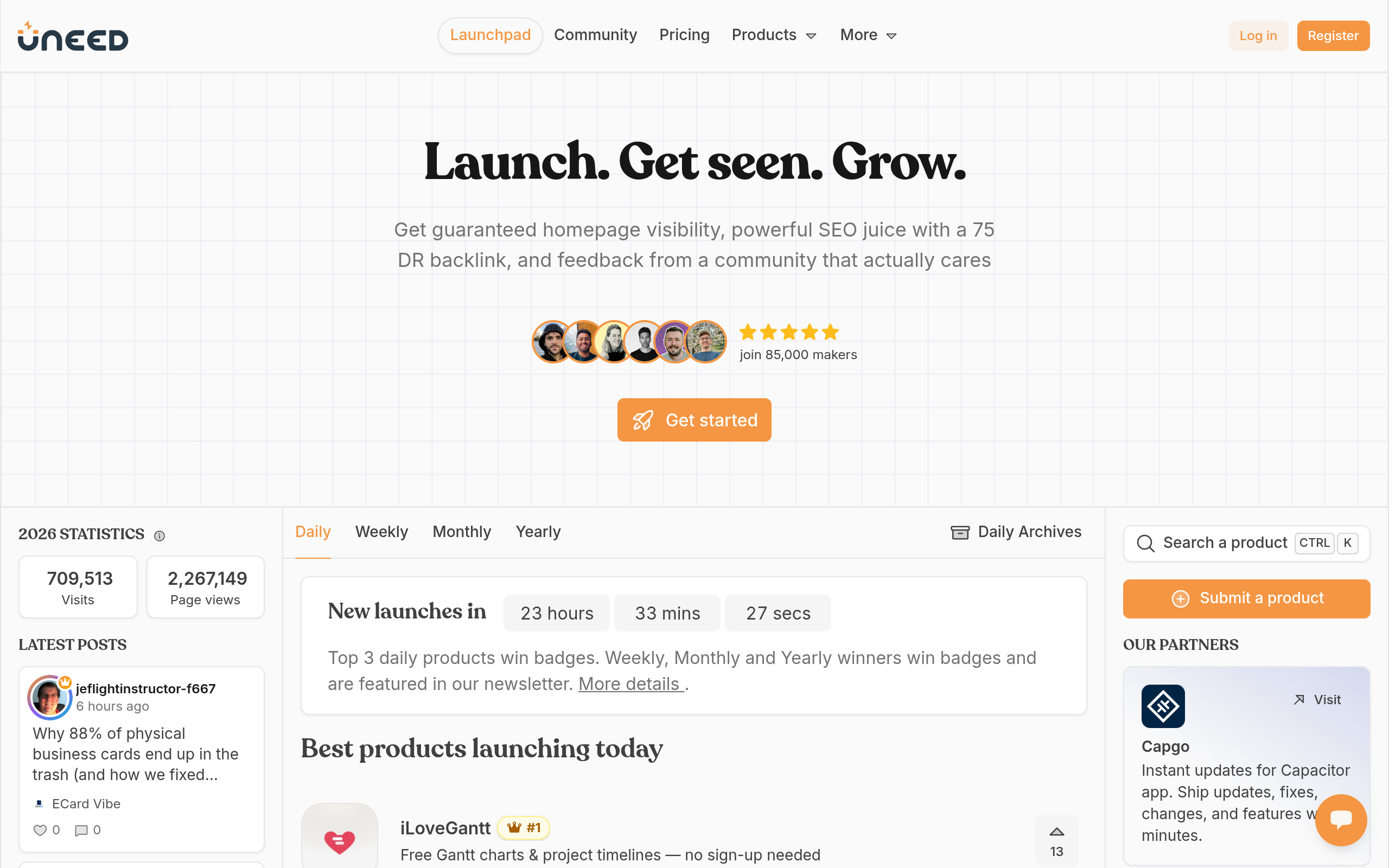
Uneed is a product-discovery directory and launch destination for new tools. It fits founders who want a listing that can remain discoverable beyond one announcement, especially when the product has a clear category such as AI, productivity, design, developer tooling, or marketing software. Its official submission route is Uneed’s submit page.
The mechanism is categorization and browsing. That changes the preparation task: instead of relying on a founder story alone, make the category, use case, and differentiator legible to someone scanning several tools. Your page should answer three questions quickly: who is this for, what job does it complete, and what can I do after clicking?
Consider an automated invoice reminder tool. “AI finance assistant” is a broad label that competes with dozens of unrelated products. “Send polite payment reminders from your existing invoice list” is narrower and gives a visitor a concrete reason to investigate.
Operational fit and limitations
- Best for: A self-serve product that can be understood from a short description and a direct link.
- Does not suit: A confidential enterprise service whose value cannot be explained without a sales call or private data.
- Standout: A directory listing can continue serving discovery after launch-day attention fades.
- Watch: Category traffic is only useful when the category matches the buyer’s actual search intent.
Implementation burden is low to moderate. Prepare a precise title, description, category, logo, screenshots, and destination page. The main implementation mistake is sending visitors to a generic homepage with no event tracking or product-specific call to action. A dedicated landing page lets you compare visitors who came to evaluate the launched product with visitors from other channels.
The commercial model may include free submission and optional paid visibility or listing treatments; verify current terms and availability with Uneed rather than assuming a package is still offered. Uneed does not suit products that need a high-touch explanation before a visitor can judge them. It also should not be your only route if you need direct conversations with a tightly defined vertical buyer.
5. Microlaunch
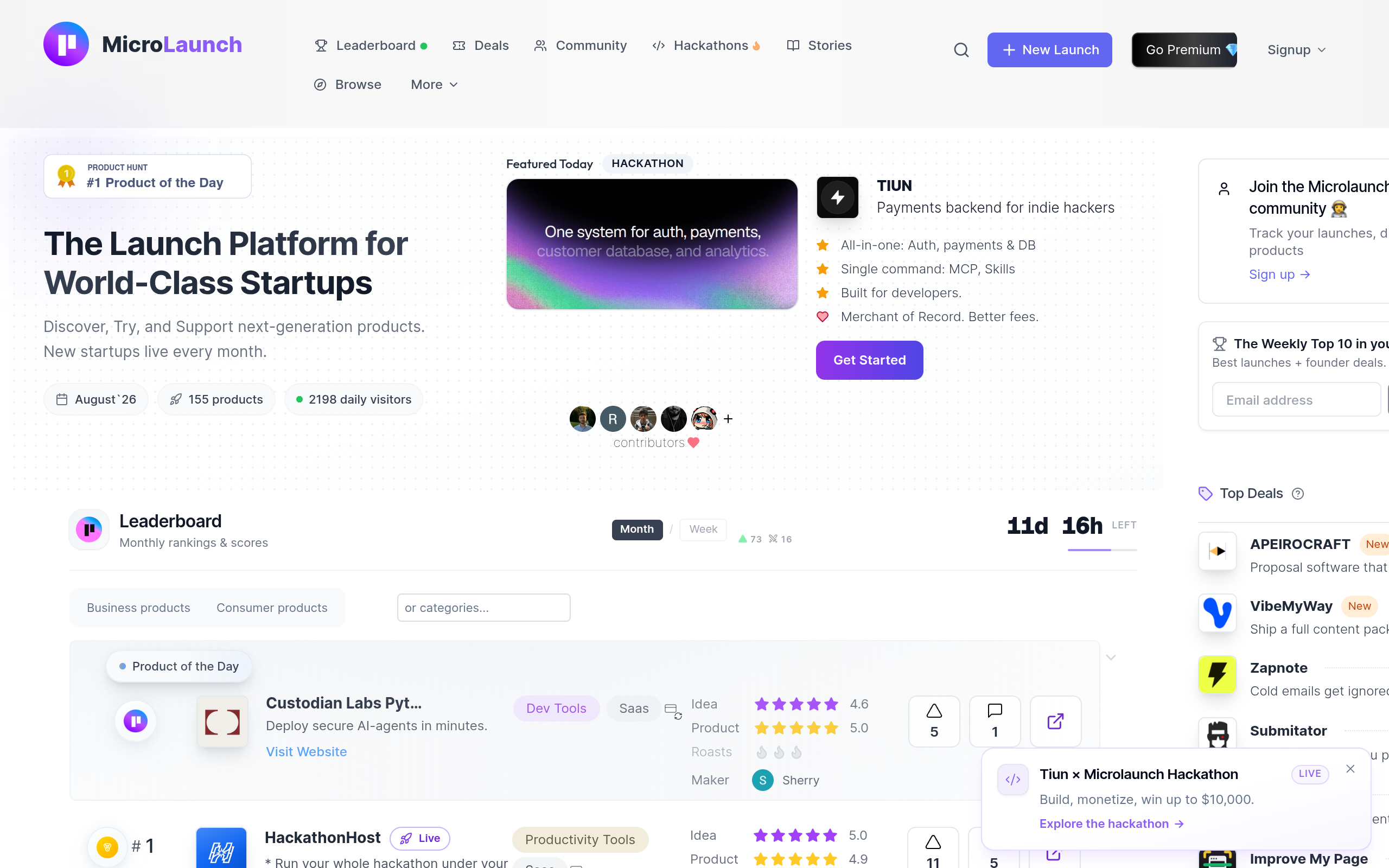
Best use: a structured launch moment for makers and small teams
Microlaunch is a launch platform aimed at makers and early products that want a focused, startup-oriented discovery event. It is relevant when you want more structure than an ordinary directory entry but a smaller-scale environment than a broad technology launch. Because launch formats and commercial terms can change, use the official homepage to verify the current submission process before scheduling a campaign.
The practical advantage of a structured launch is a forcing function. It gives the team a date by which the landing page, onboarding, screenshots, and support plan must be coherent. That can be valuable for a bootstrapped founder who has been polishing features indefinitely.
Do not confuse a launch event with product-market fit. A useful Microlaunch campaign has a hypothesis behind it: perhaps freelance designers will complete a template workflow, or agency owners will invite a teammate. The launch supplies a concentrated test; your product analytics and interviews determine what the test means.
Operational fit and limitations
- Best for: A maker-led product that is ready for a defined public launch window and can support new users.
- Does not suit: A team still deciding its target customer, pricing logic, and core workflow.
- Standout: The launch framing can turn an unfinished marketing task into a concrete operating deadline.
- Watch: Smaller launch communities may produce relevant conversations, but they should not be treated as guaranteed reach.
Implementation burden is moderate. Build the launch around one promise, one audience, and one measurable next step. Prepare answers to predictable objections: setup time, integrations, data handling, export options, and what happens after a trial. If the product is AI-based, explain where automation stops and where the user reviews or controls the output.
Microlaunch’s commercial model and any paid options should be checked on its current official site. The platform does not suit a founder who expects the listing alone to create a repeatable acquisition channel. After the event, compare signup quality, activation, and replies with your baseline traffic. If visitors arrive but do not reach the first meaningful action, change onboarding before buying more exposure anywhere.
6. SuperPublic
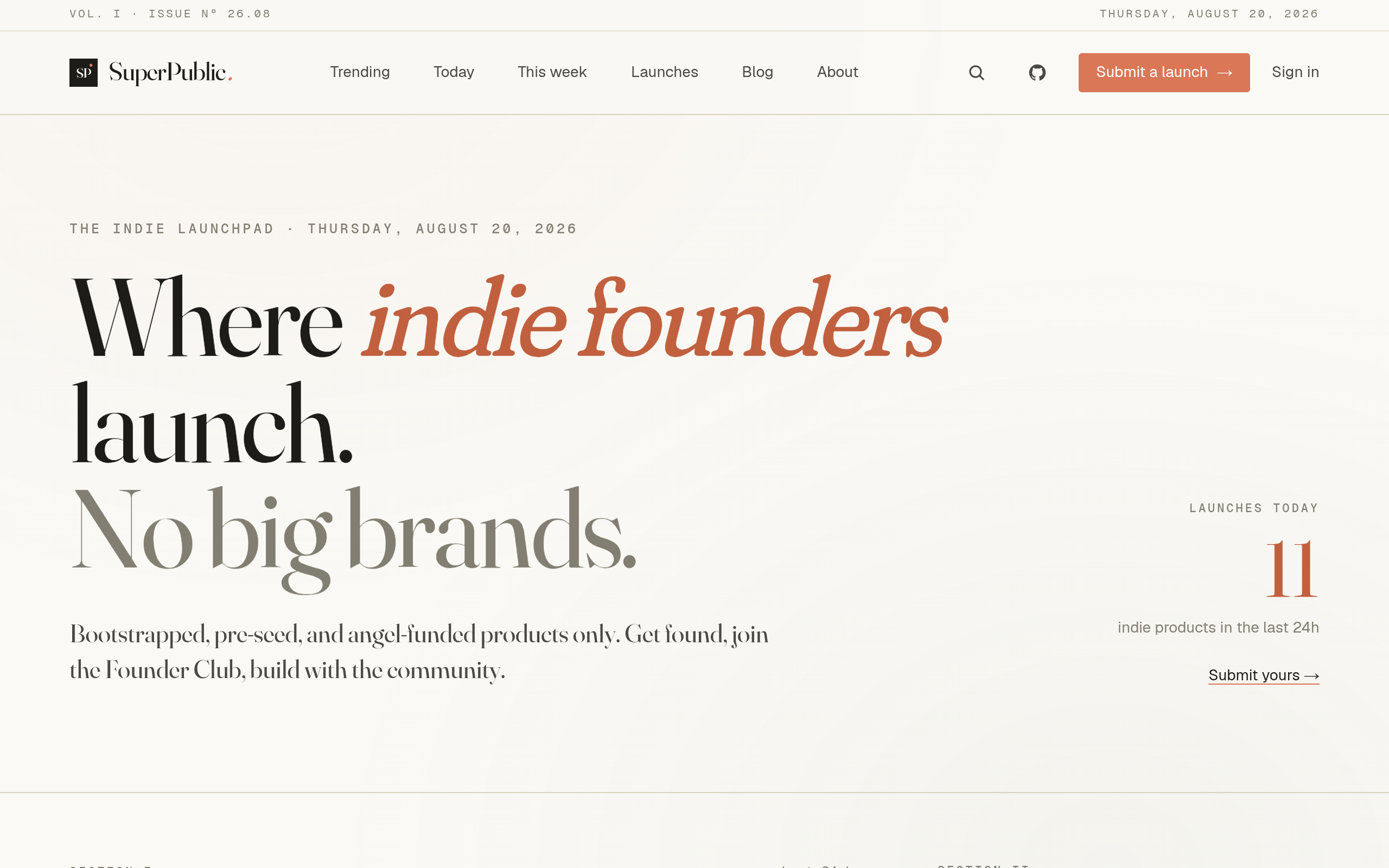
Best use: indie product discovery and founder-community visibility
SuperPublic is an indie-only product launch and discovery platform for bootstrapped, pre-seed, and angel-funded founders. Its fit is strongest when the product belongs in an early-stage ecosystem and the founder wants visibility alongside other small teams, rather than positioning the company as a finished enterprise vendor. Founders can submit your product launch through the platform.
The mechanism combines launch visibility with founder discovery. That is useful for a solo SaaS builder looking for early adopters, a pre-seed team seeking feedback from people who understand startup constraints, or an angel-funded company that wants to make its progress easier for the early-stage community to find.
A good submission should make the stage explicit without apologizing for it. Say whether the product is live, in beta, or accepting early access. Explain the user problem in operational terms, then give visitors a simple action: try the product, join the beta, send feedback, or connect with the founder.
Operational fit and limitations
- Best for: Indie founders and small startup teams that want relevant early-stage visibility and founder connections.
- Does not suit: A large company seeking mass-market reach, paid media optimization, or enterprise lead qualification.
- Standout: The indie-only focus keeps the context closer to bootstrapped and early-funded product building.
- Watch: Community relevance still depends on a specific product explanation and a responsive founder.
Implementation burden is low to moderate. Gather a clear product name, concise positioning, status, destination URL, and a launch note that tells the community what kind of response would help. Use a distinct campaign link or a dedicated launch page so you can evaluate whether visitors activate rather than merely browse.
The commercial model is platform-led product submission and discovery; check SuperPublic’s current submission details and any available options directly before planning spend. SuperPublic does not suit founders who need guaranteed impressions, sophisticated ad targeting, or a full customer relationship management workflow. It is a visibility and connection layer, not a replacement for onboarding, lifecycle email, direct outreach, or customer interviews.
Comparison
The table separates the job each platform is best equipped to do. “Commercial model” describes the general route, not a permanent pricing promise; confirm current terms in 2026 before making a purchase or setting a launch date.
| Platform | Primary route | Audience signal | Implementation burden | Commercial model and practical fit |
|---|---|---|---|---|
| Product Hunt | Concentrated public launch | Broad technology and early-adopter discovery | Medium to high; assets, launch-day replies, onboarding, tracking | Community-led platform with current optional terms to verify; best for polished, demonstrable products |
| BetaList | Early startup and beta discovery | People open to trying new products | Moderate; listing, access flow, follow-up, feedback loop | Submission and possible promotional options to verify; best for pre-launch and beta recruitment |
| Indie Hackers | Founder discussion and ongoing progress | Bootstrappers, makers, and startup practitioners | Moderate and ongoing; thoughtful posts and participation | Community-led; best for context-rich feedback and founder relationships |
| Uneed | Product directory discovery | Visitors browsing software categories | Low to moderate; listing quality and conversion tracking | Directory submission with current paid options to verify; best for self-serve products and evergreen discovery |
| Microlaunch | Structured maker launch | Early-product and maker audience | Moderate; deadline, assets, support, and one measurable hypothesis | Launch-platform terms to verify; best for a focused public launch by a small team |
| SuperPublic | Indie product launch and discovery | Bootstrapped, pre-seed, angel-funded, and founder community | Low to moderate; concise submission, destination, and response plan | Product submission and discovery; best for relevant early-stage visibility and founder connections |
How to choose the right launch platform
Start with the product’s current truth, not the audience you hope to impress. A product that is barely usable should not be dressed up as a major launch. A stable product with a sharp use case should not hide indefinitely in private beta. Pick the platform whose visitor expectation matches what you can deliver now.
Choose by launch state
- Private beta or waitlist: Start with BetaList or an ongoing founder community route if the main job is recruiting informed testers.
- Usable product with a clear demo: Consider Product Hunt, Microlaunch, or SuperPublic for a defined public moment.
- Evergreen self-serve software: Use Uneed when category discovery and a durable listing are more useful than a single-day event.
- Founder-led learning: Use Indie Hackers when the feedback conversation is as important as the click.
Choose by the feedback you need
Write the question before you choose the channel. “Will anyone use this?” is too broad to guide a launch. Better questions are operational:
- Can the intended user understand the product’s value without a call?
- Can a new user complete the first meaningful workflow?
- Which audience segment recognizes the problem urgently?
- What objection prevents activation: price, setup, trust, missing capability, or unclear positioning?
- Will the user return, invite someone, or pay after the first successful outcome?
If the first question is comprehension, a broad launch can expose messaging problems. If the question is workflow quality, a smaller group of relevant testers may be better. If the question is founder credibility, a transparent community discussion may matter more than a ranking position.
Use a measurement plan that survives a traffic spike
At minimum, define the destination, the primary action, and the next event you care about. For a note-taking SaaS, the chain might be launch visit → account creation → first note imported → summary reviewed → second session. Traffic is useful only when you can see where that chain breaks.
Use an illustrative starting policy rather than a universal benchmark: during the first week, review every signup that reaches the product but fails to complete activation, and interview a small sample of both activated and inactive users. The purpose is not statistical certainty. It is to identify whether the launch attracted the intended customer and whether the product delivered its first promise.
- Do not optimize: raw page views before you know who is arriving.
- Do optimize: the first meaningful action that proves the product was understood.
- Record: source, role, use case, activation status, objection, and requested next step.
- Revisit: the landing-page promise when visitors click but do not start.
Make the commercial decision explicit
Free submission is not free distribution. You still spend founder time on positioning, assets, support, follow-up, and analysis. Paid visibility may be reasonable when the audience is relevant and the activation path is already working, but buying more visits to a confusing product magnifies waste.
For a bootstrapped founder, an illustrative starting policy could be to use one community-led route and one directory route before paying for additional promotion. For a funded team, the policy might be to coordinate a launch with existing email, partner, and customer conversations while keeping each source separately tagged. Neither is a benchmark; the right choice depends on runway, launch readiness, and the value of a qualified conversation.
Finally, choose the platform you can participate in honestly. Product Hunt requires launch-day attention. Indie Hackers rewards context and continuity. BetaList requires responsible beta follow-up. Directories require clear categorization and conversion paths. SuperPublic is a sensible route when you want early-stage founders and early adopters to discover an indie product in the right context.
For a bootstrapped, pre-seed, or angel-funded software team, the practical recommendation is to begin with the platform that matches your immediate learning goal, then add a second route only after your activation path is measurable. If your product belongs in an indie founder ecosystem, SuperPublic offers a focused way to submit the launch and be discovered by other early-stage builders.
Authored with NotFair SEO