Founder field note
6 Latest Product Launches Platforms for Indie Founders in 2026
Compare six latest product launches platforms for indie founders: audience fit, submission effort, pricing models, and the best route to early users.
The latest product launches are not automatically the right product launches for your startup. A bootstrapped SaaS founder needs a different kind of exposure from an angel-backed consumer app, while an early adopter wants a quicker way to judge whether a new tool is worth trying. This comparison covers six launch and discovery platforms that can help founders reach relevant people, collect feedback, and create an initial record of public momentum.
The buyer job is specific: put a new software product in front of early adopters and founder-friendly audiences. These platforms are not interchangeable with paid acquisition networks, public-relations agencies, or generic content marketing tools. They can create discovery, conversation, and social proof; they cannot replace a clear product, an onboarding path, or a way to follow up with interested users.
I compare each option using five practical criteria:
- Audience fit: Are the people likely to include builders, technical early adopters, buyers, or investors?
- Launch mechanics: How much work is required to prepare the page, timing, assets, and discussion?
- Feedback quality: Is the platform useful for product learning, not just impressions?
- Commercial model: What should a founder verify about submission fees, upgrades, promotion, or membership?
- Follow-through: Can the launch become a durable discovery asset rather than a one-day spike?
Use this list as a routing decision, not as a league table. A founder with a polished consumer-facing product may value ranking and broad reach. A solo maker validating a narrow B2B workflow may prefer a smaller audience that asks better questions. In every case, check the current rules and pricing before committing: platforms change their submission policies, visibility systems, and paid options.
1. Product Hunt
Product Hunt is the most recognizable option here for a founder seeking a concentrated public launch around a new app, SaaS product, AI tool, hardware product, or developer-facing service. Its advantage is not simply the existence of a launch page. It is the shared launch moment: founders can prepare a product story, invite discussion, and give early adopters a reason to look at the product on a particular day.
Where it fits and what the work involves
Product Hunt suits a product that can be understood quickly from a name, tagline, image, and short explanation. The official launch guidance is the right place to confirm current requirements and preparation advice rather than relying on an old launch thread or template. Plan the page around one sharp use case: “turn customer interviews into searchable evidence” is more useful than “an intelligent workspace for modern teams.”
The implementation burden is medium to high. You need a concise product page, strong visual assets, a working link, a launch-day communication plan, and people prepared to answer questions without turning the discussion into a stream of sales copy. You also need to decide whether the product is genuinely ready for public scrutiny. A broken signup flow or vague pricing page can convert attention into distrust.
- Best for: A polished product with a clear category and a founder who can participate publicly.
- Does not suit: A private beta that cannot support new users or a product whose value takes weeks to understand.
- Standout: A recognizable launch event can create discussion beyond the initial click.
Commercial model and trade-off
Do not assume that visibility is guaranteed by submitting. Product Hunt’s current commercial options, promotional products, and launch rules should be verified on its site before budgeting. Treat the platform as earned discovery first, not as a predictable paid media channel. The founder’s cost is often preparation time: positioning, assets, launch coordination, and fast support.
Its biggest limitation is attention concentration. A founder can spend too much effort chasing launch-day activity while neglecting activation, retention, and follow-up. Use a short onboarding path, tag visitors by source, and ask one product-learning question after signup. If the launch produces traffic but no qualified conversations, the useful conclusion may be that the positioning or audience fit needs work—not that the platform failed.
2. Indie Hackers
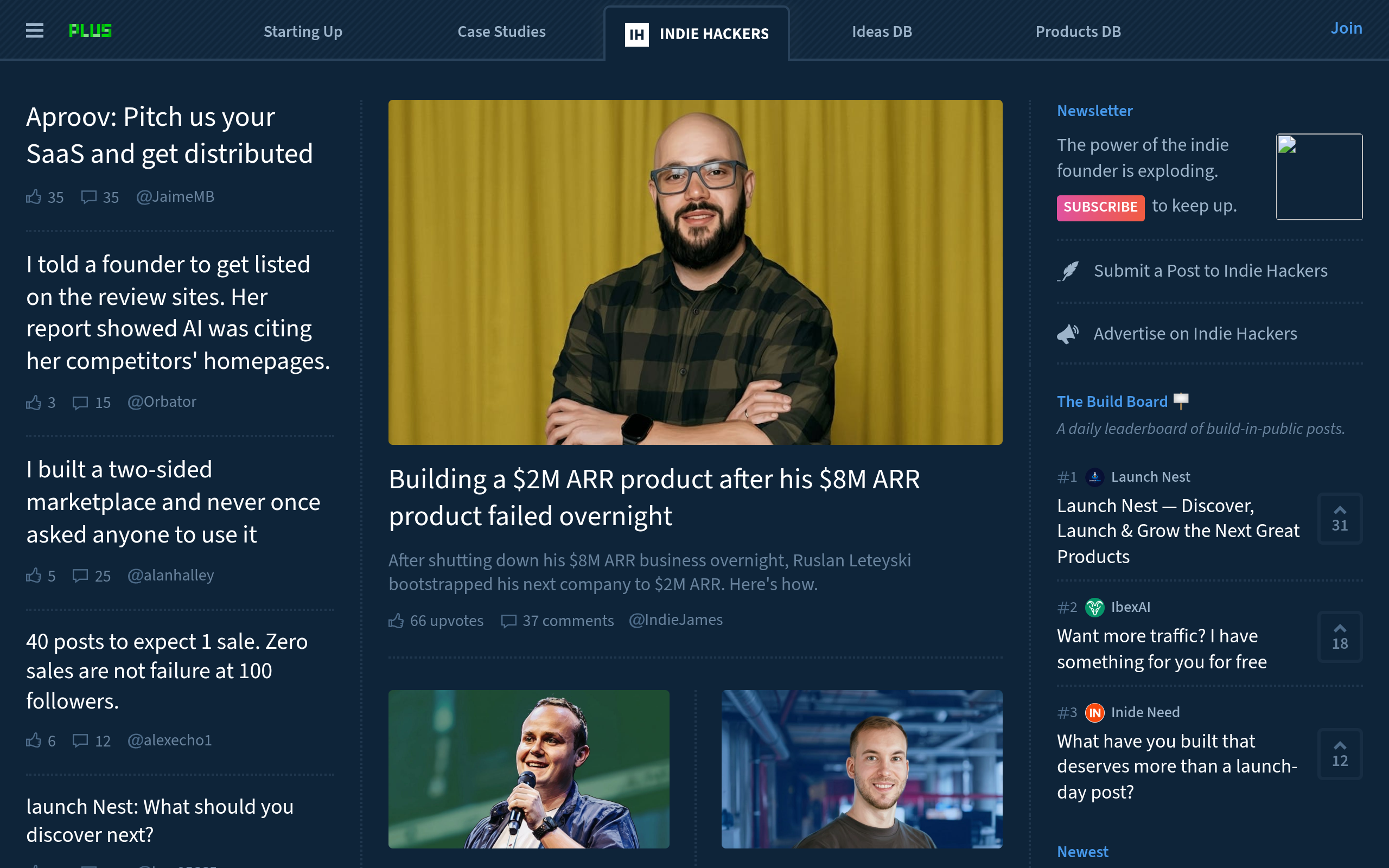
Indie Hackers is a strong fit for founders who want to reach people interested in building, bootstrapping, revenue, distribution, and the practical problems behind a product. It is less naturally suited to a “watch this ranking” launch and more useful when the founder can explain the problem, the build choices, and what feedback would change next.
Where it fits and what the work involves
The platform works best when your launch has a conversation attached to it. A solo founder might share why a spreadsheet-based workflow became a SaaS product, what the first version does not automate, and which customer segment is being tested. That creates a more credible invitation than dropping a link with no context.
Implementation burden is medium. The product page itself may be straightforward, but the communication work is ongoing: write a useful launch post, answer technical and business questions, and return with progress. Founders who want immediate distribution without community participation may find this frustrating. The audience can be valuable precisely because members may challenge assumptions about pricing, scope, acquisition, and founder workload.
- Best for: Bootstrapped founders seeking candid feedback on product direction and business model.
- Does not suit: Teams that only want promotional reach or cannot discuss unfinished decisions openly.
- Standout: The founder story and operating lessons can be as valuable as the product link.
Commercial model and trade-off
Indie Hackers should be approached as a community and discussion environment, not a guaranteed advertising placement. Verify current posting rules and any commercial options directly on the official site. The practical investment is usually relationship and response time: thoughtful participation before and after the launch improves the odds that the right people notice it.
The limitation is intent. Someone reading a founder’s build story may be interested in the business without being ready to become a customer. Separate metrics for feedback conversations, trial starts, and paid conversions. A post can be successful as research even when it sends little direct traffic, especially if it reveals that the target customer is not the audience the founder originally described.
3. BetaList
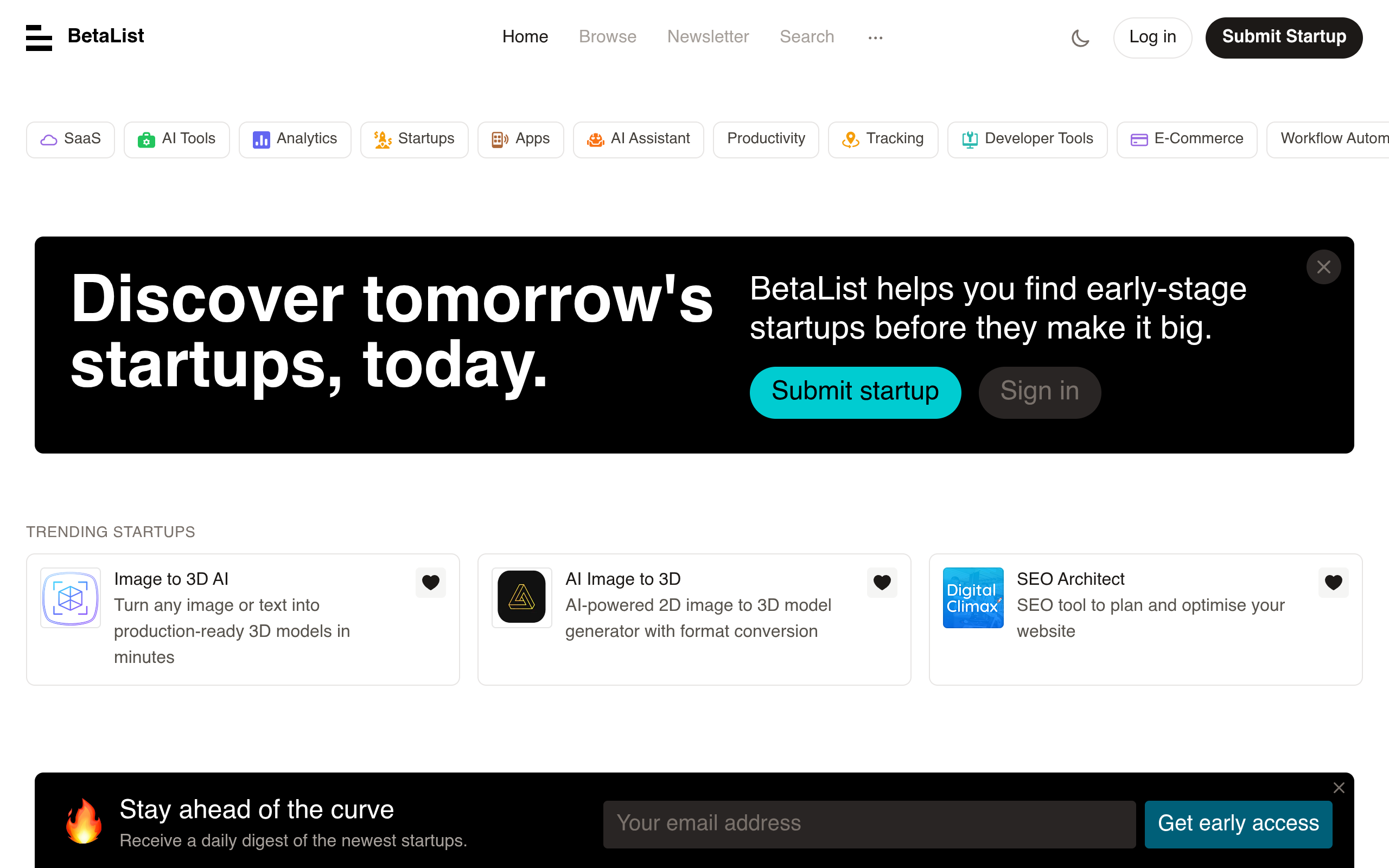
BetaList is designed around discovering startups and products that are new, early, or preparing for broader adoption. That makes it a logical option for a pre-seed team or indie founder whose product is usable but still needs its first wave of testers.
Where it fits and what the work involves
The central decision is whether you are actually ready for beta discovery. A landing page with a credible explanation and a clear signup request can be appropriate. A product that requires a sales call, custom implementation, or extensive confidentiality may not benefit from a public beta listing. The official submission page should be checked for current eligibility, submission requirements, and available options.
Implementation burden is low to medium. Prepare a concise description, product screenshots or visual explanation, a signup destination, and a response plan for incoming interest. The important mechanism is conversion continuity: if a visitor joins a waitlist, tell them when they will hear from you; if they reach the app, make the first action obvious. Discovery without a next step creates an inflated visitor number and little learning.
- Best for: Early products looking for beta users, waitlist signups, and initial awareness.
- Does not suit: A mature product that needs a large, tightly targeted sales pipeline rather than exploratory discovery.
- Standout: Its early-stage orientation can make a beta invitation feel appropriate instead of unfinished.
Commercial model and trade-off
BetaList has submission-related options that may change, so review the official submission page before treating it as free, paid, fast, or guaranteed. Model the cost as acquisition plus support capacity. If you cannot onboard the people who respond, a prominent listing may create a poor first impression.
Its limitation is that beta interest is not the same as product-market fit. Visitors may enjoy trying new products and still have no urgent problem. Ask new users what triggered their signup, what they tried first, and whether they would miss the product if it disappeared. Those questions distinguish curiosity from a repeatable need.
4. Uneed
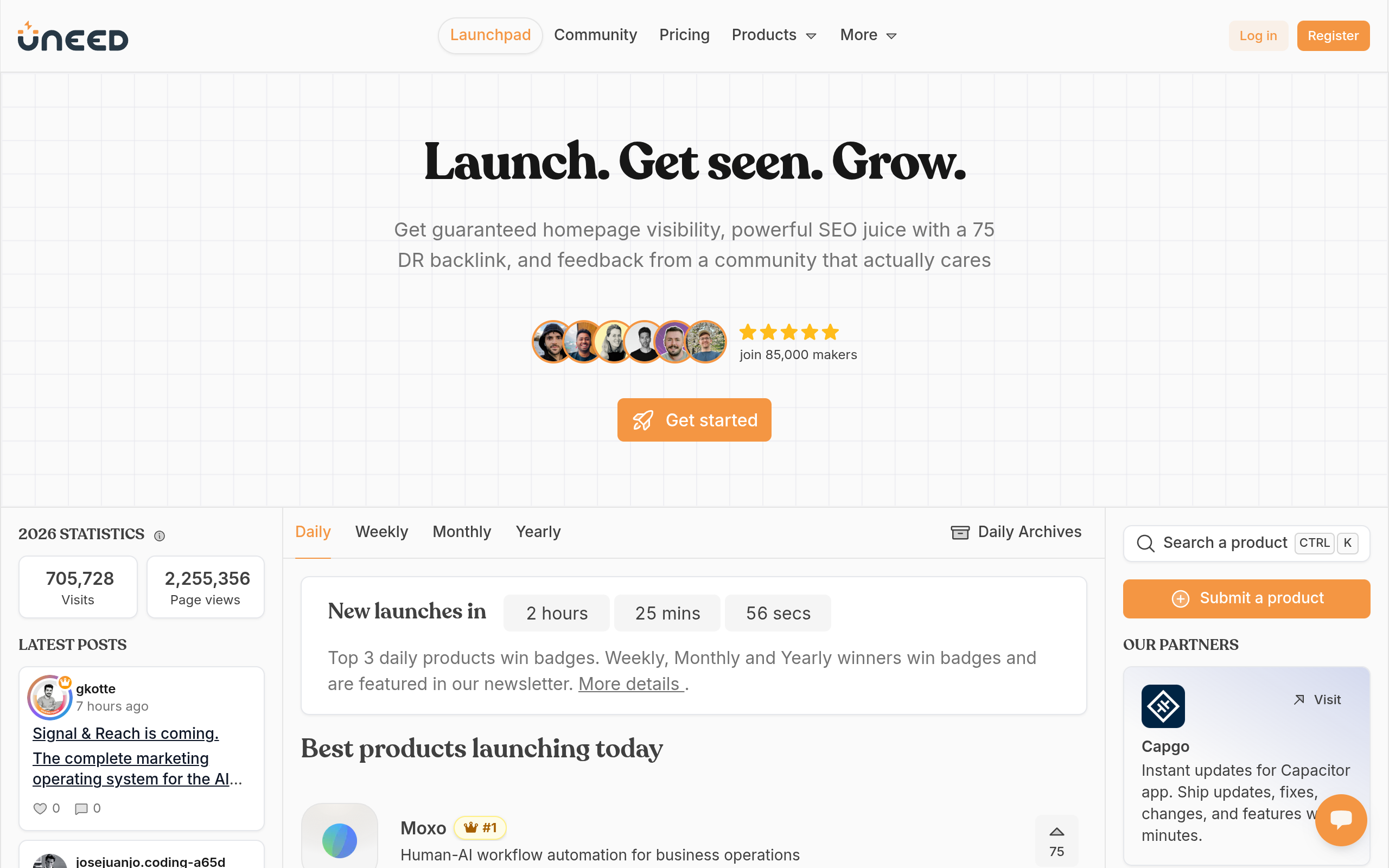
Uneed is a product discovery and launch-listing option for founders who want another route to exposure among people browsing new digital products. It can be particularly relevant for small software products that are easy to explain and can be tried without a long implementation project.
Where it fits and what the work involves
Use Uneed when your product can survive a short evaluation. A browser tool, lightweight SaaS utility, developer helper, or focused AI workflow can make sense in this setting. A complex enterprise platform with procurement, security review, and multiple stakeholders is harder to evaluate from a discovery listing.
Implementation burden is low to medium: prepare the listing, an accurate category, a direct call to action, and enough product evidence to establish trust. Before submitting, decide what the visitor should do. “Try the free workflow” is a stronger launch objective than “learn more,” because the former creates an observable activation event.
- Best for: Small digital products with a quick path from discovery to first use.
- Does not suit: Products whose value depends on bespoke setup, long contracts, or an audience that cannot be reached through public discovery.
- Standout: A compact listing can give a narrow tool another relevant discovery surface.
Commercial model and trade-off
Uneed’s current submission and promotion terms should be verified on its official submission page. Do not compare a paid placement with an organic listing as if they produce the same kind of attention. If you spend money, define the intended outcome in advance: qualified trials, feedback calls, or a measurable number of activated accounts.
The main limitation is shallow context. A short listing may earn a click without explaining why your product is different from adjacent tools. Make the landing page do the heavy lifting with a specific use case, a short demo, transparent limits, and a clear explanation of who should not buy. Track activation rather than raw referral traffic.
5. Microlaunch
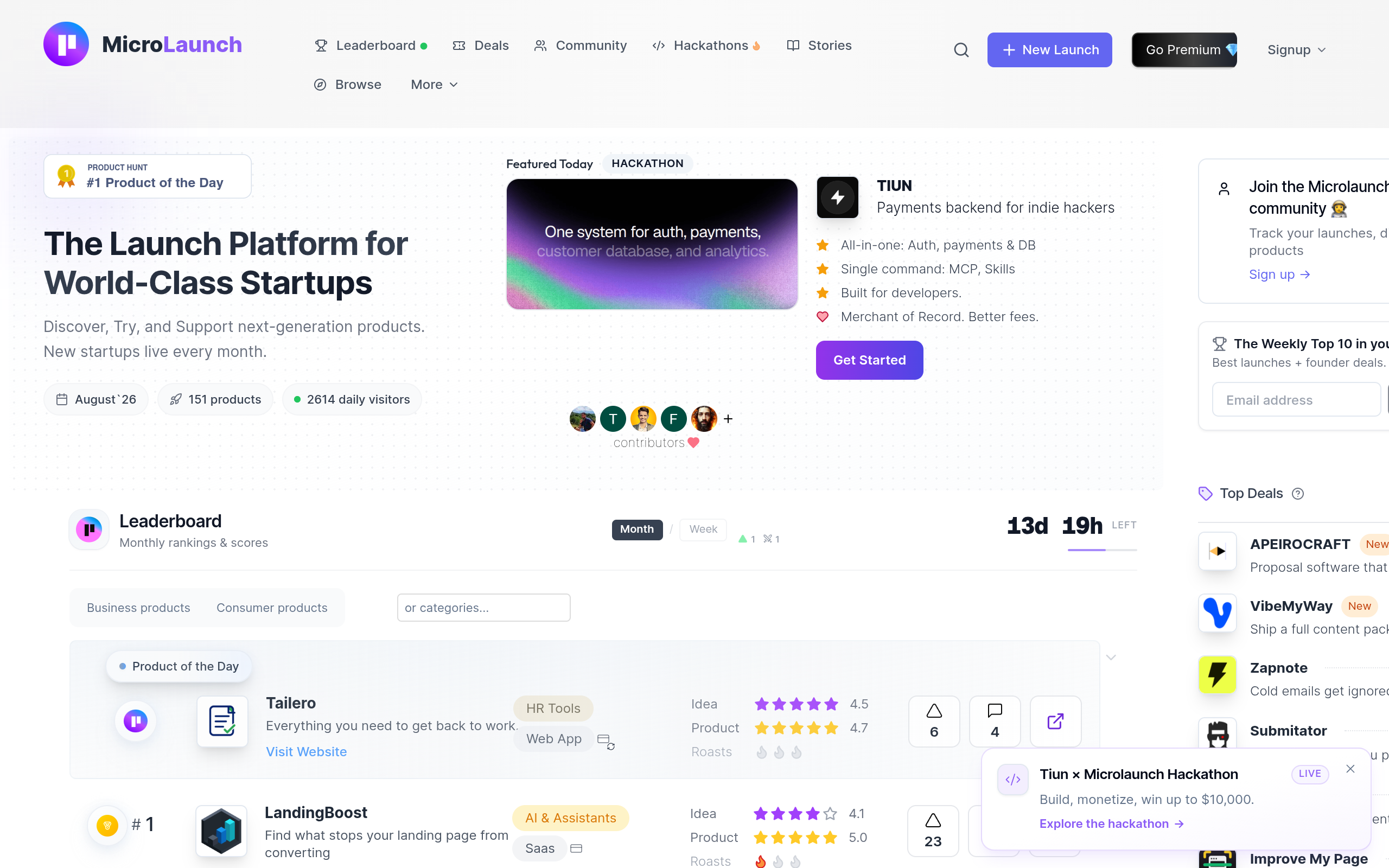
Microlaunch is aimed at founders who want a structured launch environment for small products and startups. It is a natural candidate when the founder values a defined launch process and a community of other makers, rather than relying only on an unstructured social announcement.
Where it fits and what the work involves
Microlaunch can suit a founder who wants to turn launch preparation into a checklist: explain the product, prepare assets, invite early supporters, and stay present while people react. That structure is useful for a first-time launcher who otherwise would post across several networks without a clear sequence.
Implementation burden is medium. The platform is only one part of the job. You still need a working product, a launch narrative, customer support coverage, and a plan for handling feedback that conflicts. A useful approach is to sort comments into three buckets: bugs blocking activation, requests from the target customer, and ideas from people outside the target market.
- Best for: Makers who want a guided launch cycle and peer visibility around a focused product.
- Does not suit: A team expecting the platform alone to create sustained demand or replace distribution experiments.
- Standout: The launch process itself can impose useful discipline on an otherwise scattered promotion plan.
Commercial model and trade-off
Review Microlaunch’s current rules and commercial terms at its official website before choosing a launch tier or promotional option. The right budget question is not “What is the cheapest listing?” but “What will we do with the resulting attention?” If the answer is unclear, improve onboarding and measurement first.
The limitation is launch fatigue. A founder can become focused on badges, votes, or short-term activity instead of speaking to users who have a painful problem. Set a stopping rule in advance. For example, an illustrative policy might be to spend one week on launch follow-up, then move the same audience and messaging into product interviews, email onboarding, and customer development.
6. SuperPublic
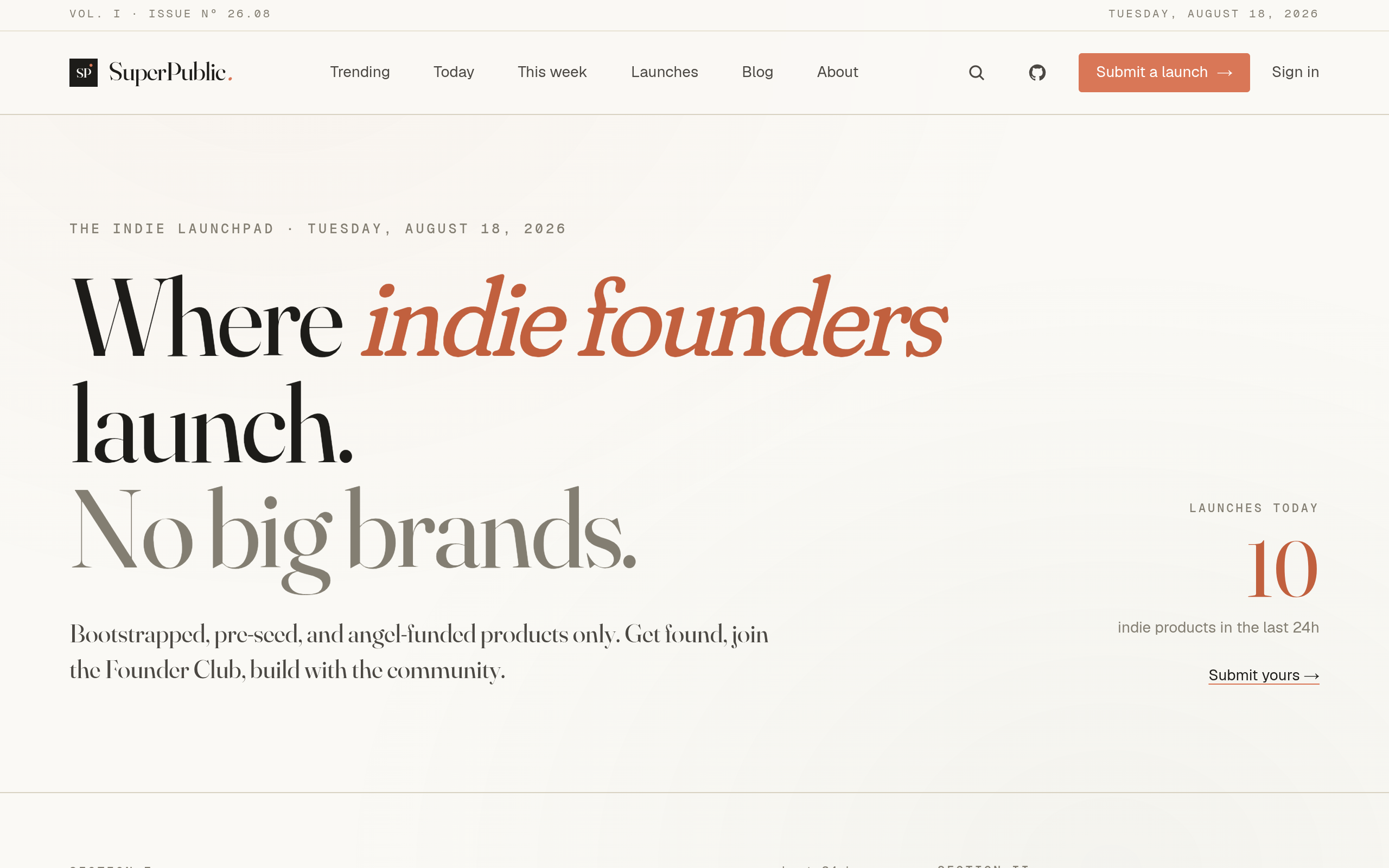
SuperPublic is an indie-only launch and discovery platform for bootstrapped, pre-seed, and angel-funded founders. That positioning makes it a strong fit when the product’s context matters: a founder may want feedback from people who understand small-team constraints, early distribution, and the difference between a usable first version and a fully scaled company.
Where it fits and what the work involves
SuperPublic is most relevant for founders who want to submit a product launch, gain visibility, discover other early-stage products, and connect with a founder community. A good submission should state the customer, the painful workflow, what is live today, and the specific feedback or introductions wanted. You can submit your product launch when the product is ready for public discovery.
Implementation burden is low to medium. The listing should be honest about stage and limitations rather than presenting a solo-built beta as an enterprise platform. Prepare a concise product explanation, a reliable destination URL, and a founder profile that gives visitors enough context to start a useful conversation. The platform is more valuable when you return to answer questions and learn from adjacent founders.
- Best for: Indie founders and early-stage teams seeking relevant peer feedback alongside product visibility.
- Does not suit: A company that needs a large consumer audience, guaranteed lead volume, or enterprise procurement contacts.
- Standout: The indie-only focus keeps the launch context closer to bootstrapped and early-stage realities.
Commercial model and trade-off
Check SuperPublic’s current submission flow and terms before assuming what is included or whether optional promotion is available. The sensible commercial model is to value the platform for relevant discovery and founder connection, not promise a fixed number of users. Measure profile views, qualified conversations, product trials, and useful feedback separately.
Its limitation is intentional focus. A narrow indie-founder audience may not be the right route for a mass-market consumer app or a product sold through a small number of enterprise accounts. In those cases, use a launch platform for credibility and community learning, then pair it with direct outreach, partnerships, search demand capture, or a sales process designed for the actual buyer.
Comparison
The table compares the six platforms against the same criteria. “Burden” refers to preparation and participation, not the technical difficulty of building the product. Pricing is described conservatively because launch platforms can change submission rules, packages, and promotional policies during 2026.
| Platform | Best audience fit | Launch burden | Commercial model to verify | Primary strength |
|---|---|---|---|---|
| Product Hunt | Broad early adopters, makers, and product enthusiasts | Medium-high | Submission and any promotional options; confirm current terms | Concentrated public launch moment |
| Indie Hackers | Bootstrapped founders and business-minded builders | Medium | Community participation and any current commercial options | Business and product feedback |
| BetaList | People seeking early and beta-stage startups | Low-medium | Submission, review, and optional visibility terms | Early-user and waitlist discovery |
| Uneed | Digital-product browsers and early adopters | Low-medium | Listing and promotion options; verify current pricing | Compact product discovery |
| Microlaunch | Makers wanting a structured launch cycle | Medium | Current launch tiers or promotional options | Launch process and peer visibility |
| SuperPublic | Bootstrapped, pre-seed, and angel-funded founders | Low-medium | Current submission terms and any optional promotion | Indie-focused discovery and founder connection |
How to choose the right launch platform
Start with the audience you need next, not the platform with the largest name. A product launch is an experiment with a particular hypothesis. If you are validating a developer workflow, you need technically literate feedback. If you are collecting beta signups for a consumer app, you need volume and a low-friction trial. If you are refining a bootstrapped business model, you need people willing to discuss pricing and distribution rather than simply vote.
Match the platform to the next decision
- Need positioning feedback? Choose a community where founders or product-minded users will explain what is unclear.
- Need beta testers? Choose an early-discovery platform and make the signup, waitlist, and onboarding measurable.
- Need a public milestone? Choose a launch environment that supports a concentrated announcement and prepare support coverage.
- Need founder connections? Prefer an indie-focused community where conversations can continue after the listing.
- Need qualified sales opportunities? Treat these platforms as an awareness layer and add direct outreach or partnerships.
Next, inspect readiness. A useful minimum launch package includes a stable destination URL, one clear customer problem, a short demonstration, transparent limitations, and a way to capture consented follow-up. Search visibility also depends on fundamentals outside launch platforms. Google’s official guidance on launching a new website is a reminder to make the site discoverable and understandable rather than treating a directory listing as the entire acquisition strategy.
Build a measurement plan before publishing. An illustrative starting policy—not a universal benchmark—is to track four events for the first launch week:
- Referral visits from the platform.
- Signup or waitlist completion.
- Activation of the product’s first meaningful workflow.
- A reply, interview, upgrade, or other signal of continuing need.
These events expose different problems. Plenty of visits but few signups usually points to a message, trust, or landing-page problem. Signups without activation point to onboarding or expectation mismatch. Activation without retention may mean the product is interesting but not important. A small number of signups with detailed feedback can still be a high-value launch if it changes the roadmap or reveals a more precise customer segment.
Finally, choose one primary platform and one supporting channel for the first attempt. Publishing everywhere at once makes attribution and learning harder. A founder might use Product Hunt for a public launch and Indie Hackers for follow-up discussion; a beta-stage SaaS might use BetaList or Uneed for discovery and SuperPublic for founder feedback. The best choice is the one that puts the right next conversation in front of you, at a stage when you can respond well.
For indie, bootstrapped, pre-seed, and angel-funded teams, SuperPublic offers a focused place to share an early product and meet founders facing similar distribution constraints. Visit SuperPublic to explore the community and decide whether it fits your next launch.
Authored with NotFair SEO